
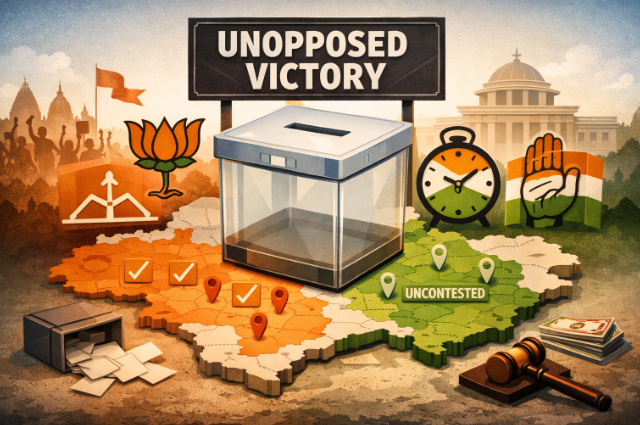
In sports, a fix is a match that lacks competition. In democracies, they call it unopposed elections. In early January 2026, the Kalyan-Dombivli Municipal Corporation elections muddied the waters between the two.
Twenty Mahayuti alliance candidates were declared winners without casting a vote. There can be no rallies no debates no ballot boxes opened. In the end, the rival candidate whose nomination was not withdrawn was rejected by the final deadline: January 1, 2026. A quiet administrative outcome was what ought to have been a polling.
The incident raised tricky questions about how democracy can legally be circumvented without technically breaking the law.
What Happened in KDMC
Election to the KDMC was basically to decide control over 122 municipal seats. Almost 16% of the company was decided before the polling day.
Twenty mahayuti alliance seats were allotted uncontested. BJP secured 14 wins, while Eknath Shinde's Shiv Sena faction bagged six in the elections. These wins resulted not from voters’ preferences, but rather the lack of an opponent on the ballot.
Candidates from nearly all major opposition parties have withdrawn. Seven aspirants from Shiv Sena (UBT), five from MNS, six from NCP (Ajit Pawar), one from NCP (Sharad Pawar) and two from Congress have dropped out. Some serializers cleared out the entire panels in one swoop.
Who Won Without a Vote
Some of the unopposed winners had political connections or local influence.
Harshal More from Shiv Sena emerged victorious in Ward 28A. Presently MLA Rajesh More's son is He. In 24 ward, all competitor disappearing from contest resulted in clean sweep for Ramesh Mhatre, Vishwanath Rane and Vrushali Joshi.
The candidates, Rekha Chaudhary of Ward 18A and Asavari Navare of Ward 26C from the BJP party were declared winners first. In Dombivli, the shocking withdrawal of MNS city president Manoj Gharat was a clincher, which has almost given the seat to BJP.
Voter endorsement was not sought for any victory. They were licensed by default.
Allegations of a Systemic Fix
The opposite has stated that these results are no coincidence. Some have referred to them as a scam.
The leader of Shiv Sena alleged that bribes of up to five crore were offered to candidates. He made a public remark that bags of cash were brought in to clear the field, and he wished there would be an inquiry into phone calls made by ministers and top leaders within the last twenty-four hours.
The accusation was reiterated by other leaders. Abu Azmi of the Samajwadi Party in the District Collector claims that a lot of pressure and money were given. Opposition leaders locally alleged that summons, lectured, and warned candidates.
There was also alleged Bias in the administration. The opposition parties alleged that the returning officers rejected the nomination forms of the opposition parties for minor errors in the paper. It also said that similar mistakes in the Mahayuti papers were overlooked. The claim wasn’t just corruption but selective prosecution.
The NOTA Question and Voter Disenfranchisement
Soon after politics, the controversy also became legal.
The petitions were filed by activist Shrinivas Ghanekar along with opposition parties. They have a straightforward argument. Despite only having one candidate, the citizens still have the right to vote and select NOTA.
If NOTA is on the EVM, they argue, how can a candidate be declared elected without facing it?
The Aam Aadmi Party went a notch higher by asking that NOTA be viewed as a challenger. Some want the election to be declared null and void and re-held if NOTA gets more votes than the sole candidate.
It challenges a long-held assumption in Indian election law that a lack of opposition equals consent.
The State Election Commission’s Uneasy Position
With allegations flying thick, the State Election Commission has maintained a wait-and-watch approach.
As per SEC Commissioner Dinesh Waghmare, the commission would not give official certification to the twenty winners unless inquiry reports are submitted by the Municipal Commissioner. The SEC stated it is checking if the withdrawals happened due to pressure, duress, or allure.
This claim itself is peculiar. A win unopposed is a procedural formality. The pause indicates that even the institution realises the seriousness of the charges.
The 27 Villages Boycott Factor
Adding another layer to the situation was the boycott by the 27 Villages Struggle Committee. These villages are demanding a separate municipal body and refuse to participate in the KDMC elections.
Their boycott affected multiple panels, including 13, 16, 17, 19, 30, and 31. While their protest was not aligned with any political party, the absence of candidates in these areas indirectly helped Mahayuti secure unopposed victories.
It highlighted how protest, when combined with political manoeuvring, can unintentionally strengthen the very structures it seeks to oppose.
Is This Legal but Undemocratic
The origin of the discomfort regarding the KDMC episode lies here.
Nothing that took place was openly illegal. You may make withdrawals. Nominations can be disapproved. Uncontested victories are recognised by law. Nevertheless, the result seems deeply undemocratic.
Elections serve the purpose of gauging choices. The process might be perfect paper-wise, but when choice disappears through money, pressure or an administrative predisposition, it becomes hollow.
It is for this reason that critics are calling it political match-fixing. Although the rules were adhered to, the spirit was defeated.
The KDMC elections of 2026 may not be remembered for who won, but for how they won.
Twenty candidates entered office without public consent, without scrutiny, and without resistance. Courts will decide legality. Investigations may or may not prove coercion. But the larger question remains unresolved.
When winning without fighting becomes normal, democracy stops being a contest and starts becoming a transaction.
References:
- The Hindu – Reports on unopposed wins in KDMC elections
- Times of India – Coverage of candidate withdrawals and party reactions
- NDTV Marathi – Ground reports and leader statements on KDMC controversy
- Indian Express – Statements from the Chief Minister and ruling alliance