
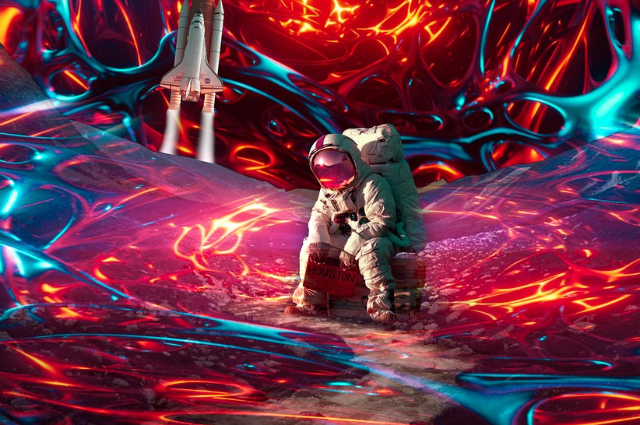
For most of history, creativity was the preserve of humans. This came from experience, emotion, intuition, memory and the ungovernable power of imagination. The emergence of generative AI has significantly widened the terrain. Machines are now capable of writing poems, making music, creating movie visuals and mimicking creativity styles which took humans years to develop. However, the most radical change that is occurring today is not just AI creating art but AI creating art for you. AI that hyper-personalizes does not make for the masses, it makes for the individual. And this makes all the difference. It changes the way creators create, how audiences delight in creativity, and how culture change. This opens up a range of opportunities but also throws up serious questions about authorship, identity, feeling and the future of “mass” art. To understand this transformation, we must look at three things.
The 'AI Muse' Dilemma: Where Does the Artist's Ownership End and the Algorithm's Begin?
Artists derive inspirations from their muses – people, places, memories, emotions. However, one of the most influential muses is no longer a person. It is an algorithm. Artists create and AI systems assist them in doing it. The computer suggests ideas and refines them. Also, creates variants and final output. This brings us to an awkward yet significant question: if artificial intelligence contributes to art, how much of the final product belongs to the human artist?
A great example from reality is Holly Herndon, an experimental musician who pushes boundaries. The AI “digital twin” Holly+ was created by her. It was trained entirely on her own voice textures, breaths, tones, and nuances. Using the system, people can upload audio and have it sung back in Herndon’s voice. In 2022, Herndon released a cover of Dolly Parton’s “Jolene” using vocals from her AI Holly+. The outcome turned out similar to how Herndon herself would sound. Rather than feeling threatened, she embraces the AI as a collaborator. She describes Holly+ as a collaborator that allows others to work with her voice an extension of her identity. In order to protect her artistry, she and her partner were building a consent layer through a DAO for the ethical use of her vocal model. This method allows an artist to maintain control while illustrating how AI can preserve and scale their identity.
Another example comes from Sougwen Chung, a renowned artist who works with robotic drawing systems. These robots are trained on Chung’s brushstrokes using neural networks, enabling them to mimic and expand her style. In live performances, the robots paint alongside her, reacting to her gestures in real time. In some versions, their movements even respond to her emotional state through EEG data. The artwork becomes a living dialogue between human intuition and machine interpretation. It is no longer a question of “who made this?” but “how do human and machine create together?”These cases show that personalized AI systems are not replacing artists they are reshaping what authorship means. The artist becomes a guide, a curator, a conductor directing an intelligent partner.
Sonic Sculpting: AI-Generated Personalised Music Based on Real-Time Biometric Data
Music has always held emotion, but it has never felt so personal. With biometric sensors built into our smartwatches, phones and headphones, AI systems can now generate music according to our physiological and emotional conditions. Picture your heart rate going up due to stress. At that very moment, an AI is already composing a calm melody as it senses stress. If your breathing becomes irregular, the tempo adjusts. If your focus drops, the rhythm sharpens. The future sonic of music sculpting made especially for your body and mind.
A good example of customized audio is the sound artist Evala’s 2025 project “Studies for.” The previous works of the human composer were used to train an AI system for more than 200 hours.
Now it generates new immersive multi-channel audio live using Shaffar’s artistic language but at the same time creating something new. The system operates as a “living archive” that acts as an AI that does not only archive the past of the artist but produces new works from it.
AI-generated music calls into question what we mean by a “song” at all. It is flexible, evolves according to emotion, behavior and biological signals. The music is no longer a distant composer. It is not just your machine and you with a direct conversation. It blurs the line between art and therapy. It turns sound into a personalized emotional instrument. This may become the most intimate creative expression people ever perform in their lives.
The Death of 'Mass Appeal': How AI Is Fragmenting Art Into Millions of Personal Experiences
There was a time when art was built for the masses. Popular movies, songs, and books were shows that everyone could enjoy. Shared art created shared culture.
Hyper-personalized AI is breaking that model.
We could see unique songs created for each unique listener rather than one song reaching millions of people. Rather than a single film capturing the world's imagination, future global narratives may be personalized stories, shaped by your personality, mood and choices. Art becomes a mirror, reflecting each person uniquely.
Check out how Refik Anadol is fragmenting creative experiences through the use of AI. The artist's project “Machine Hallucinations: Unsupervised” at MoMA was generated from a dataset of 138,000 images from the museum. In his recent works, he has begun to use real-time climate and environmental data to make “living paintings” that are constantly changing and shifting depending on the moment, the viewer, and the environment. Enter one of his installations twice and you will never see the same artwork twice. This is the future: art that belongs to the moment, the place, and the viewer.
Along with the beauty comes a quiet tragedy, the loss of shared cultural experiences. Art becomes deeply personal but less communal. Creativity becomes individualised rather than collective.
The emergence of hyper-personalised artificial intelligence is changing the world of creative arts in terms of authorship, emotion, identity, and audience experience. We are leaving behind universal art for individual art, meaning creativity that was once one-size-fits-all is now personal. AI is not replacing artists; it is extending them. Rather than eliminating our emotions, we learn how to respond to them. This will not be the death of culture, but rather its reimagining, where creators and their audiences can relate on extremely personal terms. The next era of creativity will be one where human imagination and machine intelligence co-create. And in that partnership, art may be more personal than it has ever been.