
Nestled in the rugged folds of the Garhwal Himalayas in Uttarakhand, India, the village of Reni appears as a fragile thread in the vast tapestry of snow-capped peaks and whispering pines. At an elevation of over 10,000 feet, where the air is thin and the winds carry the chill of eternal winters, life has always been a delicate balance between human resilience and nature's unforgiving grace. For generations, the villagers of Reni were simple farmers, and gatherers relied on the surrounding forests not just for survival, but for their very identity. Woods provided fodder for livestock, rhododendrons offered medicinal herbs, and deodar trees shielded homes from landslides and snow slides. Water from mountain springs irrigated terraced fields of millet and potatoes, while the forest floor teemed with wild berries and edible ferns that sustained families through lean months.
But by the early 1970s, this harmony was breaking. Commercial logging, driven by distant contractors and government policies favouring industrial expansion, had begun to carve deep scars into the green veil. Trees were felled not for local needs, but to feed factories in the plains below, supplying timber for sports, furniture, and construction booms in growing cities like Delhi and Mumbai. What began as isolated clearings soon escalated into systematic devastation. In the Chamoli district alone, where Reni sits, forest cover plummeted by nearly 30% between 1960 and 1975, according to reports from the Forest Survey of India. Landslides became frequent, burying homes and fields under mud and rock. Springs ran dry, forcing women to trek miles for water, and livestock starved as fodder grew scarce. The 1970 Alaknanda River floods, which claimed hundreds of lives across the region, were a stark warning: deforestation upstream had stripped the land of its protective roots, turning gentle rains into catastrophic deluges.
This was the crisis that birthed the Green Warriors of Reni—a group of ordinary women who, through an extraordinary act of defiance, halted the axes and ignited a movement that would ripple across India and beyond. Their story is not one of abstract policy debates or elite activism; it is a raw, human tale of desperation, unity, and triumph. Rooted in the 1974 Chipko incident, this case study explores how Reni's villagers confronted deforestation, reclaimed their forests, and forged a new future of sustainability. Drawing from historical accounts, environmental studies, and firsthand narratives, it reveals the profound impacts on ecology, economy, and empowerment, offering lessons for communities worldwide facing similar threats.
The Rising Crisis: Causes of Deforestation in the Himalayan Region
To understand Reni's rebellion, one must first grasp the broader forces eroding the Himalayas' green lungs. Post-independence India, in its fervour for modernisation, prioritised economic growth over ecological stewardship. The Forest Act of 1927, a colonial relic, vested control of forests in the state, treating them as revenue-generating assets rather than communal lifelines. By the 1960s, this led to rampant commercial farming. Contractors, armed with government permits, auctioned off tracts of Himalayan forests to the highest bidder, often bypassing local consultations. In Uttarakhand, timber extraction surged to meet demands from plywood industries and urban expansion, with over 5,000 trees felled daily in the Garhwal region alone during peak years.
The consequences were immediate and devastating for villages like Reni, home to about 200 families, mostly of the Bhotiya ethnic group. These semi-nomadic herders had coexisted with the forests for centuries, practising sustainable gathering, thinning branches for fuel but leaving roots intact. Deforestation disrupted this cycle. Soil erosion spiked, with topsoil loss rates reaching 20 tons per hectare annually in affected areas, as documented by the Indian Council of Forestry Research and Education. Biodiversity declined sharply: species like the Himalayan monal pheasant and musk deer vanished from local habitats, while invasive weeds choked native flora.
The Spark: The 1974 Reni Uprising
March 1974 dawned cold and tense in Reni. Word spread like wildfire through the village: a team of 2,000 axe-wielding labourers, escorted by police, was advancing on the oak forests above the Alaknanda Valley. Their target? A 2,500-tree contract was awarded to a sports goods company in Allahabad, aiming to harvest ash wood for cricket bats and hockey sticks. For Reni's women, this was no abstract loss; it meant the death of their primary fodder source, essential for the 500 goats and sheep that formed the village's economic backbone.
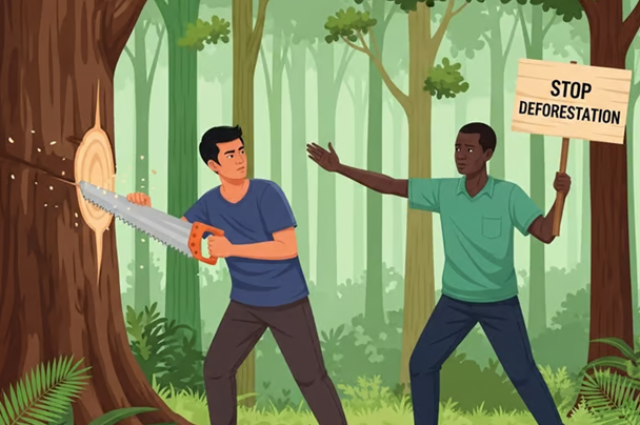
Gaura Devi, a 50-year-old widow and head of the Mahila Mangal Dal (Women's Welfare Association), rallied the response. With men away trading wool in Tibet, she gathered 27 women and girls, armed not with weapons but with resolve. "Sisters," she urged, as recounted in Bhatt's memoir Chipko Andolan, "these trees are our brothers. If they fall, our children will have no future." Led by Devi, they marched to the forest edge, forming a human chain around the tallest oaks. When the loggers arrived at dawn on March 26, they found the women clinging to the trunks, singing folk songs of the mountains and vowing to die before yielding. The standoff lasted hours. Labourers and Upset by the women's unyielding gaze, radioed their superiors. Police threats of arrest fell flat; one villager, Sudesha Devi, retorted, "Shoot us if you must, but the forest stays." By midday, the contractors retreated, abandoning their equipment. News of the "tree huggers" electrified the region. Within weeks, similar protests erupted in Advani and Phata villages, where women again embraced trees to block felling.
This was no spontaneous outburst but the culmination of simmering grievances. Preceding it, in 1973, DGSS had thwarted a logging auction in Mandal village through a 400-tree "hug-in," proving the tactic's power. Gaura Devi's leadership, forged in years of managing village cooperatives, embodied ecofeminism avant la lettre—the recognition that women's oppression and environmental degradation were intertwined. As Shiva notes in "Staying Alive" (1988), Chipko was "a woman's movement for ecological survival," challenging patriarchal structures that prioritised profit over people and planet.
Ripples of Resistance: The Spread and Strategies of Chipko
The Reni incident was the movement's watershed, transforming local defiance into a national phenomenon. Sunderlal Bahuguna, a Gandhian activist inspired by Bhatt, amplified his message through a 5,000-kilometre foot march across the Himalayas in 1975-76, linking deforestation to broader issues like soil erosion and climate shifts. By 1980, Chipko had mobilised over 150 villages, resulting in 12 major confrontations and countless smaller acts of resistance.
Strategies were grassroots and multifaceted. Women formed vigilance committees, patrolling forests at night to deter poachers. Community nurseries, like the one in Reni that produced 50,000 saplings annually by 1978, emphasised native species over commercial monocultures. Education campaigns, using folk theatre and songs, raised awareness: one popular ditty went, What do the forests bear? Soil, water, pure air, and Timber are just a few more. But the first three are the mainstays of life.
Triumph Over Timber: Policy Changes and Ecological Revival
Chipko's persistence bore fruit. In 1981, following a high-level committee's report prompted by Reni's protests, the Uttarakhand government imposed a 10-year moratorium on green felling above 1,000 meters. This evolved into the Forest Conservation Act of 1980, centralising approvals for tree felling and mandating environmental impact assessments nationwide. By 1990, the amendment to the 1927 Forest Act granted communities joint management rights, echoing Chipko's demands.
In Reni, revival was tangible. Forest cover rebounded by 25% between 1980 and 2000, per satellite data from the Indian Space Research Organisation. Springs replenished, yielding 40% more water for irrigation, and biodiversity flourished—sightings of Himalayan black bears and langurs doubled. Landslide incidents dropped by 60%, transforming precarious slopes into stable ecosystems. Economically, the village shifted to sustainable agroforestry: women-led cooperatives harvested resin from chir pines, generating Rs. 2 lakh annually by the mid-1990s, equivalent to about $25,000 today.
Broader Himalayan reforestation followed. Uttarakhand's forest department, inspired by Chipko, launched the Van Panchayat system, empowering over 10,000 village councils to manage 100,000 hectares of woodland. Nationally, afforestation efforts planted 2.5 billion trees between 1980 and 2010, offsetting 15% of India's annual carbon emissions.
A New Dawn: Empowerment and Sustainable Futures
Beyond ecology, Chipko reshaped Reni's social fabric. Women's empowerment surged: Gaura Devi's Mahila Mangal Dal evolved into a federation influencing policy, with literacy rates among Reni women rising from 12% in 1970 to 65% by 2000 through self-help groups. Ecotourism bloomed—visitors now trek to Reni's "Chipko Trail," funding homestays and handicraft sales, boosting incomes by 30%.
The village's model-inspired replicas: the Appiko movement in Karnataka's Western Ghats saved 500,000 hectares, while Africa's Green Belt Movement, led by Wangari Maathai, echoed Chipko's tree-hugging ethos, restoring 51 million trees across Kenya. In India, initiatives like the Bagepalli CDM Reforestation Programme in Karnataka have sequestered 1 million tons of CO2 while employing 1,000 locals.
Lessons from the Green Warriors
The Green Warriors of Reni teach that true change blooms from the soil of the community. Their nonviolent stand against deforestation not only saved forests but redefined futures, proving that marginalised voices, when united, can feel empires of exploitation. In a world losing 10 million hectares of forest yearly, Reni's story urges us: embrace the trees, for in their roots lies our resilience. As Gaura Devi said, the mountain is our mother, and we are her children. May her words echo in every village, every policy, every art.
. . .
References:
- Guha, R. 1989. The Unquiet Woods: Ecological Change and Peasant Resistance in the Himalaya. Oxford University Press.
- Shiva, V. 1988. Staying Alive: Women, Ecology and Survival in India. Zed Books.
- Bhatt, C. P. 1986. The Chipko Andolan: Forest Conservation Movement. Gandhi Peace Foundation.
- Forest Survey of India. 2021. India State of Forest Report.
- Right Livelihood Award. 1987. Citation for Chipko Movement.
- Earth.Org. 2024. 50 Years On: The Legacy of India's Chipko Movement.
- FAO. 2000. Tropical Deforestation and Forest Degradation: A Case Study from India.