
The Invisible Foundation
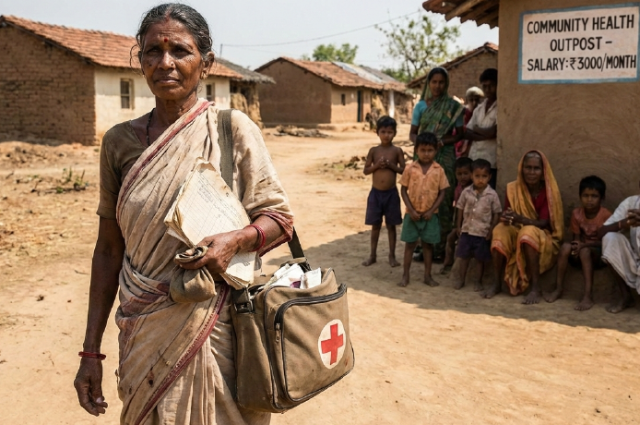
Imagine a monsoon-swollen stream in rural Bihar, its muddy waters churning fiercely under a leaden sky. Fahima Akhatar, a 42-year-old Anganwadi worker from Purnea district, wades waist-deep through it, her faded sari clinging to her skin. On her back, a sack of nutritional supplements for malnourished children; in her hand, a weathered notebook logging vaccination data. She slips, steadies herself, and presses on—because 45 families depend on her arrival. This is no cinematic heroism; it's the daily grind of India's rural backbone.
Fahim's story reveals a profound truth: the stability of urban skyscrapers and the national economy rests on the shoulders of rural workers paid in pennies but entrusted with lives. Their small salary exposes a glaring policy failure, while their big responsibility stands as a testament to human resilience. These grassroots guardians—delivering the last-mile services that urban India takes for granted—embody the dignity of labour. Yet society undervalues them, perpetuating socio-economic disparity. This essay argues that recognising their precarity of labour is not charity but justice, demanding we rebuild the social contract from the ground up.
The Scale of Responsibility
In the labyrinth of rural India, Anganwadi workers like Fahima form the invisible web of grassroots governance. Appointed under the Integrated Child Development Services (ICDS), they juggle an overwhelming roster of duties that would daunt any bureaucrat. Each morning, Fahima measures the mid-upper arm circumference of 50 toddlers, mixes fortified porridge laced with micronutrients, and dispenses iron supplements to combat anaemia. By noon, she's tallying growth charts, referring severe cases to distant health centres, and conducting doorstep vaccinations—often chasing down reluctant parents through paddy fields.
Her responsibilities extend beyond nutrition. She collects vital healthcare data for national surveys, identifies pregnant women for antenatal care, and runs preschool sessions teaching the ABCs to children who might otherwise never see a classroom. In crises, she's the first responder: during floods, she evacuates families; in pandemics, she tracks fevers and enforces quarantines. Sanitation falls on her too—distributing hygiene kits and counselling on latrine use to curb open defecation.
The impact is staggering. When Anganwadis falter, India's health and literacy statistics crumble. A 2023 NITI Aayog report notes that these workers prevent 2.5 million child deaths annually through early interventions. They ensure the last-mile delivery of schemes like POSHAN Abhiyaan, bridging the chasm between policy and village reality. Fail them, and stunting rates—already at 35% in Bihar—spiral, dooming generations to poverty. Fahima doesn't just feed bodies; she nurtures the nation's future. Her scale of responsibility dwarfs that of any corporate executive, yet society sees her as peripheral.
The Economic Paradox
Fahima earns an honorarium of ₹6,000 monthly—roughly ₹200 a day—supplemented sporadically by incentives. This pittance starkly contrasts with India's minimum wage, pegged at ₹10,000–15,000 in urban areas, or even a living wage estimated at ₹18,000 by the Centre for Labour Research and Education. An entry-level data entry operator in Patna commands ₹12,000–15,000 for typing spreadsheets, while Fahima safeguards an entire village's health metrics.
This wage-value gap epitomises socio-economic disparity. Why does the woman charting malnutrition trends—data that shapes billion-rupee budgets—earn less than someone digitising invoices? The paradox lies in urban bias: policymakers funnel funds to visible metros, starving rural outposts. Anganwadi workers, classified as "volunteers," receive honorarium rather than wages, a semantic sleight that evades labour laws.
Precarity of labour defines their existence. Living on scraps, Fahima borrows from moneylenders at 36% interest to cover her daughter's wedding or her husband's dialysis. Health crises compound the trap: no paid leave means working through fevers, accelerating burnout. A 2022 ILO study on Indian gig workers highlights how such vulnerability cascades—debt spirals into asset sales, trapping families in cycles they themselves disrupt for others. Urban India thrives on apps delivering groceries; rural workers deliver life itself, yet their economic fragility undermines the very stability they uphold. This isn't oversight; it's systemic injustice, demanding wage parity to match responsibility.
The Emotional Labour
Beyond ledgers and ladles lies the hidden work—the emotional labour that extracts Fahima's soul. She doesn't just weigh children; she wipes tears from a mother's face whose infant stunted despite her efforts. In whispered evenings, she counsels widows on widow pensions, mediates land disputes between feuding kin, and coaxes dropouts back to school. Trust is her currency: villagers confide de abuses they'd never share with distant officials, making her confidante, therapist, and judge.
This toll is invisible and immense. Personal time evaporates—nights spent poring over records by kerosene lamps, weekends chasing absentees. Family suffers: Fahima's own children grew up on hurried meals, her husband resenting the "village wife" she'd become. Burnout festers without an outlet; a 2024 ASER survey found 40% of Anganwadi workers report chronic stress, yet no counselling exists.
Social security is a mirage—no pensions until age 60, scant insurance, zero maternity leave despite handling others' pregnancies. Their responsibility devours boundaries, turning professionals into perpetual volunteers. Fahima's story echoes thousands: dignity of labour demands we honour this emotional fortitude, not exploit it.
The Social Contract
Society's betrayal of rural workers fractures the social contract. We hail the dignity of labour in speeches but treat Anganwadi workers as volunteers, justifying honorarium over wage to skirt accountability. This pretence dehumanises them—professionals reduced to goodwill ambassadors, their expertise unpaid. Grassroots governance crumbles when those at the last mile are disposable.
Formalisation is the antidote. Transition from erratic honorariums to dignified salaries, with pensions, health insurance, and training as public servants. States like Tamil Nadu show the path: raising pay to ₹15,000 yielded better retention and outcomes. Policy must enshrine them in labour codes, closing the precarity gap.
Recognising their professionalism honours the social fabric. A just society remunerates responsibility, not just revenue.
The Mirror to Society
Fahima's stream-crossing odyssey encapsulates the rural worker's saga: immense responsibility on a small salary, resilience amid precarity. From the scale of their duties as first responders, through the economic paradox of wage-value gaps, to the emotional toll and breached social contract, their story unmasks India's priorities. We celebrate urban innovators yet ignore the grassroots governance holding villages—and thus the nation—afl oat. Socio-economic disparity thrives because we undervalue last-mile delivery, trapping workers in honorarium limbo while they combat precarity for us all.
This struggle mirrors our soul: a nation building heights on crumbling foundations cannot stand. Urban influence depends on rural vitality; neglect Fahima, and literacy falters, health collapses, and futures dim. To value the rural worker is to value the nation itself—restoring dignity of labour through just wages and security. Let Fahima's untold story spur action: policy reforms that pay not in pennies, but in justice. Only then will India's promise reach every stream and village hearth.