
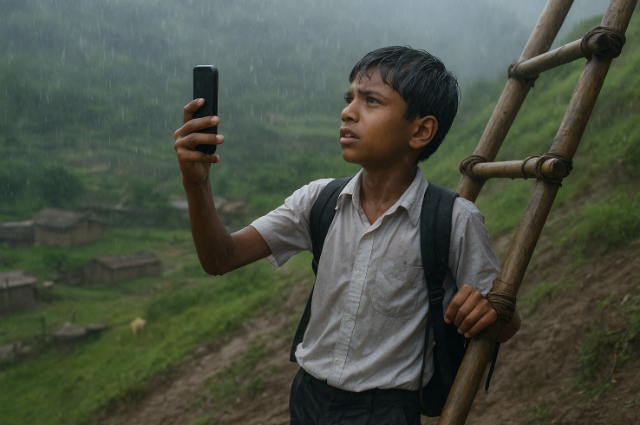
Rain hammered the tin roof like a thousand impatient fingers, turning the dirt path into a slick river of mud. Rohan gripped the bamboo ladder with white-knuckled hands, his school uniform plastered to his skin, backpack slung over one shoulder, heavy with yesterday's notebooks. Twelve years old, and already he knew the hill behind the village like the veins on his own wrist, the one spot where the signal bars flickered to life, two stubborn ghosts refusing to die. Below him stretched the cluster of kuccha houses in this forgotten corner of Rajasthan, silent except for the bleating goats and his mother's distant call to come down before he slipped. Up here, though, the world buzzed: his cracked smartphone screen glowed faintly as it downloaded a single PDF homework file at the speed of dripping molasses. One bar dropped to zero. His heart sank. Class started in five minutes, and the online classroom waited like a locked door, mocking him from the ether.
Rohan wedged the phone between two jagged rocks, shielding it from the downpour with his palm, whispering prayers to the network gods. Static crackled from the speaker, his teacher's voice, distant and distorted, assigning math problems he couldn't see. Back home, his three younger siblings huddled around the same phone after him, taking turns like miners sharing a single lantern. The village had no Wi-Fi tower, no library computers: just this hill, this ritual, twice a day. As thunder growled, Rohan wondered if the city kids even knew what it felt like to chase a signal like a hunted animal.
That invisible wall between them? It's what people call the digital divide, but to Rohan, it felt like a chasm carved by giants, one side lush with endless bandwidth, the other a barren scramble. Imagine Priya in Mumbai, her MacBook propped on a desk bathed in air-conditioned light, Zoom camera on, sharing her screen without a stutter. High-speed fiber optic humming like a lullaby, homework apps loading in seconds, tutors on speed dial. Now picture Rohan and his siblings: one ancient Android phone passed hand-to-hand, battery draining faster than hope during a live quiz. Turn on the camera? Shame burned hotter than the midday sun, the mud-brick wall behind him, peeling posters, and a kerosene lamp screamed "poor" to classmates who might laugh or pity.
The toll wasn't just logistical; it clawed at the soul. Nights blurred into anxiety-fueled marathons, eyes burning from the screen's blue glare, stomach twisting as data packs dwindled. "Camera off," Rohan would mutter, his square blacked out in the grid of perfect faces, voice lagging like a ghost in the conversation. Exams were terror:
Mid-question, the connection would gasp and die, leaving him to scribble answers from memory while classmates typed flawlessly. Friends drifted, city cousins with gaming setups and Netflix, oblivious to his world. "Why don't you just Google it?" they'd text. Rohan wanted to scream: Because Google lives on the other side of this hill.
But Rohan didn't break. He transformed. In the way a seed cracks open under pressure, pushing through stone to reach sunlight. It started small that evening when the rain finally relented, and he gathered his siblings under the banyan tree. "No more chasing alone," he declared, voice steady despite the quiver in his chest. They called it the Signal Circle, a jugaad pact, born of desperation and village ingenuity. Every dawn, before the network choked on daytime traffic, they'd trek to old Uncle Raju's house, the one relic with a community radio antenna jury-rigged to pull faint signals from the state education broadcasts. There, huddled on charpoys with notebooks splayed like open wings, they'd listen to lessons crackling through static, scribbling equations by lantern light.
Nights were for the real hunt. Data is cheaper after midnight, Rohan's secret weapon. He'd climb the hill under stars thick as scattered salt, phone plugged into a solar charger scavenged from a broken lantern. Download bursts: Khan Academy videos, NCERT PDFs, YouTube lectures on physics compressed to bare essentials. Offline apps became his arsenal, Grasshopper for coding puzzles, Duolingo for English drills, even a solar-powered Wikipedia mirror app that worked without internet. The Signal Circle grew: neighbors' kids joined, pooling rupees for a shared data plan, trading handwritten summaries like underground currency. Rohan's mother boiled extra tea; Rohan's father fixed the bamboo ladder with fresh rope.
What emerged wasn't just survival; it was superpower. Discipline forged in fire: Rohan memorized formulas because he couldn't rewind videos. Resilience from repeated failures: dropped connections taught him to summarize aloud to his siblings, turning weakness into teaching strength. City kids binge-watched tutorials; Rohan lived them, body aching from climbs, mind sharpened like a village knife on whetstone. He outpaced his class in math, explaining vectors to baffled online classmates whose gadgets did the work for them. "How do you know this stuff?" one asked. Rohan grinned into the camera (finally brave enough to turn it on). "Because I had to earn it."
This wasn't just Rohan's story. Zoom out, and the hill multiplies: Veveonah in the Appalachian hollows of West Virginia, balancing on a rusted water tower for LTE bars, her Chromebook useless without them. Jamal in rural Kenya, pedaling miles to a cyber cafe for solar-charged lessons while Nairobi peers streamed VR simulations. From India's Vindhya mountains to America's rust-belt towns, the digital divide yawned wide, 85 million kids worldwide locked out during COVID lockdowns, per UNESCO whispers, their futures flickering like bad signals.
Yet here's the revelation: education's new battlefield isn't facts; it's grit. Memorizing dates? Apps do that. But scaling a slippery hill in monsoon, rallying a circle of dreamers around a crackling radio, hacking solutions from scraps, that builds the unbreakable core. Rohan didn't just learn algebra; he learned agency. The kid with everything handed to him might ace the test, but crumble at adversity. Rohan? He'd already summited worse peaks.
Months blurred into triumph. One sweltering afternoon, heart pounding from the final climb, Rohan watched the progress bar creep to 100%. Assignment submitted, graphs plotted, essay typed on a borrowed keyboard, proofread by firelight. The confirmation ping echoed like victory bells across the village's silence. He slid down the hill, mud-caked but beaming, siblings cheering from the doorway.
The internet connection stayed weak, bars dancing like shy fireflies. But Rohan's connection to his future? Forged unbreakable, a signal stronger than any tower could beam.