
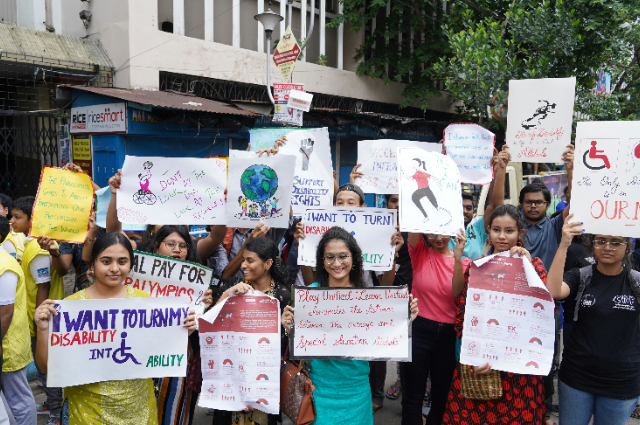
Sometimes, the most ordinary words carry the heaviest truths. "Ek Kachori, Do Samosa, Mardon Ka Kya Bharosa?" sounds almost playful, almost light. But listen closely, and you'll hear something else beneath the rhythm — the exhaustion of a generation of women who have learned to laugh so they don't have to cry.
The slogan echoed through Delhi University, carried by young women who had finally had enough. It came after the reported gang rape of a seventeen-year-old girl near Astha Kunj Park — a name that should have been just a place on a map, but became another wound in a long, familiar story. The protest was not about a single night or a single girl. It was about every woman who has been told to come home before dark, to share her live location to feel safe walking to a bus stop.
What Does Freedom Mean When Fear Follows You Home?
Ask any woman what freedom feels like, and she might pause. Not because she doesn't know, but because she has never fully experienced it.
What does it mean to be free if you cannot walk home without your heart beating too fast? What is the value of education if a young woman spends her lectures worrying about the journey back? For countless women, ordinary life is a careful choreography of precautions — share your location, avoid the deserted road, don't stay out too late, don't walk alone, don't trust too easily.
These precautions are not wrong; they are survival. But survival should never be the price of living.
One message from the protest cut straight to the heart: "Check your son's intentions, not your daughter's location."
Somewhere along the way, we started teaching our daughters how to avoid danger instead of teaching our sons how to avoid becoming it. We handed our daughters rules and our sons excuses. Safety was never supposed to be a woman's job. It was everyone's responsibility.
When the Victim Is Put on Trial
There is a particular cruelty in how society responds to sexual violence. Before the accused is even questioned, the survivor is already being cross-examined — not in a courtroom, but in drawing rooms and comment sections.
Why was she out so late? What was she wearing? Why was she alone? Why didn't she fight back?
Why is the question never about the one who committed the crime? This quiet violence shifts the weight of shame from the perpetrator to the survivor. It turns a crime into a character judgment.
Let us be clear: no clothing, no location, no hour of the night gives anyone the right to violate another person's consent.
The protest slogan said it plainly: "Rapist ko andar karo, ladkiyon ko nahi." Put the rapist behind bars, not women behind doors. Instead of restricting women's movement in the name of protection, we must demand safer public spaces, honest investigations, and justice that doesn't require a woman to prove her virtue before she can prove her pain. behaviour
The Invisible Walls We Build
Patriarchy is rarely loud. It lives in quiet expectations — the way a woman is told to be a good daughter, an obedient wife, a respectable woman. Her clothes, her friends, her choices — all subject to judgment she never asked for. Meanwhile, men are often held to a different standard altogether.
The protest's satirical slogan — "Gobi ki sabzi, saath mein roti, mard jaat ki soch hai chhoti" — made people laugh, then made them think. Why are women expected to meet impossible moral standards while disrespectful behaviour from men is shrugged off as "just how they are"?
"Boys will be boys," we say — as if gender itself is a permission slip for harassment. But dignity is not a gender-based privilege. Respect is not a favour granted to women. It is a right, and it belongs to everyone.
A Park Belongs to Everyone
After the reported incident near Kalkaji, discussions turned to park timings and restrictions. Practical measures, perhaps. But they raised a deeper question: should the solution to unsafe public spaces be to keep people out of them?
A park is not a private garden. A street is not a privilege. Their safety should never depend on the exclusion of women. What we need is not fewer women in public spaces, but better lighting, reliable transport, accessible emergency services, and responsive policing.
Protection without freedom is just control wearing a kinder mask.
Women should be able to study, work, travel, and simply exist in public life without trading their independence for a fragile sense of security.
Men, This Is Your Responsibility Too
Not all men harass. Not all men are violent. Many stand against discrimination and actively work toward equality. That matters. But responding to every conversation with "Not all men" doesn't solve anything — it deflects, silences, and makes the problem about men's feelings instead of women's safety.
Men have a responsibility to challenge harmful behaviour, especially when no one is watching. When a friend makes a degrading joke. When someone shares an inappropriate image. When a woman is being harassed, and everyone looks away. Silence is not neutrality. Silence is permission.
Respect consent. Challenge sexist language. Support fair investigations. Refuse to excuse misconduct. These are not grand gestures — they are small, everyday choices that build safer communities. True solidarity is not a hashtag. It is a habit.
It Begins at Home
Laws matter, but social change begins at the dinner table, in the classroom, in the way we raise our children. We must teach our children that consent is not a topic reserved for adulthood, that boundaries deserve respect, and that every person carries the same inherent dignity.
We must teach our sons that emotional maturity is strength, not weakness. And we must teach our daughters to recognise their rights — to pursue their ambitions without restrictions they never deserved.
Parenting was never meant to be about protecting daughters from every possible danger. It was always meant to be about raising sons who understand their responsibilities toward others.
Beyond the Slogan
"Ek Kachori, Do Samosa, Mardon Ka Kya Bharosa?"
It's funny. It's catchy. But behind the humour is frustration. Behind the frustration is a demand. And behind that demand is something achingly simple: the right to live with dignity. The right to walk home without fear.
India's progress cannot be measured only by its economy or global standing. It must also be measured by how safely and freely all its people can live.
The goal was never to create hostility between women and men. It was to build a society where trust is earned through respect, equality, and accountability. Where safety is not a privilege but a given.
Perhaps the most important question this protest raised is not whether women can trust men. It is this: what kind of society are we building if women must repeatedly protest for the freedom to live without fear?
The answer will tell us everything about what we truly value. And whether we are brave enough to change.