
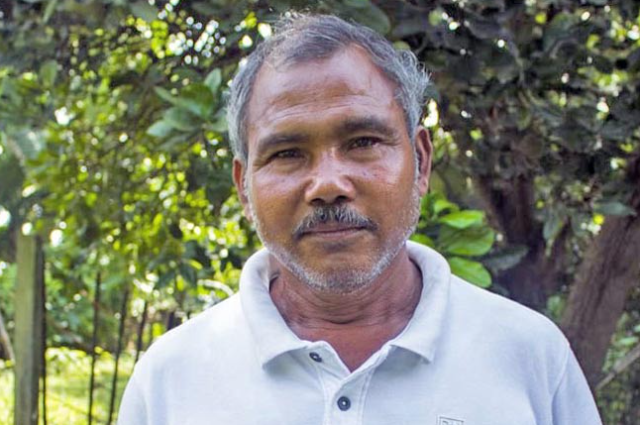
In the heart of India’s Assam, where a barren, skeletal island stood as a monument to human greed, one man began a quiet, solitary battle. His weapon was not a protest or a petition, but a simple bamboo sapling. Four decades later, his unwavering faith has grown into a forest larger than Manhattan, a self-made kingdom teeming with life, and a testament to the fact that one person’s conviction can indeed change the face of the Earth.
Prologue: The Skeleton Island
The Brahmaputra River, one of the mightiest in the world, is both a life-giver and a life-taker. Its serpentine flow through the state of Assam carves and reshapes the landscape, creating and destroying countless chars—temporary, shifting sandbar islands. In 1979, after a period of intense flooding, the river receded to reveal a new, desolate char near the town of Jorhat. It was a vast, 1,400-acre expanse of sand and silt, utterly barren, without a single tree or shrub to anchor the earth. The locals named it Mojong Sora, the “Skeleton Island.”
The island was a dead zone. Without roots to hold the soil, the sand shifted with the wind, creating a dusty, inhospitable environment. The relentless Assam sun beat down on the white sand, creating a mirror-like reflection that was blinding. No bird sang there, no animal sought shelter. It was a place of profound silence, a stark reminder of nature’s fragility.
This was the canvas upon which a 16-year-old boy named Jadav "Molai" Payeng would begin his life's work. The son of the Mishing tribe, a community intrinsically linked to the river and the land, Jadav had already witnessed the slow erosion of his environment. But it was a specific, heartbreaking encounter on the banks of the Brahmaputra that would ignite his mission.
Chapter 1: The Serpent and the Seed
The popular legend, now etched into the folklore of the region, begins with a tragedy. After the floods, Jadav came across a sandbar strewn with the corpses of snakes. They had washed ashore during the deluge and, with no vegetation for shade or shelter, had baked to death under the merciless sun. The sight of these helpless creatures, dead on a barren wasteland, struck the young boy with the force of a revelation.
“I sat down and wept over their lifeless forms,” Payeng has recounted in numerous interviews. “It was a massacre. I alerted the forest department and asked them if they could grow trees there. They said nothing would grow. Instead, they asked me to try growing bamboo. It was just torture for me, but I did it. There was nobody to help me. It was painful, but I did it.”
The forest department’s suggestion, perhaps offered as a way to placate a determined teenager, was the only spark he needed. They gave him a small bag of bamboo seeds and a few saplings. It was an impossibly small arsenal with which to confront a 1,400-acre desert.
Undeterred, Jadav began. He carried the seeds and saplings to the island by boat and on foot. He dug holes in the hard, dry sand with his bare hands and sticks. He planted each seed with a prayer, carrying water from the river to nourish them. For days, then weeks, then months, he repeated this back-breaking routine. He would wake before dawn, make the journey to the island, plant, water, and return home, his body aching, his clothes caked in sand. His neighbours and even his family thought he was mad. Why waste his youth on a hopeless, barren land? Why not focus on finding a proper job, a stable income?
But Jadav was not driven by logic or economics; he was driven by a deep, spiritual conviction. He saw the potential for life where everyone else saw only death. Each tiny, green sprout that pushed its way through the sand was a victory, a confirmation of his faith.
Chapter 2: The Solitude of a Creator
For the first few years, Jadav Payeng’s life was one of profound solitude. He was the lone gardener in a garden the size of a city. The initial bamboo plantation was just the beginning. He quickly realised that a monoculture would not create a resilient ecosystem. He began collecting seeds of other native species from the surrounding areas—red silk cotton, arjun, mango, jackfruit, tamarind, and bomba. He became a student of the forest, learning which plants attracted which insects, which trees provided the best fruit for birds, and which roots were best for binding the soil.
His daily routine was monastic in its discipline. He would leave his home in the nearby village of Kokilamukh and spend the entire day on the island. He built a small hut and sometimes stayed for days at a time, tending to his burgeoning plant children. He married, and his wife and children understood that his first love, his primary responsibility, was the forest. His family supported him, often at great personal and financial sacrifice, while he dedicated his life to his green mission.
The work was physically gruelling. Planting in the sand was difficult, but protecting the fragile saplings from the elements was even harder. The Brahmaputra’s floods would sometimes threaten to wash everything away. The scorching summer heat would threaten to wither young plants. But Jadav devised ingenious solutions. He built bamboo platforms to protect the saplings from floods and created small, intricate water channels to direct rainwater. He used red ants, collected from other areas, to naturally enrich the soil, a technique he learned from his tribal forebears.
Slowly, imperceptibly at first, the island began to change. The bamboo groves took root, their complex underground rhizome systems knitting the sand together, creating a stable floor. The canopy began to form, casting cool shade on the once-baking earth. The shade retained moisture, which allowed other seeds to germinate. With the plants came insects. With the insects came birds. The silence of Skeleton Island was gradually broken by a chorus of whistles, chirps, and calls.
Chapter 3: The Accidental Discovery and the Ecosystem’s Return
For nearly three decades, Molai Forest—as it had come to be known locally, after its creator’s nickname—was Jadav Payeng’s secret. It was a thriving, dense, 1,300-acre woodland, unknown to the outside world. The government and scientific community were completely unaware of its existence.
This changed in 2008. A herd of over a hundred elephants, displaced from their traditional migratory routes by habitat loss elsewhere, strayed into the area. They found refuge in the dense cover of Molai Forest. From there, they began raiding nearby villages, destroying homes and granaries. Officials from the Forest Department arrived, tracking the elephants, and were utterly astonished by what they found.
They expected a barren char. Instead, they walked into a lush, vibrant, healthy forest. They found a man living there, who calmly explained that he had single-handedly planted the entire ecosystem. The news spread like wildfire. Journalists, photographers, and environmental scientists from across India and the world began to make the pilgrimage to Jorhat to see this modern-day miracle and meet the man behind it.
What they discovered was breathtaking. Molai Forest was no mere plantation; it was a fully functional, self-sustaining ecosystem. The initial bamboo had given way to a rich, multi-layered canopy of tall trees. The forest floor was covered in a thick layer of humus, a stark contrast to the sterile sand Jadav had started with.
And the wildlife had returned in staggering numbers. The forest was now home to:
- The Bengal Tiger: A small but breeding population, including a famous tigress that made the forest her territory.
- Indian Rhinoceros: A vulnerable species, finding a haven away from poachers.
- Herds of Elephants, which now use the forest as a permanent corridor and nesting ground.
- Deer, Rabbits, and Apes: A thriving prey base that supported the larger predators.
- Vultures and Eagles: Circling the newly created food chain.
- Countless Bird Species: Including several endangered migratory birds that had made the forest their home.
The river itself had changed its course, bending away from the now-anchored island. Jadav Payeng had not just planted trees; he had engineered an entire watershed, taming a destructive river and creating a bastion of biodiversity.
Chapter 4: The Philosophy of the Forest Man
Meeting Jadav Payeng is a humbling experience. A man of modest stature with a weathered, kind face and calloused hands, he speaks with a quiet authority that commands respect. His philosophy is as profound as his achievement.
He does not see himself as a hero, but simply as a human being fulfilling his duty. “Humans are the biggest parasites on Earth,” he has said. “We consume everything until there is nothing left. We need to learn to give, not just take.”
His critique of modern society is sharp. He laments the disconnect between people and nature. “In my childhood, we played with trees and snakes. Today, children play with mobile phones. They are scared of spiders. How can you be scared of nature? You are a part of it.”
He has refused lucrative offers from real estate developers and logging companies. For him, the forest is not a commodity; it is his family. He knows every tree, every animal trail. He has given names to the tigers and follows the lives of the elephant herds with a paternal concern. His ambition is not to stop. He continues to plant trees, not just on his island, but on other barren chars along the Brahmaputra. His dream is to turn the entire 750-kilometre river stretch in Assam into a green, life-filled corridor.
His life is a powerful rebuke to the paralysis that often accompanies large-scale environmental problems. While governments debate, corporations greenwash, and individuals feel powerless, Jadav Payeng demonstrates the staggering power of direct, personal action. He embodies the Gandhian principle: “Be the change you wish to see in the world.”
Epilogue: A Legacy Taking Root
Today, Jadav “Molai” Payeng has received numerous awards, including the Padma Shri, India’s fourth-highest civilian award. He has been the subject of documentaries, and his story is taught in schools. But his greatest legacy is the forest itself.
Molai Forest stands as a living, breathing, growing symbol of hope. It is a concrete example of ecological restoration on a massive scale. It proves that desertification can be reversed, that climate change can be mitigated one tree at a time, and that biodiversity loss is not an inevitability.
The forest also serves as a crucial carbon sink, absorbing thousands of tons of carbon dioxide from the atmosphere, and as a natural bulwark against the increasingly violent floods of the Brahmaputra, protecting the villages downstream.
But perhaps its most profound impact is on the human spirit. In a world often dominated by news of environmental collapse, the story of the Forest Man is a necessary corrective. It is a reminder that the relationship between humanity and nature need not be one of exploitation. It can be one of nurture, of reciprocity, of love.
Jadav Payeng’s story whispers to us, just as the wind whispers through the leaves of his forest: that one person, with minimal resources but maximum determination, can indeed change the world. He did not wait for permission, for funding, or for a committee. He saw a need, and he began to fill it. His life challenges every one of us to ask a simple, powerful question: If one man can create a forest of a thousand whistles, what can I do?