
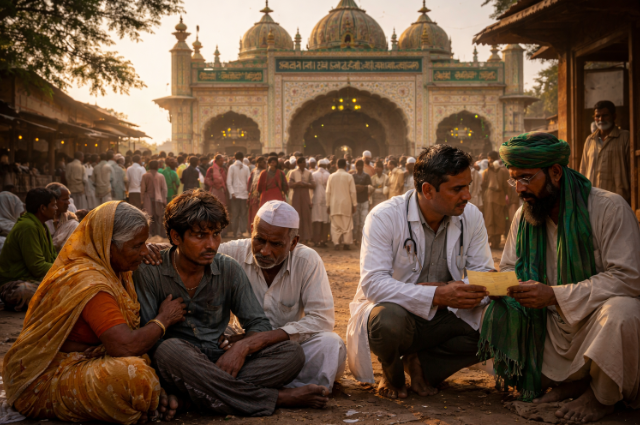
A visit to a shrine for schizophrenia might clash with what doctors expect. Still, across villages in India, mixing faith and healing works better than many guessed. Sickness shows up at holy places long before clinics see it. Temples, shrines, and prayer circles - these come first. Strange visions, fearfulness, losing touch, outbursts - rarely get called medical issues. Spirits taking over, anger from above, unseen forces - that is how people make sense of them. This way of understanding sickness isn’t rare - it shapes how many people see health, particularly those facing hardship. Mainstream mental health care often falls short there, not due to weak science, yet failing to earn trust within such cultures.
Out here in Unava, nestled within Gujarat's Mehsana region, stands the Mira Datar Dargah - often called the “spiritual high court” when unseen forces take hold. This sacred ground honors Hazrat Saiyed Ali Mira Datar, a revered Sufi figure. People travel far, sometimes hundreds of miles, bringing kin they feel are gripped by supernatural beings. Many act in ways that line up closely with symptoms seen in severe mental health conditions like paranoid schizophrenia or mood disorders laced with psychosis. Some show physical reactions without a medical cause, pointing toward psychological roots. Yet, until recently, doctors trained in mind care had no part in how these cases unfolded. Folks eyed doctors warily, diagnoses carried heavy shame, while pills got tossed aside without a second thought. Yet week after week, the shrine swelled - bodies packed tight where prayers masked what medicine never reached.
Belief doesn’t vanish just because facts arrive. Many well-meaning efforts fall apart by treating faith like an obstacle to be removed. Instead of swapping prayers for prescriptions, tension builds. People pull back when their worldview feels dismissed. Trust fades fast if help sounds like criticism. Withdrawal follows quickly once care begins to feel like an attack. It's not about reaching services. Trust opens doors. A social worker saw this first. Not someone with a medical degree. Their answer grew from real talk on city streets. Ideas bloomed where help felt human again. Finding himself face to face with the clash, Milesh Hamlai saw it unfold in his own home after his brother was diagnosed with schizophrenia. Watching the strain on family bonds opened his eyes - medical advice often crashes into deep-rooted traditions. What stood out most? Doctors sat idle in quiet rooms, yet temples drew crowds carrying invisible suffering. Rather than target patients, a path already littered with setbacks, he turned toward those who held sway over people's trust - the spiritual healers.
Out of that choice came something people today call the "Divine Referral" approach. Rather than tearing down religious habits, the method moves within them. A relative arrives at Mira Datar Dargah carrying hope and worry. The Mujavir - seen by many as a spiritual guide - carries out an age-old rite meant to cast away suffering. That act strengthens what the kin already hold in their hearts. Right when trust runs deep, there's a shift: no rejection, no claims of miracle cures alone. Instead, a small paper is passed - a note guiding them toward medical help hidden inside the sacred grounds. That medicine given at the clinic? It’s said to soften a person's inner strength, making room for prayer to take hold. So instead of fixing illness, antipsychotics become helpers in faith - less about symptoms, more about surrender.
What makes this approach work so well isn’t force, but fit. It doesn’t clash with a person’s thinking - it slips quietly alongside it. Medicine becomes part of what they already hold. There’s no push against long-held views. Belief stays intact, untouched by doubt. Healing feels less like change, more like deepening trust. When people see help differently, they stick with it more often, show up for check-ins, and stay on track. Think of the Mujavir - not an official voice, yet respected - someone locals believe without question. Their approval makes mental health support feel right, something worth accepting.
What also helped the model work well was how it dealt with influence and personal pride. At first, several spiritual healers did not want to join, worried physicians might push them aside or weaken their standing. Hamlai responded by presenting the health centre as something that backs them up instead of challenging them. For patients who acted aggressively or had serious conditions, professionals stepped in - easing pressure on the healers themselves. The boldest shift may have come from clinicians: they allowed traditional healers to be seen as the reason someone got better. Success, when it came, was often credited by doctors to the spiritual grace found at the shrine. Setting aside their own expertise helped keep trust alive over time. More than thirty-eight thousand people have received help since Mira Datar began in 2008. Healing here doesn’t stop at easing symptoms. Travel and lodging expenses drop, so families avoid financial strain tied to long stays near sacred sites. Care happens gently - no force, shame, or dread involved. Researchers took notice early; work appeared in journals like Transcultural Psychiatry. Even India’s highest court pointed to it as a working blueprint for local mental health efforts.
Some people say using medicine within spiritual beliefs tricks patients. Yet what matters most is helping them get better. If strict medical talk stops care from happening, changing the approach isn’t weak - it’s right. Belief here isn’t used for gain or laughed at. It helps healing by meeting people where they are.
What if healing doesn’t require discarding faith? The Mira Datar Dargah approach quietly sidesteps the old battle between logic and belief. Systems stumble less from public misunderstanding than their own unwillingness to listen. A place once seen only for prayer became, slowly, somewhere people found therapists, too. When shame often hides mental pain across the nation, offering help within holy ground feels less like a strategy - more like common sense showing up at last.
. . .
Reference:
- Saha, S. et al. (2021). Unique collaboration of modern medicine and traditional faith-healing for the treatment of mental illness: Best practice from Gujarat. Journal of Family Medicine and Primary Care.
- Shields, L., Kirmayer, L. J., & Hamlai, M. (2016). Collaborative mental health care with faith healers in Gujarat. Transcultural Psychiatry.
- World Health Organisation (2013). Mental Health Action Plan 2013–2020. WHO.
- Government of India (2014). National Mental Health Policy of India. Ministry of Health & Family Welfare.
- Satyamev Jayate (2014). Nurturing Mental Health, Season 3, Episode 5.