
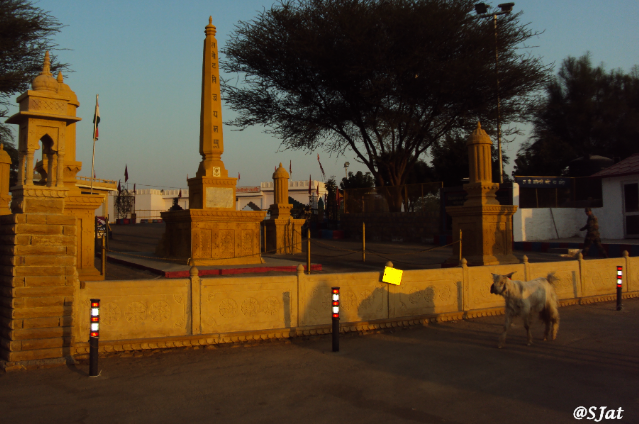
Not many spots on Earth stay calm while brushing up against battle – defying reason without warning. Sitting just twenty kilometers from the India–Pakistan frontier, in the rough stretch of Rajasthan's Thar Desert, lies a small shrine known as Tanot Mata Temple. When full wars erupted between the nations in 1965 and again in 1971, gunfire traced paths straight toward this quiet site. Shells rained down nearby; some say they struck inside the sacred grounds. Still, through it all, the building held firm – no breaks, no collapse, nothing but silence afterward. A strange survival sparks a question without clear proof – could it have been luck shaped by chance, an error in weapons, timing within war, or something beyond knowing? What remains unclear turns Tanot Mata into more than prayer; it becomes history tangled with doubt.
What makes this survival remarkable ties back to where the temple stands. Not tucked away in calm territory, Tanot Mata Temple sits near Longewala – a hotspot during fierce western front clashes. Flat stretches of desert wrap around it, ground that tanks cross easily, with nothing blocking viewlines for miles. Without hills or barriers, anything standing there would normally vanish under heavy fire. For a building to remain intact through extended shelling here seems nearly impossible. A blast like that should have turned the temple into dust. Still, it stood there untouched.
That year, Pakistan’s army opened heavy fire on India’s lines close to Tanot. Records say around three thousand rounds flew into the zone. Four hundred – or maybe up to four fifty – hit right inside the temple grounds. Not one shell went off. It just sat there, silent. One stray misfire usually means several blasts go off, yet nearly every shell failing in just one tight zone defies normal combat odds. Those troops on the ground said afterward they ducked into the temple simply due to silence, not strength in its walls.
Years later, stories began to swirl about what happened. Soldiers told, again and again, how some Indian troops said they dreamed the same dream – of Tanot Mata promising safety near her temple. These visions were never recorded by the army. Beliefs like this can’t count as proof. Yet groups under fire sometimes share strange moments of mind and emotion. When tired, scared, pushed to the edge, people hold tighter to what they trust. Faith becomes something to lean on. Just because something feels real doesn’t prove it true – yet dismissing everything outright isn’t so simple either. What came after adds weight, whether we like it or not.
Out in the open, the same puzzle showed up in 1971. At Longewala, a handful of Indian troops stopped a huge wave of Pakistani tanks dead in their tracks. Across the sand near Tanot, wrecked vehicles smoldered, shelters crumbled, chaos ruled. All through it, mortar fire crept close to the temple walls. Explosions shook the ground just beside sacred grounds while buildings nearby cracked under impact. Built on shifting sands, it stands untouched. Now, doubt creeps in where luck used to explain everything.
Around here, one thing stands out – inside the Tanot Mata Temple sits a collection of live war relics. Not models or stand-ins, but actual bombs left behind after two separate conflicts. Each piece was checked and made safe by the Border Security Force, the group now watching over the site. What makes this matter? It moves stories into something you can touch. Proof that explosions once echoed nearby, ruling out claims that no attacks reached this ground. An odd event took place, and what really needs asking is not whether it happened, but why.
Nowhere else do beliefs blend quite like at Tanot Mata. Some see miracles, others look for proof. Devotion holds that divine forces guard the shrine – spoken of by border guards and villagers alike. After the conflict ended, stories say a Pakistani officer named Shaukat Ali came to pay homage. Moved perhaps by what he heard, he left behind a silver umbrella in tribute. Even now, some patrol members take small amounts of earth from near the altar. Not because science demands it – but because moments defy logic. What counts is what they’ve lived through.
Scientists who doubt the mystery offer different ideas. One idea says loose sand on the dunes soaked up shell impacts, stopping fuses from going off. Another point to bad ammo or odd landing angles are reasons explosions did not happen. While those factors might cover a small number of cases, applying them to hundreds of shells in one spot during two wars stretches belief. Possible? Yes. But so unlikely it feels hollow.
Now here's a place where stories pile up like old letters never sent. Some say gods moved the dunes that day, others claim wind did what wind does – shift, hide, erase. Truth? Maybe it breathes in the quiet space between those two. Soldiers have seen things they cannot explain, felt calm when chaos ruled, and stood tall because someone whispered prayers through cracked lips. War changes how people see. What sticks is not just steel or strategy but something softer, harder to name. It might surprise you how far chance can stretch while still obeying nature's rules. Humility matters more than faith when facing Tanot Mata.
Still now, Tanot Mata's tale holds weight. Rising through time, the temple marks more than stone – it carries grit, a silent echo in India’s army past, showing how some things slip between reason and myth. When most chase black-or-white truths – proof or belief – the shrine lingers, unseen but steady, in the space between. Maybe just staying there, without fanfare, is what truly defies explanation.
Reference –
- This temple in Rajasthan stood against thousands of bombs: The untold story of war, faith and Indian Army — Times of India
- Tanot Mata Temple: history + museum + unexploded bombs — Times of India Travel Guide
- Tanot Mata war story and miraculous survival — IndiaTimes article
- Tanot Mata temple miraculous defence accounts — Rajasthan Bhumitours blog
- Wikipedia — Tanot Mata Temple background & battle connection