
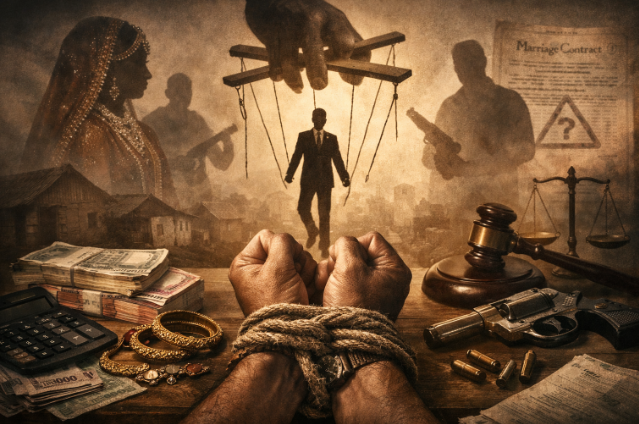
One moment you’re walking home, next thing - you’re tied up in a stranger’s house. In places like western Bihar or eastern UP, young men vanish without warning. Not taken by criminals, but by families desperate to fix marriages. A brother-in-law holds a pistol while an uncle forces a ring on your finger. No court orders, no police reports - it just happens, quietly. People say it’s culture, but look closer: it’s about money, dowries, land deals gone wrong. Marriage here acts less like love, more like debt repayment. Boys pulled off bikes, beaten until they agree to brides they never met. The fear isn’t the act itself, but how normal everyone pretends it is. Silence spreads because speaking risks being next. This isn’t folklore passed down through songs; it’s survival math twisted beyond sense. When weddings become auctions, someone always ends up stolen.
Pakadwa Vivah finds its roots in the persistence of dowry, still widespread even though banned by Indian law. Job status, schooling, caste, and income shape how much a groom is seen to be worth here. Men who work for the government, or are engineers, doctors, those with steady pay - these attract huge dowry demands. Sums often sit between ₹20 lakh and ₹1 crore. When money is tight, wedding a daughter feels out of reach unless fields get sold. Taking on endless debts becomes normal. Some households end up carrying burdens passed down through years. Facing these conditions, certain households turn to what seems like a lower-cost option: arranging for armed groups to take a fitting bridegroom. To them, it’s less about violence, more about survival - skirting financial collapse within a structure that hits the poor hardest.
A sudden move? Not how Pakadwa Vivah usually works. Planning shapes it, coordination tightens the grip, trust becomes the trap - people close to the man help set it up. A friend might call him out, a cousin invites him over, someone familiar draws him in with talk of work, a party, just catching up. Separated from others, he finds himself surrounded fast. Men rush in, hold him down, drag him off before anyone notices. Pain shows up early; fists fly, guns get waved around, fear gets drilled into his mind on purpose. Breaking him comes first - only then does the outfit appear, stitched for a false celebration. From there, they lead him forward, clothed like a guest at his own undoing, steps watched by those holding weapons. The rites unfold beneath their gaze, each gesture forced, every word hollow.
Fear turns ceremony into trap in Pakadwa Vivah. Not joy, but pressure shapes these weddings. Rituals meant for unity happen under threats. Grooms appear broken - some sob, others freeze mid-motion applying sindoor. Cameras catch what words often miss. Elders stand close, silent endorsers of forced vows. Priests chant as if consent were present. Community nods along, treating abduction like tradition. A fake sense of normal settles once rites finish. Suddenly, the man is called husband, whether he agrees or not. What begins in panic gets rewritten as fate.
What makes it hard to grasp is how these marriages go on long past danger. Reasons tie back to harsh reactions when someone tries to walk away. Out in traditional villages, women who break off weddings get marked by shame. People call them unfit, point fingers at them, their chances for love later vanish. That weight of judgment presses down heavy, shapes choices, controls outcomes. It weighs on him when they say walking away could ruin her future. Slowly, shame creeps in, mixed with worry about what people will think. Pressure from those around keeps building, until giving in feels like the only way out.
Sometimes the mind adjusts in quiet ways. If fighting back looks pointless and help feels out of reach, survival can slowly turn into giving up. Stuck without a way out, people start treating ongoing pain as normal. Over time, some grow numb or begin justifying their situation. They might tell themselves it hurts less to stay than to leave. Stuck together by money ties, kids they both care for, one person’s need to keep peace slowly locks them into a life they did not choose. A situation that started with being taken ends up looking like an ordinary home, shaped more by society than choice.
Many years passed while Pakadwa Vivah stayed in a murky area of the law. Even though taking someone against their will and forcing them into marriage breaks criminal rules, officials often saw such incidents as internal family disputes. Law enforcement stepped in only once in a while. Those affected usually found themselves pushed away from reporting what happened. A shift came strongly in late 2023 - November, to be exact - when judges at the Patna High Court made a firm decision: any union built on pressure, fear, or harm holds no weight in court. Forced ceremonies hold no weight in law, said the judges, because real agreement must sit at the heart of any lawful union. Recognition finally came through this ruling for men who suffered abuse, giving them access to both annulments and criminal charges down the line.
Still, change hasn’t spread far beyond courtrooms. Laws shifting doesn’t erase habits built over lifetimes. Fear keeps many away from judges - fear of being pushed out, harmed, or ignored by police. Power held by a few in villages protects those who do harm, using old hierarchies and connections. Still knowing what the law says does not always help. Walking away from home, people who matter, even work might be the price. That distance - between rules on paper and how life actually feels - stays deep.
A closer look at Pakadwa Vivah reveals more than local oddity - it points straight to broken systems. Marriage becomes less about people, more about money, thanks to the lasting grip of dowry practices. When social norms dictate choices, even men find themselves stuck, their freedom quietly taken away. What seems like custom might actually be control dressed up as respect. The real issue? Letting old habits block basic dignity.What really matters isn’t if Pakadwa Vivah is bad - everyone knows it is - but why people have looked away for years. So long as giving gifts at weddings feels normal, saying no gets ignored, and what neighbors think beats the law, taking grooms by force won’t vanish. Stopping this act needs more than judges’ words; it means changing how society sees marriage - as something chosen freely, not bought through fear. Without that change, dragging a man into marriage with fists will still linger where Indian weddings meet power.
Reference -
- NDTV, “Patna High Court annuls marriage of man kidnapped and forced to wed at gunpoint,” 2023.
- The Times of India, “Bihar teacher kidnapped and forced into marriage in Pakadwa Vivah case,” 2023–2024.
- India Today / Aaj Tak, “Pakadwa Vivah: Thousands of grooms kidnapped annually in Bihar,” crime reports and investigations.
- BBC Hindi, “Pakadwa Vivah: Dowry, coercion and forced marriages in Bihar,” ground reporting.
- LiveLaw, “Consent is mandatory: Forced marriages void under law, Patna High Court,” 2023 judgment analysis.