
Feminism has been steadily gaining momentum over the years. From the Suffragette movement in the early twentieth century to the #MeToo movement that took the world by storm in the twenty-first, each wave has altered how women are perceived and how they resist discrimination from men across societies.
Yet, some stories of feminine resistance remain untold and ignored by people, whether in Western feminism or even within Eastern feminism. It is time we read one such story of extraordinary resilience and courage: the story of Sinagi Dai and the women warriors of the Oraon tribe.
The Story of Unlikely Battles
Sinagi Dai, the princess of Raja Ruidas of Rohtasgarh, belonged to the Oraon (Kurukh) tribe, a Dravidian-speaking Adivasi community inhabiting present-day Jharkhand and parts of Chhattisgarh and Odisha. The legend places her story near Rohtasgarh Fort, in what is now Bihar.
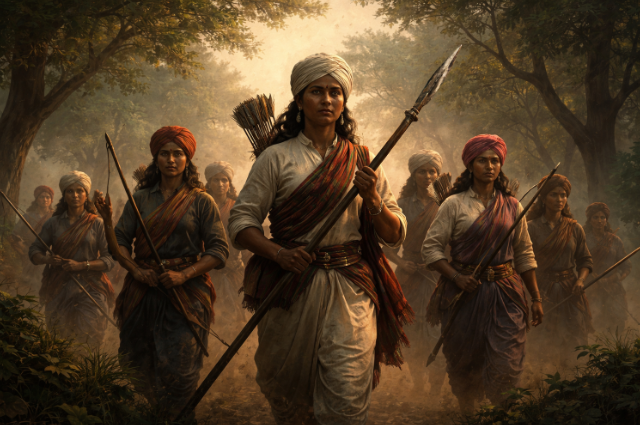
Along with her trusted comrades, Champai Dai and Kaili Dai, Sinagi Dai commanded a group of women to disguise themselves as men and fight battles against invading forces.
But how did this situation arise, and what about the men?
According to oral history, the male warriors were engaged in ritual celebrations during the festival of Sarhul. Having consumed hariya, a traditional rice beer, they were rendered incapable of fighting and eventually fell asleep. The women, however, remained awake, completing household duties and cleaning up after the festivities.
The warning of the approaching enemy forces was heard by the women. Something had to be done.
This is where the powerful trio (Sinagi Dai, Champai Dai, and Kaili Dai) devised a strategy that resembled a Trojan Horse tactic. They instructed the women to wear men’s clothing, arm themselves, and prepare for battle.
They fought not one, but three battles against the invading forces! The first two encounters were successful.
The enemy was bewildered by the strength and tactical skill of the warriors, something they had never anticipated. However, a spy among the enemy forces noticed a subtle difference: the warriors stationed near the river washed their foreheads using both hands, whereas male warriors typically used one.
This discovery led to a third battle where Dai’s army lost. Some women were captured, but Sinagi Dai managed to guide the rest of the women and villagers through a hidden passage into another settlement.
The captured women were tortured to death and branded with three dots. The three dots were said to represent the battles fought. While these marks, at first, symbolized shame and humiliation, they later became a symbol of bravery and courage, honouring the resilience and extraordinary leadership of Sinagi Dai.
The Hunting Festival of Jani Shikar
To honour the bravery of Sinagi Dai and her all-women Oraon army, a hunting festival known as Jani Shikar is celebrated in Jharkhand and parts of Odisha and Chhattisgarh.
Jani Shikar, known as “women’s hunt” in the Sadri language, is observed once every twelve years during the spring season. On this occasion, Adivasi women emerge from the hamlets dressed in men’s clothing and march out armed with spears, axes, bows, and arrows.
It almost feels like something out of an Independence Day parade, exclusively led by women. They assembled at their local akhra, a space for social and religious gatherings, where they received blessings from the pahan, the village’s religious head.
This marks the beginning of the hunt. Poultry and cattle are usually the primary game.
In earlier times, women wore men’s garments such as the karea, which resembled a lungi. In modern times, many women wear pants and shirts to observe this occasion, which transcends gender roles.
Once the hunt concludes, the women return to the akhra with their game and celebrate with their community. The leaders are garlanded, and festivities follow. Different villages mark the end of Jani Shikar in different ways. Some divide the catch among households, while others organize a communal meal shared by everyone. The celebrations conclude with singing and dancing that last through the night.
It is fascinating how such stories rarely enter mainstream feminist discourse, whether Western or even Indian. Many remain unaware forms of feminist resistance that existed long before the term “feminism” was ever coined in the West.
I make it a point to research and write articles that center feminist voices, which are neglected and swept aside. Through these narratives, I often wonder why such stories have never found their way into our history textbooks.
Nevertheless, we are fortunate to live in an age where access to information is easier and faster than ever before. Stories like that of Sinagi Dai serve as powerful reminders of the enduring bravery, persistence, and resilience of Adviasi women, a legacy that continues to resonate across generations, and in many ways, surpasses even the most widely recognised feminist movements across the world.
. . .
References: