
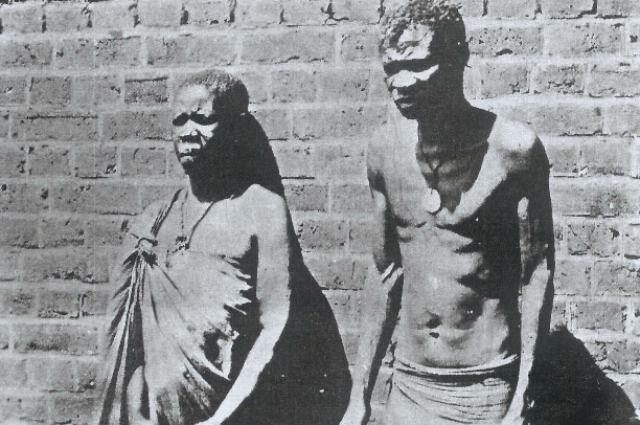
“My bones will rise again.” - Nehanda, hours before her execution in Harare
Before Zimbabwe, there was Rhodesia, a tourist attraction for Britishers by Britishers. Uncovering the layers of English reverie and mineral wealth lay the real story of an indigenous population whose lives, land, and dignity were stolen by their imperial rulers. Among these were the Shona people, a community deeply rooted in spirituality, art, and music. The Britishers did not know what was coming.
The Shona people were subjected to heavy taxation, forced labour, and violent suppression. They had had enough of this oppression. Their connection to the spiritual ancestors was a motivator for a revolutionary struggle for freedom. And at the heart of this struggle stood a woman whose voice, courage, and spiritual powers would echo beyond Africa: Mbuya Nehanda Charwe Nyakasikana.
It Starts With Her: The Brewing of a Rebellion
Rhodesia (now, Zimbabwe) was a land rich in sculptural traditions, oral storytelling, and dance. However, the British Empire was attracted to the most attractive of materials: gold and platinum. Establishing their colonies there, they grabbed the cattle and the land of the natives.
The arrival of the British South African Company (BSAC) in 1890 marked the start of aggressive colonial expansion. The company had the power to dispossess the natives of their cattle and land, and imposed heavy taxation and forced labour onto the Shona and Ndebele people. These harsh measures sparked the beginning of a rebellion.
The First Chimurenga, known in Shona as the first “revolutionary struggle” against the colonisers, was a battle of spirits versus colonial bodies. Among the spiritual leaders who fought this resistance, Nehanda stood out as the bravest.
The Lioness of the Shona
Born in 1863, Mbuya Nehanda was already revered as a svikiro, a medium who communicated with the spirits of her ancestors. During the 1880s, she was believed to be possessed by the Nehanda spirit, granting her strength, fearlessness, and divine clarity, like a lion. From then on, the term “Nehanda” was placed in her name in honour of her spiritual identity.
Through the Nehanda spirit, she elevated from village medium to a model of leadership for women. Nehanda’s voice could mobilise entire communities. His leadership skills were apparent when she made decisions on when to fight and how to resist their imperial masters. Together with Sekuru Kaguvi, another respected medium and freedom fighter, she led the First Chimurenga in 1896 and fought against the British.
This is a unique scenario. A woman leading a revolution, especially in Africa, is unheard of. In a world where patriarchy reigns supreme, Nehanda comes across as an African feminist in many ways than one. She was a brave woman who had a no-nonsense stance against the British and fought a rebellion through her leadership skills.
The Passion of Nehanda
Unfortunately, in 1897, British forces ultimately suppressed the African resistance, and the First Chimurenga came to an end. Nehanda was captured and charged with the killing of Native Commissioner Henry Hawkins Pollard, and was executed. Even before death, she rebelled. When they forced her to convert to Christianity, she refused and stood by her ancestral traditions.
On the day of her execution, she vowed that her soul would return to organise a second rebellion against the British forces. And, she was right.
In 1964, the Second Chimurenga, known famously as the Zimbabwe War of Independence, was fought between the coloniser and the colonised forces. Fighters spoke her name in camps, and she was invoked in speeches, songs, and rituals. It was her contribution that led to the war of independence, which saw the renaming of Rhodesia as Zimbabwe in 1979. It was an independent state emerging from decades of domination. Truly, Nehanda’s appeal for freedom was accomplished, thanks to the determination of those who fought long after her execution.
The Legacy of Nehanda
Today, Nehanda is celebrated as an icon of African resistance and the beginning of African feminism. The Shona honorific term “Mbuya,” meaning grandmother, reflects her wisdom and strength that continues to resonate with future generations of feminism.
In 2021, a statue of her stands tall in Harare, stern and honourable. Her statue and her history are a reminder that the first rebellion against the British was fought not by kings but by a woman whose only weapons were her ancestral spirit and unwavering courage.
Her legacy inspires African feminists, liberation movements, and anyone who seeks strength in ancestry. When one speaks her name, one is reminded of the power that comes from bravery, not from guns or politics. Her refusal to surrender her spirit is what we need in a world that silences us.
As an Indian student who has absorbed the perspectives of not only Indian feminist writers but also Western feminist thought, hearing Nehanda’s story was a breath of fresh air. It opened my eyes to an African feminism that was neither covered in academic textbooks nor considered in mainstream feminist discussions. The fact that she led a resistance against British colonial rule is admirable. In the future, I hope to learn about a new feminist from a different background and nationality every day.
. . .
References: