
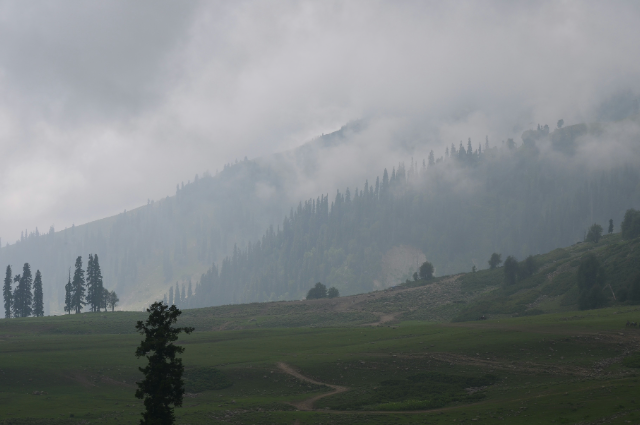
“There are wounds that never show on the body that are deeper and more hurtful than anything that bleeds.” - Laurell J. Hamilton.
Trauma is a memory or an experience that evokes pain, sorrow, and ignorance in the minds of people. It is a wound that spreads like a disease. It fractures families, ripples through communities, and passes from one generation to another. People inherit these memories filled with fear, silence, shame, violence, and the consequences of historical violence that impacted their people before them.
But there is a question nobody rarely asks: whose trauma is it to tell?
This question is widely debated and contested in literary circles dealing with memory and trauma. For example, Urvashi Butalia’s The Other Side of Silence: Voices from the Partition of India, focuses on the narrative trauma of women and children who suffered the worst of the Partition of India and Pakistan during 1947.
Their trauma was immediate and raw, but when it comes to recording these stories, whether by an interviewer, writer, or memoirist, a second layer is created. Who receives the trauma then? Is it the speaker? The writer? The reader? Or the future generation of trauma inheritors? And even more crucially: who is entitled to narrate it publicly?
This question lies at the center of the concept of sensitivity reading in memoir publishing. Sensitivity readers are ethical individuals whose job is to ask what the writer might not ask themselves, especially when the memoir touches upon elements of personal suffering with the suffering of communities, cultures, and nations.
One such memoir is Basharat Peer’s Curfewed Night, a memoir that explores the underrepresented, collective trauma of Kashmiris living amid militancy, constant surveillance, and uncertainty.
Peer’s Memoir as an Archive of Shared Trauma
The definition of a memoir, according to Oxford Languages, is “a historical account or biography written from personal experience.” It appears simple for a genre yet branches out into topics that demand ethical discretion: that of the personal and of the communal.
Peer’s memoir underscores this tension. Born and raised in Kashmir at a time when militancy and tension were at their height in the 80s and 90s, he witnessed militants brandishing guns, shouting anti-India slogans, and recruiting young boys under the banner of liberation. He hears gunshots near his home, notices his neighbors disappear overnight, and internalizes fear at an age when most children worry about homework and attendance.
His memoir, like Satrapi’s Persepolis, blends childhood innocence with the brutality of a state in turmoil. Peer narrates trauma through his experiences in Kashmir, and includes the stories of parents who lost their sons to the allure of joining arms training in Pakistan-occupied Kashmir (POK), the young men tortured in Papa-2 (the infamous interrogation center), and the hundreds of Kashmiri Pandits forced into exile. This trauma also belongs to the Kashmiris frisked at every checkpoint, living each day under the surveillance of two opposing entities: the militants and the Indian government.
Returning to the question: whose trauma is being documented, and whose voice is the loudest and most effective?
Who Gets to Speak?
Gayatri Spivak, a postcolonial theorist, posits the question: “Can the Subaltern Speak?” But most importantly, can the subaltern choose not to be spoken for?
Peer is a Kashmiri Muslim, a witness to the conflict of Kashmir. One could say that he has firsthand experience of the turmoil of his homeland, but he is also a reporter, educated in Delhi. A journalist uses bias and hype to shape the narrative. His interviewees: fathers who lost sons, widows of militants, and young men who sought militant training, do not share this privilege. Their trauma is merely filtered through his interpretation, which may prove to be untrue.
A sensitivity reader, examining such a memoir, would ask:
Did these interviewees consent fully, or were they pressured by social norms, grief, or the presence of a journalist?
Do the people speaking have the same ability to challenge or correct how they are portrayed?
The memoirist has the freedom to speak, to publish a work that outlines the trauma of both sides, from personal to collective. However, the difference lies in when the concept of ethicality becomes discernible.
Takeaways from a Traumatic Memoir
Peer ends his memoir with a hope that Kashmir will return to its former beauty and peace. However, events like the Pulwama attack in 2019 and the Pahalgam attack in 2024 show that turbulence still prevails. History keeps repeating itself, and trauma never stops spreading.
Can a memoir truly speak for a trauma that is still ongoing? Sensitivity readers today argue that representing ongoing conflict means acknowledging how incomplete and unresolved it really is. No memoir can claim to deliver a truth that is completely final or vulnerable.
I repeat: whose trauma is it?
Is it Peer’s? Yes.
Is it Kashmir’s? Definitely.
Is it the collective trauma of families, the former militants, and the citizens of Kashmir? Absolutely.
But this is where it gets complicated: no one person can claim full authority over the transmission of trauma in narratives.
Readers, when engaging with such sensitive works, must remind memoirists that while trauma transcends societies and cultures, it cannot be used freely to serve the writer’s personal interests or bias. When writing about conflict, they must remain unbiased and avoid a sense of entitlement over another person’s experience. He must create space for trauma to be acknowledged within literary circles.
All in all, in the realm of memoirs discussing the sensitive topic of trauma, one must write with empathy for the bereaved and with genuine care for those who endured turbulence after turbulence.
References:
- Peer, Basharat. Curfewed Night. Random House, 2009.
- Neogi, Soumyadeep, and Anil Kumar Aneja. Curfewed Night and the Emergence of Kashmiri Anglophone Resistance Literature. Zotero.