
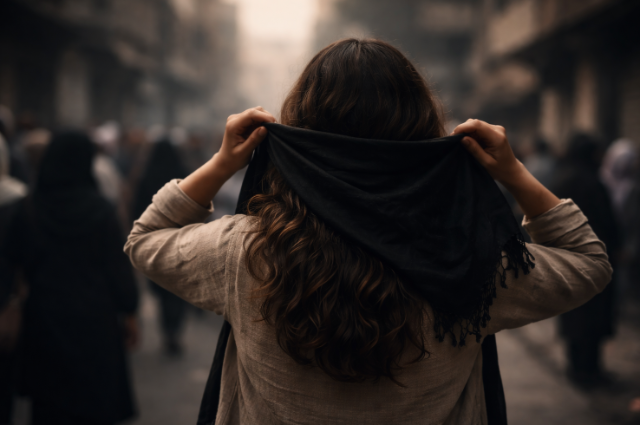
Have you ever read Persepolis?
It is a graphic novel that tells the real-life story of Marjane Satrapi as she observes the impact of the Islamic Revolution in Iran. Brimming with humour and tension, Satrapi sets a narrative that goes beyond Eurocentrism and portrays the reality of women who are forced to subject themselves to religious standards imposed by the government.
As we approach the new year, the graphic novel (released in 2000) remains as relevant as it was when it was released decades ago.
The story starts with Marjane and his classmates wearing veils. This phenomenon occurred during the Islamic Revolution of 1979, when rebels overthrew the Shah's regime and the revolutionary leader Ayatollah Ruhollah Khomeini became the Supreme Leader of Iran.
Marjane was 10 when her French non-religious school in Tehran made wearing the veil compulsory. Boys and girls used to co-exist together, but she was soon separated from her male friends in the name of what the leaders called the Cultural Revolution. They were of the notion that bilingual schools contradicted Islamic law.
Demonstrations occurred between those who supported the veil and those who didn't. Marjane's mother was the latter, donning sunglasses and casual clothes. It would soon impede her ability as a supportive feminist protester.
Let's look into the timeline of the Islamic Revolution and how it has impacted the lives of women over the years.
The Life of an Iranian Person
According to CNN, the average age of protesters arrested for demonstrating in Iran is 15. As many as young as 16 have reportedly been killed by Iranian security forces.
Iran is a turbulent country with a long history of protests over a variety of issues. From the Islamic Revolution of 1979 to the burning of hijabs to protest against the untimely demise of Mahsa Amini.
By the time the Islamic Revolution of 1979 occurred, women's protests exploded within a week, with thousands marching in Tehran to oppose the Supreme Leader Khomeini's law that required every woman to wear the veil or hijab.
It included the ban on alcohol, the separation of boys and girls in universities, schools, pools and beaches. Music was completely banned from the radio and television. Satrapi, in one moment, strolls into a town where hooded men call out names of singers and sell pirated cassettes because music itself was considered blasphemy. The women were met with threats, as well as pro-state mobs who attacked them with sticks and stones.
After numerous protests against media censorship in 1999, rising fuel prices, environmental concerns, and internet blackouts, we move towards the protests that occurred as a result of Mahsa Amini’s death.
Mahsa Amini and the Protests
Mahsa Amini (1999-2022) aspired to become a doctor after completing her diploma in high school. According to her father, she was a reserved resident of her hometown and was never politically aligned as a teenager, nor an activist. To those who knew her well, she did not follow the news, had few friends, and mostly socialised with her relatives.
Her father works as an employee in a government organisation, while her mother works as a homemaker. Amini had a cousin, a left-wing political activist who belonged to the Komala party and a Peshmerga fighter living in self-exile in Iraqi Kurdistan. He was the first family member to speak to the media after her death.
So what triggered the death of Amini?
According to sources, there were many instances where Amini never wore the hijab, especially in weddings where she wore traditional Kurdish clothes. She sometimes observed hijab when travelling to tourist areas, and even in some instances, improperly. It was this issue that caused the morality police officers to arrest her and beat her.
After her brutal treatment in custody, it triggered a revolutionary protest where women and girls took off their hijabs and fought against the injustices imposed on women.
She was reportedly beaten in a police van after her arrest. When she arrived at the police station, she began to lose her vision and fainted. They called for an ambulance, which came late by 30 minutes, and it took over an hour and a half to reach the hospital. The police claimed she suffered “a sudden heart failure.”
She was in a coma for two days. On 16 September, she breathed her last. The problem was: how did she die? Some reports suggested that she was brain-dead; others reported bruises on her head, legs, and eyes. Even there, the Iranian authorities continued twisting the narrative without reaching a clear conclusion.
In a report released on 8 March 2024, the United Nations Human Rights Council concluded that Amini's death was caused by physical violence she suffered while in morality police custody. Iran was found responsible for her death and was accused of attempting to hide the truth and intimidate Amini’s family rather than conduct a thorough and unbiased investigation.
Protests and civil unrest would engulf Tehran on 16 September 2022 following the announcement of Amini's death. To be arrested and beaten for wearing the hijab "improperly" was a disgrace to the struggles women faced in Iran.
Many eyewitnesses claimed that she was severely beaten by Guidance Patrol officers, which was denied by the authorities. The government later implemented region-wide internet blackouts with restrictions on social media use.
On her gravestone lies the Kurdish epitaph, translated into English: "Beloved Jina, you will not die. Your name will become a symbol."
Approximately 190 people were killed while fighting against the tyrannies of the Iranian Republic, as tear gas and live rounds were fired at protesters. Several were arrested, sprayed with pepper spray, while chanting slogans like "death to the dictator" and "woman, life, and freedom."
The Severe Case of Narges Mohammadi
Narges Mohammadi is an Iranian human rights activist who won the Nobel Peace Prize in 2023 “for her fight against the oppression of women in Iran and her fight to promote human rights and freedom for all.” She was endowed with this award following years of protests and continuous imprisonment from 1998 to 2025 by Iranian authorities for speaking out against mandatory hijab laws.
Even after losing a part of a bone in her right leg due to cancer, she remains at risk. She was arrested yet again arrested on December 12, 2025, even as the Nobel Committee pleaded with Iran to release her.
It is disappointing that despite receiving the Nobel Peace Prize and international acclaim, no immunity or protection has been provided for her well-being, as cancer and imprisonment continue to threaten her life.
The Islamic Revolution of 1979 changed the way Iran interpreted women. From the mandatory law of wearing hijab for women to the hundreds of protests across the country that took the world by storm, women have continued to resist.
Protesters sacrifice their lives for a better future, while international authorities observe and criticise Iran’s countless human rights violations without reaching out a hand to those who are dying for a country that remains rigid in its laws.
References:
- https://www.euronews.com
- https://www.aljazeera.com
- https://en.wikipedia.org
- https://en.wikipedia.org
- https://edition.cnn.com