
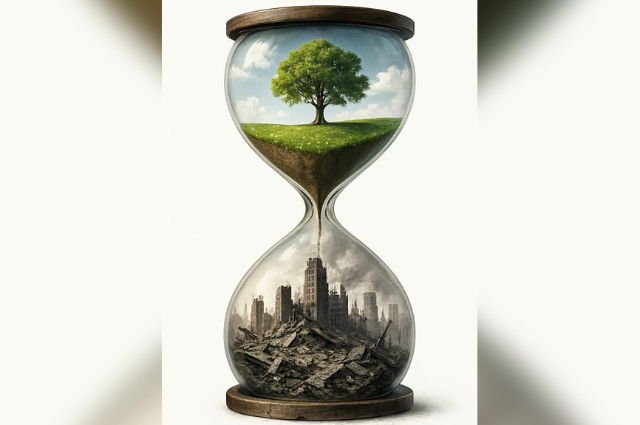
Nature is stable, but fickle too
It is benevolent but cruel too
It is symbol of peace but-
Of dread too!
- My teacher, Madan Mohan sir
Life on Earth is thought to have begun with a solitary cell deep in the oceans 3.5 billion years ago, and from that single cell, life has evolved on this planet. How beautiful it is! When the sun rises, sunlight touches the leaves, flowers and grass. The sweet wind and warm sunlight blend into one another. Birds are chirping in the bright sky. Everything is swaying in nature. I'm in the union territory of India, visiting a historical tourist spot: Jantar Mantar, which is an 18th-century astronomical observatory built by Maharaja Jai Singh-Ⅱ of Jaipur in 1724. The harmony between the monument and the environment here makes it fascinating in itself. Alas! Tourists are capturing their photos and are too curious to post them on social media. There is a group of uncles, one of them is smoking, someone is plucking grass in overthinking, and some are busy finding fault with the government. People demand rights, but the same ones will turn away when it's time for duties. A lot of scratches are on the tree's trunk and on the walls, done by shameless people. Some are with their umbrellas for protection from the sunlight. Truth is: nature needs protection from human beings.
As the foundation of life, nature is everything part of it. It is vast, infact too vast, whereas humans are like an ant in front of it. knowing 1% of nature and considering oneself a genius, that is stupidity. This is what humans do! We have to stop, just stop, sit straight with silence and try to feel peace by placing your head on the lap of nature.
THE ORIGIN OF HUMAN AND THE TRANSFORMATION OF NATURE
The development and transformation of anything happen sequentially. The earliest known member of the genus, anamensis, existed in eastern Africa around 4.2 million years ago and was Australopithecus, employing a combination of bipedal walking, tree climbing, and social cooperation. Homo habilis survival strategies focused on fraging and scavenging in the African savanna, whereas Homo erectus developed several key including stone tools, a diet rich in meat and protein and start cooking food. They depended on nature and were afraid of it. 400k to 40K years ago, Homo neanderthalesis wеre highly skilled specialised hunters of large animals like the Mammoth. Modern Human: Homosapiens began to emerge in Africa between 200k and 300k years ago. And they started migrating out of Africa. The key to survival changes time to time, like food storage, hunting, then agriculture and animal husbandry. In the morden world history, in the 18th Century, Industrialisation was at its peak, where the economy shifted from agriculture to one based on manufacturing and other industries. The colonisation, wars [1914-18, 1939-45], incident of Hiroshima - Nagasaki. The whole world was very busy with modernisation. Nature was badly neglected. Time went on....
Possibilism countered environmental determinism. In ancient times, humans listened the nature and worshipped it. The neuron system was developing. Humans started to understand science and developed observation Capability. Now, Humans are so advanced with their technologies such as AI, robotics, biotech, 5G, quantum and spatial computing, digital currency innovations, nuclear power-etc. Man can do anything for his own needs.
THE RISING TEMPERATURES
The world's leading scientists agree that human actions are causing the Earth to get warmer. Through our use of oil, coal, and gas to supply the world's energy, we are increasing the heat-trapping gases in our atmosphere so raising our planet's temperature. Temperatures have increased by 1.1°C since the pre-industrial era in Europe, and the warmest year in the record was 2022, whereas Asia has warmed by 1.2°C, with the Arctic region warming at a rate nearly four times faster than the global average. North and South America have warmed by 1.0°C, Africa and Australia: 1.2°C, 1.1°C. Antarctica has warmed by 0.5°c with significant ice sheet melting contributing to sea level rise. Globally, the average has increased by 1°C since the Pre-Industrial era with 2024 being the hottest year on record.
CARBON EMISSIONS
On earth carbon is everywhere we look and is one of the basic building blocks of life about 760 Billion tonnes are combined with oxygen as CO2 in our atmosphere, and over 2000 billion tonnes are stored in trees. vegetation and soil and almost 40k Billion tonnes are stored in the world's ocean. Carbon is constantly exchange from lands-to oceans, from oceans to land and atmosphere, moving each way every year in the natural Carbon Cycle.
Before human activities become a significant disturbance and over periods short compared with geological timescales, the exchanges between the reservoirs were remarkable constant. The industrial revolution disturbed this balance and since its beginning over 600 thousand million tonnes of Carbon have been emitted into the atmostphere from fossil fuel burning.
2024 seeing a record high of 40.8 billion metrics ton increase from 2023. The top emitters are china (32.88% of global emissions),united states (12.60%), russia (4.96%), india ( 6.99%), and Japan (2.81%). It rose will 0.3% Annual growth rate over the past decade.
IPCC (Intergovernmental Panel on Climate Change) in its 6th assessment report indicates that to keep warming 1.5°C, global carbon emissions must be reduced by 48% from 2019 levels by 2030, and net zero emissions must be reached by 2050.
CLIMATE CHANGE
Preventing catastrophic and irreversible damage to the global climate requires a major de-carbonization of the world energy sources.... Securing energy supplies and speeding up the transition to a low carbon energy system both call for radical actions by the goverment
-Would Energy Outlook
[OCED/ International energy Agency 2008)
As our climate changes it is affecting the natural world, causing ice melt, sea level rise and ecosystem loss. As temperature continue to increase , chaotic and unpredictable impacts cascade across the globe, causing potentially rapid and irreversible. Climate change is intensifying heatwaves, drought, heavy rainfall, leading natural disasters. more frequent and severe natural disasters.
Since the 1970's windstorm disasters have increased three-fold, drought disasters have increased five fold, flood disasters have increased six fold and the number of people affected by natural disasters has tripled to an ordinary 280 million people a year.
ECOSYSTEM
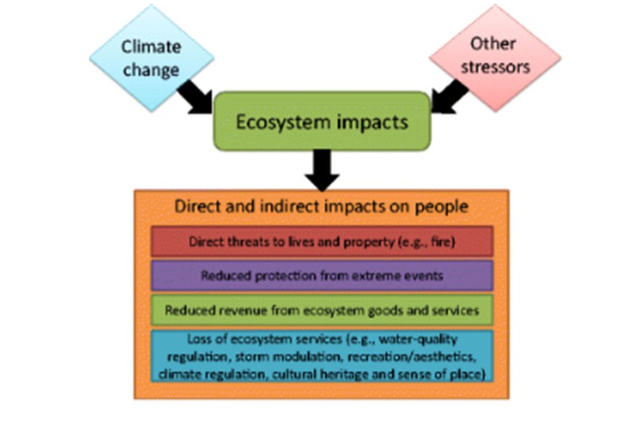
Climate change is having a profound impact on eco system worldwide, effects on changing precipitation Patterns ( shifts rainfall and drought patterns, ENSO], shifts in species distribution, distrupted migration pattern etc. Coral bleaching, polar ice melt and drought-impacted forests are the main effected region. Ecosystem gives services such as bio diversity, which provides services like air and water filtration, soil formation and climate regulation. But it is collapsing, disease risk is increasing, soil degradation, decreased water quality,
Coral reef ( great barrier reef, Caribbean reefs, indian ocean reefs) loss affects tourism, recreation and coastal Economy.
THE DEVELOPING COUNTRIES
The effects of climate change are expected to be greatest in the developing countries in term of loss of life and relative effects on investment and the economy...Those with the least resources have the least capacity to adapt and are the most vulnerable.
-IPCC (2001) on the 3rd report
Climate change will increasingly overwhelm efforts to make poverty history by making the lives of those in the developing countries largely much worse. it will increase heat-stress, disease and disasters. Those that are the most vulnerable will suffer the most, even though they are the least responsible.
The next war in the world will be fought over water not politics" The impacts of climate change, combined with population growth and political or social unrest, could lead to national and cross-border conflicts, particularly concerning water scarcity. West africa, central asia, in indie (Sindhu and ganga river conflicts) etc.. region are all potential risk zones.
The Australian geographer: Griphit Taylor gave a concept of neo-determinism ( stop and go theory ), highlighting to take care of nature, otherwise it will come in its terrible form and can ruin the whole world, the whole civilisation. when we don't see the red light of traffic Signal and become victim of accident, it is like that.
SOLUTION
In the past we didn't understand the effects of our actions - unknowingly we sowed the wind and now literally we are reaping the whirlwind - but we no longer have that excuse - now we do recognise the consequences of our behavior - now Surely we must act to reform it - Individually, Collectively, nationally, internationally before we dorm future generations to catastrophe
-Sir David Attenborough
Humanity is dependent on the natural world and the world's climate is fundamental to our life support. we all need food, water, shelter bearable temperature without there basics we will flounder. If humanity continues on its current path, our world will be irretrievably altered this century
If it occurs, there will be nothing we can do to STOP IT!