
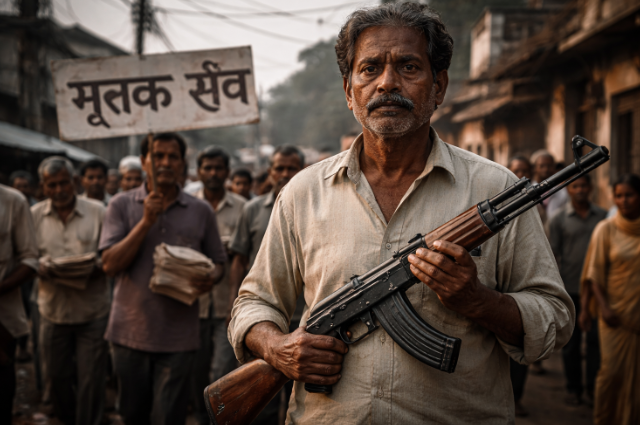
The name Lal Bihari “Mritak” is a name that is more of a dark comedy actor than a real-life person, but his tale is one of the most unusual court cases in the history of India. Lal Bihari was born in Azamgarh in Uttar Pradesh and was a notorious person who, at a time when he was living, was declared dead by a judge, and this declaration was the most shocking betrayal he had ever betrayed his life, and this was going to be the starting point of a long journey to prove his existence. The movement that began as an individual fight has now become bigger, with the absurdity of bureaucracy, exploitation of the weak, and the growing threat of crimes of identity on the Internet in India.
It starts in 1975, when a 20-year-old weaver called Lal Bihari requested a bank loan. The bank declined his application in a terrifying explanation, too: You are dead. This was not a clerical error. The uncle of Lal Bihari had bribed one of the local government land officials, known as Lekhpal, a paltry 300 rupees to make it appear that he was dead in the books. The reason was rather simple and ruthless, as by declaring Lal Bihari dead, the uncle was actually entitled to lawfully inherit the ancestral land of the family, an acre worth of valuable farmland. The young weaver was now trapped in a Kafkaesque nightmare as he was technically dead but very much alive.
What ensued was a 19-year battle that would exercise his ingenuity and patience. Lal Bihari understood quite early that he could not merely go to court because there was no systemic motivation to recognise the living when the official documents claimed that an individual was dead. He had to be able to stand out. His ways were unusual, even daring. He stole his personal cousin-son of the uncle that has robbed him of his land in the hope that the police would receive a message that a living being exists. However, there is a dark comedy element in the refusal by the police to do anything about it because they could not kill a corpse.
The stunts of Lal Bihari were increasing. He conducted mock funerals all over Azamgarh, requiring the government to bury him in case he was really dead. He even made his wife apply for a Widow's Pension, which they refused as he stood there. His denials became evidence of life, since he insisted it be written down on record. This was not all his creativity, as he even challenged elections against two Prime Ministers, Rajiv Gandhi in 1989 and V.P. Singh, aware that he would not succeed. Filing nomination papers, he compelled the Election Commission to give him the status of a living candidate.
This feeling of never being believed inspired Lal Bihari to issue a brash statement: He added the suffix “Mritak meaning deceased, to his proper name. After that, he started to sign with the name of letters of the protest against the system, which had denied his existence: Late Lal Bihari Mritak. His tenacity proved to be rewarded in 1994. Six months and 23 days after 19 years, a District Magistrate in government books formally pronounced him alive. He might have instantly reinstated his land, but Lal Bihari spared his uncle, saying that the struggle provided him with another reason other than property.
That aim was in the form of Mritak Sangh, which was an association of people who had been declared dead on paper. The group has today more than 20,000 members in India. The problematic nature of their joint predicament involves the fact that there is something wrong with the system: the government is filled with people who are poor leaders and unscrupulous members of their families who use the loopholes in the law to defraud and take away their possessions. Lal Bihari was awarded in 2003 with the Ig Nobel Peace Prize due to his prolific post-mortem activism, though he was not allowed to travel to the U.S. to receive the award, because by law, he was dead.
Rewind to 2026, and the narrative has assumed a different approach, which is more modern. The introduction of the Digital Personal Data Protection (DPDP) Act and the updates to the Aadhaar system in India that are connected to AI have increased the complexity of paper deaths. The emergence of digital identity theft provides a new threat to vulnerable citizens, however. Lal Bihari, who is now in his seventies, has hit the headlines once more demanding a license to carry an AK-47. His logic is just as unusual as it is frightening: Living humans have acquired the right to carry revolvers, but the dead people require something to defend themselves against the mafia of the land. This demand emphasises the issues of personal security and property rights that continue to worry people many decades after they had first fought them.
Lal Bihari Mritak is not merely a law oddity story. It is a warning story of bureaucracy, corruption and sacrifices that people go through to defend their rights. It is also indicative of the increasing overlap between conventional legal fights and new technology. The threat of fraudulent claims, be it to land, pensions or social benefits, is also an actual threat as government databases become digital and AI systems are used to verify identity. This is why the demand for the AK-47 by Lal Bihari is rather controversial, yet it is a call to be secure in the world when even the living can be insecure because of paperwork and digital systems.
Lal Bihari is not just an Indian legacy. His case has brought about debates even in law schools, debate forums on governance, and in international conferences on identity rights. It shows how common people can do the same with perseverance, ingenuity and boldness to correct inefficiencies within the system. In addition to that, it brings out the human cost of bureaucratic indifference as a reminder that a mere line on paper can radically change life.
Finally, the story of Lal Bihari Mritak, who grows up a national icon of resistance after being a dead man, demonstrates the absurdity and the interests behind identity management in India. Through mock funerals to petitioning courts, nominating to the election and 1 lastly, through establishing a nationwide association, he turned his own tragedy into a collective action. In 2026, the call to AK-47s might appear outrageous, but it is more of a reflection of the reality that when systems fail, citizens will be compelled to struggle to gain recognition, safety, and dignity in ways that they never intended to. The story of Lal Bihari is as weird as it is, and yet, it makes one remember that official death should not be the end of being powerless.
. . .
References:
- Lal Bihari “Mritak.” Wikipedia. Available at: https://en.wikipedia.org
- Ig Nobel Prize. “Peace Prize Winners 2003.” Improbable Research. Available at: https://www.improbable.com
- Times of India. “Sons hire hitmen to murder ex-IAF officer.” The Times of India, January 2, 2026. Available at: https://timesofindia.indiatimes.com
- Kerala Snakebite Murder Case. Wikipedia. Available at: https://en.wikipedia.or
- Aircraft Act, 1934. Ministry of Civil Aviation, Government of India. Available at: https://legislative.gov.in
- Sarais Act, 1867. India Code. Available at: https://www.indiacode.nic.in