
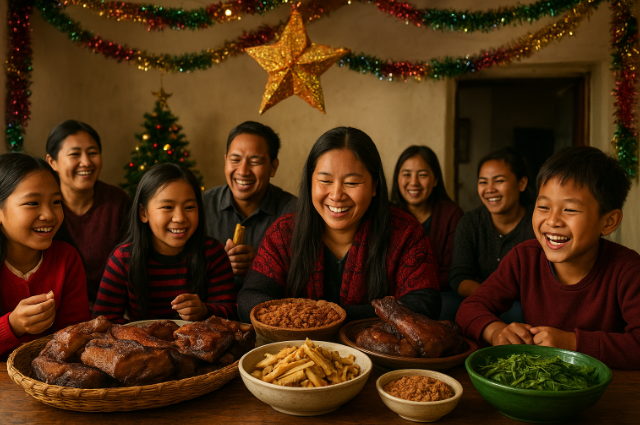
The rumour that Nagalanders consume their pets during Christmas is a myth that has gone rampant because of cultural misconceptions, stereotyping, and viral misinformation. When outsiders, who are not part of the area, learn about the variety of available food options of the Indigenous people in Northeast India, they often stereotype or over-romanticize such practices, not realizing the cultural background of the practices. This has made many believe that Nagas feast on their pets, on a regular basis, and at Christmas time, particularly something that is not true at all.
Nagaland boasts of a distinctive and multicultural food culture, the history of which dates back centuries and has been influenced by the ways of life of the various tribes. The Naga people in the past used to eat meat that is not common in the Indian mainstream culture, including dog meat, cat meat, frogs, and insects, among the wild animals. These were the activities involved in the Indigenous cuisine, and in many cases, they had certain cultural connotations. It should be noted, though, that these animals were never viewed as pets in the emotional/domestic context that we see in city households today. The dogs used in the past were either domesticated as food or hunting dogs, not as pets. This may pose a problem to outsiders who may not draw the line between the two in a cultural context where the sources of food animals and pets may be different.
Culinary habits of most Naga families have changed over the years due to modernization, education, Christianity, as well as Western influence. The younger generations do not eat a lot of dog meat today, and increasing numbers of Naga families keep dogs as pets, like other people in the world. The old cliché that Nagas eat their pets without thinking is not only not up to date, but also highly deceptive. Most Naga young people are irritated or even angry at having foreigners presume that their pet dogs or cats are being eaten, particularly during festivals.
Christmas in Nagaland is among the most significant holidays of the year. The celebration is celebrated with a lot of joy, devotion, and community spirit, given that over 85 percent of the population is Christian. The midnight church services, the caroling of houses in youth groups, the exchanging of gifts and food among communities, and the whole village as one are just some of the ways people celebrate the birth of Christ. The feast is an intrinsic element of the celebration, though the primary dish of the festivity is pork and, in particular, smoked pork with bamboo shoots, fermented soybean (axone), or local herbs. Christmas meals in the state revolve around pork as opposed to dog meat and other strange forms of meat, which the outside world is accustomed to associating with the region.
The lack of understanding about the culture and the lack of historical evidence supporting the claim that Nagas exclusively consume their pets on Christmas probably stems from the combination of cultural ignorance and colonialistic mythology. The early anthropologists and colonial officers tended to blow out of proportion the Indigenous traditions so that they sounded exotic or shocking. Their works were used as the foundations of numerous stereotypes that exist to date. Gradually, rather than distinguishing between traditional food culture and the culture of the festival, people started to repeat a single story, written down and simplified: Nagas eat dogs. This story later fused with the concept of Christmas eating among a largely Christian community, resulting in the present myth about the eating of pets at the time of the holiday.
Racial stereotyping has also played a great role in this misconception. Indians of the Northeast are subject to rude remarks regarding their cuisine, language, and looks. Inquiring about a Naga individual about the Christmas eating of pets indicates not only a lack of knowledge, but also a lack of concern and approval towards Indigenous cultures. Such questions are offensive to many Nagas as they do downplay their rich heritage to one disturbing stereotype. In addition to this, social media has increased out-of-context sensational claims. One viral post or meme can transform a cultural tradition into a rumor that is twisted and that propagates much further than the source.
The other reason behind the confusion is the different definitions of what constitutes a pet as defined in different cultures. Among the Indigenous people, animals are classified into three types according to their purpose: working animals, food animals, and some household companions in a few communities. The dogs raised to hunt or to be eaten in earlier times were not the pets that we take to be pets. When the outsiders are presented with images of dogs in Naga households, they might think that every dog is a pet, but the cultural difference between pet and livestock is not the same. It is easy to have misinformation grow because of this gap in perception.
The topic has also been in the limelight due to legal developments in recent years. In 2020, the government of Nagaland decided to prohibit the commercial importation of dogs, trading, and sales of dogs and dog meat. Animal rights organisations rejoiced at the move, but the move was perceived by many individuals in the state as an encroachment on cultural independence. In 2023, the Gauhati High Court reversed the ban, citing that it contravened the constitutional provisions on culture and food preferences. Although such debates attracted national attention, they still did not have anything to do with Christmas traditions. Rather, they are indicative of larger debates in terms of cultural identity, modernization, and the entitlements of Indigenous people to maintain their culinary traditions.
The fact is still straightforward: Christmas in Nagaland does not have a cultural connection with eating pets or eating dog meat. The festival is observed with strong religious faith, family reunions, and community feasts that are based on pork and other festival meals. There is a myth circulated around that Nagas feed on their pets at Christmas due to ignorance and poor comprehension of their culture. Not only does it disseminate fake news, but it also supports the negative stereotypes about a place of tradition, hospitality, and diversity.
It is crucial to learn the cultural context before coming up with assumptions about any community. A country such as India is diverse, and the countries have different traditions, food preferences, and cultural practices. Instead of listening to viral statements or stereotypes that were made many years ago, it is more significant to hear people belonging to the community itself and find true information. By doing that, it allows the myths, such as the one about Nagas eating their pets on Christmas, to melt away in favor of a respectful and knowledgeable view of their culture.
REFERENCES:
- Aier, A. (2019). Culture and Food Practices among the Naga Tribes of Northeast India. Journal of Tribal Studies, 12(2), 45–58.
- Ao, A. (2015). Christianity and Cultural Transformation in Nagaland. Eastern Theological Review, 28(1), 77–90.
- Baruah, S. (2020). “Nagaland Bans Commercial Trade of Dog Meat.” The Hindu.
- Gaukein, R. (2023). “Gauhati High Court Quashes Nagaland Dog Meat Ban.” The Indian Express.
- Hazarika, S. (2018). Rites, Rituals, and Food Traditions in Northeast India. Guwahati: North Eastern Heritage Press.
- Kikon, D. (2017). Experiences of Identity and Stereotyping among Naga Youth in India. Contemporary South Asia, 25(3), 289–303.
- Murry, V. (2021). “Christmas Celebrations among Naga Communities: A Cultural Study.” Asian Journal of Cultural Studies, 9(1), 15–28.
- Thong, T. (2012). Anthropology and the Politics of Representation in the Naga Hills. Social Anthropological Review, 20(4), 110–130.