
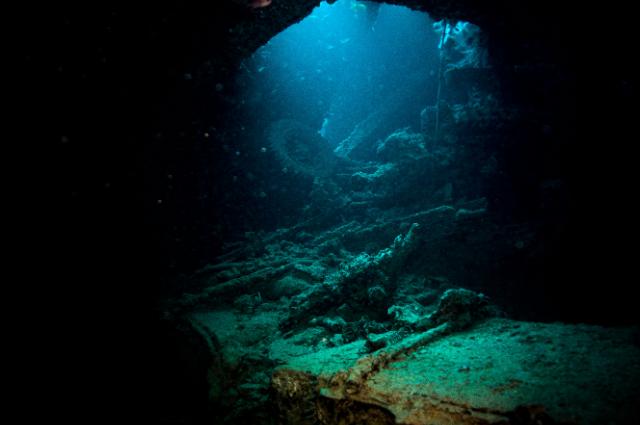
Light fades below the surface of the ocean more than 200 metres down. At depths of over 1,000m, the ocean becomes a place of perpetual darkness: the deep sea. The abyssal zone extends from 3,000-6,000 metres below sea level and is one of the most extreme environments on Earth. The temperature is just above freezing, the pressure may be as high as 600 times that at sea level, and the sunlight does not reach these waters. But even in these extreme circumstances, death does not reign in the abyss. Researchers have discovered fertile ecosystems that contradict the notion of how life lives and evolves.
Life Without Sunlight
For a long time, it was thought that the sun was essential to all life. Photosynthesis is the process by which plants transform energy from the sun into food and is the basis of most food chains. But in 1977, hydrothermal vents were found and changed this thinking. These vents are found on the seafloor along tectonic plate boundaries and discharge superheated, mineral-laden fluids into the ocean.
In this area, the researchers discovered groups of organisms that live completely without the light of the sun. Chemosynthesis is the only way microorganisms get energy, as opposed to photosynthesis, which is the process that has been adopted by the ecosystem. These microorganisms are the foundation of a distinctive food chain that enables larger life forms like giant tube worms, clams, shrimp and crabs to survive. This finding showed that life is capable of thriving without light energy in the presence of chemical energy, furthering the understanding of the boundaries of life's survival.
The Oases of the Deep – Hydrothermal Vents.
The hydrothermal vents are called ‘underwater oases' because they host a remarkable life in comparison to the surrounding abyssal plain. Very little life lives in the deep ocean, but vent communities are very densely populated. There are giant tube worms, some over two metres long with no mouths or digestive systems. Rather, they harbour commensal bacteria in their body tissue. They are chemosynthetic and autotrophic, supplying the hosts with nutrients.
One fascinating example is the vent systems found along the East Pacific Rise. In this case, thousands of organisms gather around the black smoker vents to form ecosystems that are as productive as some shallow-water environments. Scientists believe that the communities of microorganisms living around the vents are important factors in the deep-sea carbon cycle and help to regulate the flow of carbon in the ocean ecosystems.
Nature's Ingenious Modifications for Survival in the Severest Conditions.
In the abyss, some beings seem to be from another world. Numerous species have developed special characteristics to deal with crushing pressure, darkness and food scarcity. The anglerfish uses a bioluminescent lure hanging from its head to lure its prey, for example. This natural light that is produced by chemical reactions in special organs.
Bioluminescence is also used as a communication, camouflage, or defence mechanism for other deep-sea creatures. It has been suggested that over 75 percent of deep-sea organisms could have some kind of bioluminescence. The vampire squid lives in ‘low oxygen conditions where many animals would not s and some shrimp have heat-sensitive organs that enable them to detect hydrothermal vents in total darkness.
The adaptations are indicative of the incredible evolutionary creativity that springs up under environmental pressure. Many of the organisms in the abyssal zone have not simply adapted to life in the depths, but have evolved to their utmost capacity to live in a deeply inhospitable environment.
Subsurface ecosystems in the ocean
Recent studies have shown that life exists beyond visible vent communities in the deep ocean. Scientists in 2024 employed cutting-edge technologies for robotic exploration to find bustling animal communities in cavities under hydrothermal vent systems. Giant tube worms, snails and marine worms were discovered in underground areas of the Earth's crust, extending the known limits of the deep-sea ecosystem.
This discovery indicates that the hydrothermal vent habitats may be much larger and more complex than has been thought. Now scientists believe that huge networks of animal and microbe life may live beneath the seafloor, outside the scope of what they are able to observe with traditional techniques. These are just some of the finds that are changing the nature of our knowledge of deep-sea diversity.
What abyssal life can tell us about the origins of life.
This is an important finding for organisms that grow in the dark, not just in marine biology. The environment of hydrothermal vents is thought to be similar to that on the early Earth 4 billion years ago. Vent chemical energy may have been the raw materials for the first simple life forms.
Additionally, abyssal ecosystems have been used as models in the quest for extraterrestrial life. Jupiter's moon Europa and Saturn's moon Enceladus have subsurface oceans under their icy crusts. No sunlight reaches these oceans, and scientists assume that if there is life there, it is based on chemosynthesis, like the ocean's hydrothermal vents.
The deep sea is thus an environment in which to study the adaptability of life and its possible existence beyond Earth.
The abyssal zone is a testament to the resilience of life—more than was ever thought. Where there is no sunlight, organisms have come up with alternative means of obtaining energy, communicating, reproducing and flourishing. Deep-sea life still blows the minds of the scientists, from the chemosynthetic bacteria and giant tube worms to the bioluminescent predators and the mystery of life down there, which lies underground. The ocean is still one of the world's biggest mysteries, and as technology extends the range of their investigations, even the deepest regions of the ocean offer no reprieve for life.
References
- National Oceanic and Atmospheric Administration (NOAA). Chemosynthesis. https://www.pmel.noaa.gov
- Dick, G. J. (2019). The microbiomes of deep-sea hydrothermal vents: Distributed globally, shaped locally. Nature Reviews Microbiology. https://www.nature.com
- MarineBio Conservation Society. Hydrothermal Vents & Chemosynthetic Ecosystems. https://www.marinebio.org
- Reuters. Animals found living underground near deep-sea hydrothermal vents. https://www.reuters.com
- Scientific Reports. Hydrothermal activity, functional diversity and chemoautotrophy are major drivers of seafloor carbon cycling. https://www.nature.com