
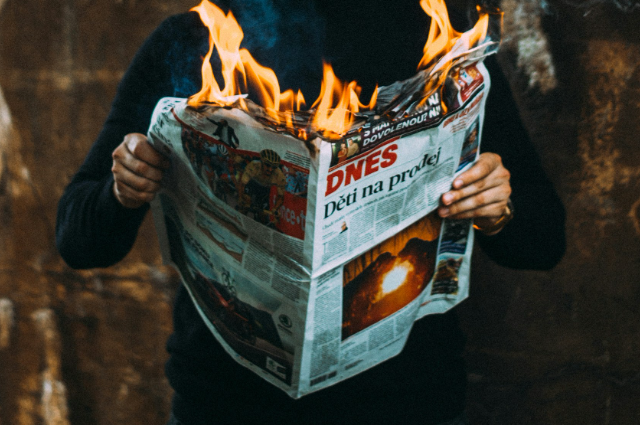
Photo by Marek Pospíšil on Unsplash
The long-standing tradition of Hong Kong as a haven of press freedom in the region has been undermined even more after the conviction of pro-democracy media tycoon Jimmy Lai, yet this case, which many observers now note is the first clear indication that independent journalism in the city is being pushed into extinction. Lai, the founder of the vocal tabloid Apple Daily, was convicted under the national security law in Hong Kong, which is a form of legislation enforced by Beijing in 2020, and the critics believe that it has made ordinary journalistic practices a criminal offense. The decision has sparked debate around the world on whether the freedom of expression in Hong Kong will survive, and also raised awkward questions on whether the city can still boast of having an independent legal system.
The story of Jimmy Lai cannot be discussed outside of the emergence of Apple Daily, which was once one of the most popular newspapers in Hong Kong and a strong opponent of not only the local authorities but also the Chinese Communist Party. The paper was an embodiment, decades long, of uncompromisingly political, openly combative, and pro-democracy journalism rooted in the pro-democracy movement in the city. The same stance that had been endured on semi-autonomous status as of Hong Kong was used as grounds to destroy it afterwards. Raids into the newsroom by the police, arrests of senior editors, as well as the seizure of the company's property, ultimately made Apple Daily close down, thousands of people were left jobless, and millions of readers had no publication they could trust.
The conviction Lai is experiencing is not an isolated case but a wider trend involving legal and political pressure on the media since the national security law was enacted. The vaguely defined offences in the law, such as collusion with foreign forces and subversion, have provided an atmosphere of fear where the journalists cannot tell where good reporting ceases, and the criminal responsibility starts. In the Lai case, the prosecutors claimed that the writings, interviews, and supposed contacts with foreigners were activities that were a threat to national security. The proponents respond that such acts are squarely within the entitlements of a publisher and a citizen in any given society that prides itself on free speech.
The response of foreign countries to the verdict has been quick and highly critical. The conviction has been denounced by press freedom organizations as being a politically motivated move to censor dissent, with a number of governments in the West threatening that the case would weaken the belief in the legal protections of Hong Kong. To them, the fact that Lai was put on trial proves that the national security law has taken the city out of the common-law traditions to the political loyalty system, where civil liberties are not taken seriously. Both Chinese and Hong Kong leaders have strongly defended against these allegations, claiming that the law only applies to a few people who pose a threat to national stability and that freedom of the media still applies to people who abide by the law.
Within Hong Kong, though, the effects of the case are experienced not so much in terms of what is said but through day-in, day-out newsroom decisions. The practice of editors shying away from politically sensitive issues, journalists toning down topics, or even dropping them is a common occurrence, and media organisations are more and more about survival rather than exposure. It is not necessarily the threat of being arrested directly, but of some red lines that can be changed without prior notice. The belief held by Lai strengthens the feeling that even high-profile people with international media coverage are not safe, and leaves the common reporters with no assurance that they are safe.
The effect has been immense on the media ecosystem. Since the year 2020, a few independent sources have been closed down, some of them have changed hands, and many of them have opted to leave Hong Kong altogether. Those who stay usually talk about working in the environment of self-censorship at all times, when questions about whether a story is true or important have been replaced by whether or not it is worth the risk. Investigative journalism, which was formerly a quality of the Hong Kong press, has become a rarity and has been superseded by tentative reporting, looking to ask no questions of the power.
Outside of journalism, the belief has some symbolic meaning to the identity of Hong Kong. The city was also extensively promoted as a destination where East and West met, economically open and at the same time, provided the personal liberties that were not experienced on the Chinese mainland. One of the major components of that image was the press freedom, which guaranteed foreign investors, diplomats, and other international entities that Hong Kong had a set of rules that it could predict. That image is gradually fading away as high-profile cases such as Lai continue to pile up, questioning the future confidence in the institutions in the city.
Beijing insists that there should be stability and security preceding the unrestricted freedoms, citing that the protests of 2019 were able to show the potential risks of letting dissent go uncontrolled. In this light, the law and subsequent prosecution of national security is a corrective action as opposed to authoritarian overreaching. The detractors, though, note that the stability created by the dread of fear is not long-lasting and that press silencing erases a tool of accountability. In the absence of the independent media, corruption, power abuse, and mistrust of the people, they state, are most likely to increase.
To advocates of press freedom, the conviction of Jimmy Lai is more than what happens to a single publisher; it is the turning point of the political development of Hong Kong. Sending the case is understandable: the challenge-of-power journalism, which addresses the international community, which is active and mobilizing the citizens, can be claimed as a threat to security. This reinterpretation fundamentally changes the role of the press from being a watchdog position to a possible suspect.
With Hong Kong going deeper into this new era, the room to do independent journalism is still becoming smaller. The belief of Lai is likely to hasten the already existing trends of censorship on self and media consolidation, which will complicate the coming out of other voices. It is still not clear whether Hong Kong will be able to retain any form of press freedom under such circumstances. What is evident, though, is that the media landscape of the city has been forever altered, and the price to tell ugly truths is never higher.
. . .
References:
- BBC News. (2024). Jimmy Lai: Hong Kong media tycoon on trial under national security law. British Broadcasting Corporation.
- Freedom House. (2024). Freedom in the World: Hong Kong. Freedom House
- Human Rights Watch. (2024). Hong Kong: National Security Law dismantles press freedom. Human Rights Watch.
- Reporters Without Borders. (2024). Hong Kong drops further in World Press Freedom Index. RSF.
- Reuters. (2024). Hong Kong convicts media tycoon Jimmy Lai in landmark national security case. Reuters News Agency.
- The Guardian. (2024). Jimmy Lai's conviction sends a chilling message to journalists in Hong Kong. The Guardian.
- The New York Times. (2024). Hong Kong’s national security law and the end of Apple Daily. The New York Times.
- Associated Press. (2024). Explainer: How Hong Kong’s national security law reshaped the media. AP News