
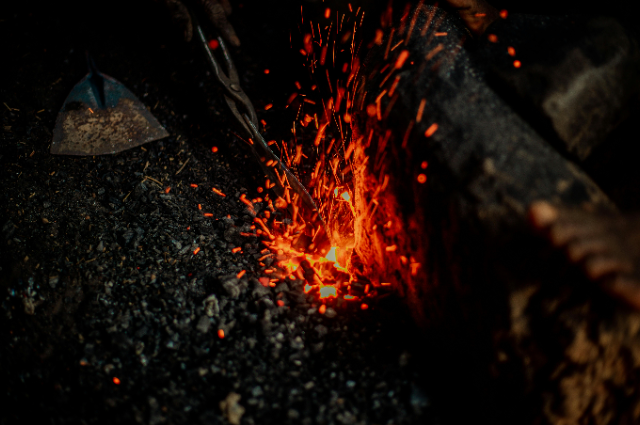
The beat of metal on metal can still be heard in a distant part of Kafanchan, Kaduna State, in the morning air. It is a song that used to resonate in most of the Nigerian societies - a marker of life, labor, and being. Nowadays, it is made of fewer substances, floating like the fading memory of a trade that used to support whole families. Within a soot-darkened smithy, an elderly blacksmith is bent to his anvil, working hot iron the way his father and grandfather have always worked, by natural, unconscious motion. Resistance is not work only; it is every strike of the hammer. It is survival. It is the lack of willingness to see a tradition pass away.
Blacksmithing in Nigeria dates back centuries in the North. These craftsmen had sustained the countryside of generations, the producers of hoes, knives, cutlass, farming blades, hunting weapons, and traditional weapons. The blacksmith was not just a craftsman in most communities; he represented the culture, a problem-solver, and an apostle of knowledge to be transmitted orally. However, the emergence of factory-made tools, cheap products of the Asian market and the ever-evolving economies have pushed this craft to the background.
The workshop is nearly a shrine to a dying way of life today. Once the centre of the communal production, the fire becomes weaker every year. The younger generations are easily lured into urban employment, and online possibilities scramble that they hardly ever get to the soot-filled huts where their fathers made the tools that made their communities. Metalwork is turning into a thing of the past.
The deterioration did not take place in one day. The initial attack was the entry of the cheap, manufactured goods that flooded the Nigerian markets in the early 2000s. Mass-produced hoes and machetes are now available in hardware shops at prices that are much lower than those of local forged products. One that a smith may spend hours crafting can be substituted by a factory version, which may cost a fraction of the price. To the majority of the rural farmers, it is a simple matter of one or the other, cheaper or better.
This economic transformation was disastrous to artisans. Customs that used to engross the workshops started wearing off. Established customers resorted to market stalls. Skilled products, precision, and narrative tools were substituted with assembly-line products. To most blacksmiths was not just a loss of money but also a loss of identity-related pride.
Nonetheless, the artisans that are left are still continuing. They operate in the conditions which have not been improved in decades: bellows made of animal skin, anvils that have been inherited through generations, furnaces made of mud and stones. They might seem outdated in their approaches, yet their quality is unquestionable. Blades made locally are sharper, stronger and more versatile to the local soil conditions. Farmers who can pay the difference confirm that the hoe of the blacksmith is sturdier than any imported hoe.
Pockets of intervention give some hope. The support in states such as Kaduna, Plateau and Benue is done by cooperatives and NGOs in terms of training programmes, tool improvement workshops and microcredit loans. Some organizations have started reporting the traditional skills, such as the blacksmithing, as a heritage of Nigeria. Yet even these programmes are uneven, even insufficient and hardly sufficient to subsidise cheap imports.
Efforts to initiate the youngsters in the craft by introducing them through the apprenticeship plans are struggling. A significant number of young people perceive blacksmithing as a form of antiquity, physically intensive and completely unsuitable, in contrast to the contemporary ideals. Cultural pride does not attract them easily without the financial gains. Interested persons usually find it hard as the market is no longer a guarantee of income.
Despite all these, in as much as the story of the blacksmith is that of decline, it is also that of adaptations. Other artisans are diversified producers of decorative metal work, garden tools, ornamental door hinges and even custom knives for collectors. Some have also been able to market their products online through social media, which has enabled them to access customers with the ability to buy quality products as opposed to mass production. Much like this narrow path suggests possibilities.
The existence of the traditional crafts in Nigeria relies on deliberate collaborations. Governmental departments can institute a policy in favour of local output, grant subsidies, and offer up-to-date and more efficient equipment that does not eradicate tradition without enhancing efficiency. Universities and the technical institutes would be able to collaborate with the communities of artisans to help in documenting knowledge and using it in vocational programs. Cultural festivals and local markets can be used as ways to showcase artisans and sell their work.
However, assistance has to be beyond economics. It must have cultural awareness, it must realize that the art of blacksmiths, weaving, pottery, leather workers, or carvers, is not merely a trade; it is history. They show us the way people used to relate to their surroundings, their implements and with each other.
In the Kafanchan workshop, the blacksmith is working at his fire, making another piece of equipment, a hoe of a farmer who still insists on purchasing locally. His perspiration gathers on his brow, and his motions are regular. Tools, of years earlier and later, edges dull, shapes known, all surround him. He does it alone, though not alone; every rhythmic stroke echoes the teaching of his father, the laughter of his pupils who have long since become men, the pride of a family that will not die away.
The future of such artisans as he is still unknown as the Nigerian economy is restructured with industrial production. But his art surpasses time - unyielding, dogged, nearly obstinate. He does not only do so to make a living but also to retain a tradition that once characterised entire societies.
In the era of mass-production, he might be among the few craftsmen, but as long as he keeps the fire shining, the history of Nigerian craftsmanship will still live.
References
- Adepoju, T. (2018). Traditional blacksmithing in northern Nigeria: Heritage, challenges, and sustainability. Journal of African Arts and Crafts, 5(2), 45–59.
- Aina, O., & Onuoha, B. (2020). The effects of imported goods on indigenous crafts in Nigeria. African Journal of Cultural Studies, 12(1), 78–91.
- Nwosu, C. (2017). Endangered crafts: Preserving Nigeria’s artisanal heritage. Lagos: Heritage Press.
- Okeke, I. (2019). Artisan livelihoods and adaptation in Nigeria’s modern economy. Nigerian Journal of Social Development, 11(3), 101–117.
- UNESCO. (2016). Safeguarding intangible cultural heritage: Nigeria. Paris: UNESCO.