
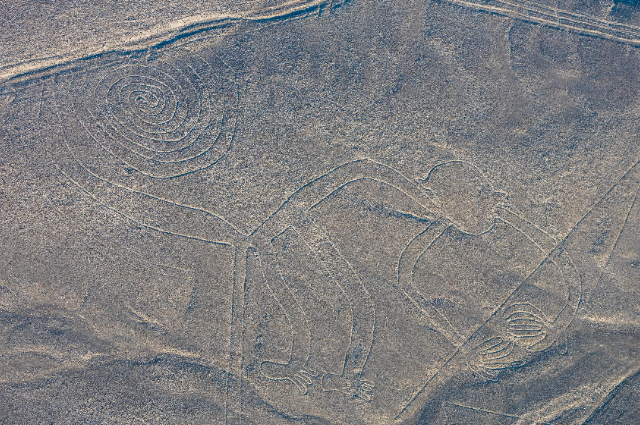
High in the arid plains of southern Peru lies one of the most intriguing and enduring enigmas of the ancient world: the Nazca Lines. Etched into the desert surface more than a thousand years ago, these immense geoglyphs—depicting animals, plants, geometric patterns, and long straight lines—have fascinated archaeologists, historians, scientists, and travellers alike. Their sheer scale, precision, and the mystery surrounding their purpose have led to countless theories, from religious rituals to astronomical calendars and even extraterrestrial involvement. Despite decades of research, the Nazca Lines remain one of humanity’s most captivating puzzles.
Geographical and Environmental Context
The Nazca Lines are located in the Nazca Desert, a vast, dry plateau between the towns of Nazca and Palpa in southern Peru. This region is one of the driest places on Earth, receiving less than an inch of rainfall annually. The extreme dryness, combined with stable atmospheric conditions and minimal wind, has helped preserve the lines for centuries.
The desert surface is covered with reddish-brown iron oxide-coated stones. When these stones are removed, the lighter-colored soil beneath is exposed, creating a contrast that forms the visible lines. This simple yet effective technique has allowed the geoglyphs to remain intact for over a millennium. The absence of vegetation and human interference has further contributed to their remarkable preservation.
Discovery and Early Study
Although local inhabitants were aware of the lines for centuries, they did not fully grasp their scale or design because they are best viewed from above. The Nazca Lines gained international attention in the early 20th century when pilots flying over the region noticed strange patterns on the desert floor.
One of the earliest scholars to study the lines was the Peruvian archaeologist Toribio Mejía Xesspe, who began documenting them in the 1920s. However, it was the German mathematician and archaeologist Maria Reiche who dedicated her life to studying and preserving the Nazca Lines. Reiche meticulously measured and mapped the geoglyphs, proposing that they had astronomical significance.
Description of the Geoglyphs
The Nazca Lines consist of over 800 straight lines, 300 geometric figures, and around 70 animal and plant designs. Some of the most famous figures include a hummingbird, monkey, spider, condor, dog, whale, and a mysterious humanoid figure often referred to as “the Astronaut.”
These geoglyphs vary in size, with some stretching over several kilometres. The straight lines are particularly impressive, running uninterrupted across hills and valleys, demonstrating an advanced understanding of geometry and spatial planning.
What makes the Nazca Lines truly remarkable is that they can only be fully appreciated from the air. This raises an important question: how did the ancient Nazca people create such large and precise designs without the ability to view them from above?
The Nazca Civilization
The lines were created by the Nazca culture, which flourished between approximately 200 BCE and 600 CE. The Nazca people were skilled artisans, known for their intricate pottery and textile work. They also developed advanced irrigation systems, including underground aqueducts called “puquios,” which allowed them to survive in the harsh desert environment.
The creation of the Nazca Lines would have required careful planning, coordination, and labour. Researchers believe that the Nazca people used simple tools such as wooden stakes and ropes to measure and align the designs. By marking key points and connecting them, they could create large-scale figures with surprising accuracy.
Theories About Their Purpose
One of the most fascinating aspects of the Nazca Lines is the mystery surrounding their purpose. Over the years, scholars have proposed several theories, each offering a different perspective.
Religious and Ritual Significance
Many archaeologists believe that the lines were created for religious purposes. The Nazca people likely viewed the sky and natural elements as divine forces. The geoglyphs may have been used in rituals to honour gods or spirits, particularly those associated with water and fertility.
Given the arid environment, water was a precious resource. Some researchers suggest that the lines were part of ceremonies intended to bring rain or ensure agricultural success. The act of walking along the lines may have been a form of ritual procession.
Astronomical Calendar
Maria Reiche strongly believed that the Nazca Lines had astronomical significance. She argued that certain lines and figures aligned with the positions of the sun, moon, and stars during solstices and equinoxes.
According to this theory, the Nazca people used the lines as a kind of calendar to track seasonal changes and plan agricultural activities. However, later studies have shown that while some alignments exist, many do not correspond clearly to astronomical events, making this theory only partially convincing.
Water and Irrigation Markers
Another widely accepted theory is that the lines are connected to water sources. Some researchers believe that the geoglyphs point toward underground aquifers or mark locations of water-related rituals.
In a desert environment where survival depends on water, it is plausible that the Nazca people created these lines as part of a system to manage or symbolise water resources.
Social or Cultural Expression
The Nazca Lines may also have served as a form of social or cultural expression. Creating these massive designs would have required collective effort, suggesting that they played a role in uniting communities. The lines could have been a way for the Nazca people to express identity, beliefs, and artistic creativity.
Extraterrestrial Theories
One of the most popular—but least scientifically supported—theories is that the Nazca Lines were created by or for extraterrestrial beings. This idea gained popularity through writers like Erich von Däniken, who suggested that the lines served as landing strips for alien spacecraft.
While this theory captures the imagination, there is no credible evidence to support it. Most scientists and archaeologists dismiss it as pseudoscience, emphasising human ingenuity as the true explanation.
Modern Research and Technology
In recent years, advances in technology have allowed researchers to study the Nazca Lines in greater detail. Satellite imagery, drones, and geographic information systems (GIS) have revealed new geoglyphs that were previously unknown.
Japanese researchers, for example, have discovered smaller and more intricate figures, suggesting that the Nazca Lines are even more extensive than previously thought. These findings have provided new insights into how the lines were created and how they evolved.
Additionally, studies of soil composition and erosion patterns have helped scientists understand how the lines have survived for so long. Conservation efforts are now focused on protecting the site from threats such as tourism, urban development, and climate change.
Preservation and Challenges
The Nazca Lines are a UNESCO World Heritage Site, recognised for their cultural and historical significance. However, they face several challenges. Increased tourism has led to concerns about damage from vehicles and foot traffic. In some cases, careless actions have caused irreversible harm to parts of the geoglyphs.
Climate change also poses a threat. Although the region is extremely dry, unusual weather patterns, including heavy rains, can erode the lines. Conservationists are working to monitor and protect the site, ensuring that future generations can continue to study and appreciate this ancient wonder.
Cultural and Global Significance
The Nazca Lines are more than just an archaeological curiosity; they are a testament to human creativity, ingenuity, and the desire to connect with something greater than oneself. They challenge our understanding of ancient civilisations and remind us that even without modern technology, humans were capable of remarkable achievements.
The mystery of the Nazca Lines continues to inspire curiosity and debate. They have become a symbol of the unknown, encouraging exploration and scientific inquiry. Whether viewed as religious symbols, artistic expressions, or scientific tools, the lines represent a unique intersection of culture, history, and imagination.
Engineering Genius Behind the Nazca Lines
One of the most fascinating aspects of the Nazca Lines is not just their appearance, but the engineering knowledge required to create them. At first glance, removing surface stones to form lines may seem simple, but the level of precision suggests a deeper understanding of planning and measurement. The Nazca people likely used a grid system to scale small drawings into massive designs. Archaeologists have found wooden stakes in the ground, which may have been used as markers to guide the construction process.
This method indicates that the Nazca civilisation possessed advanced practical geometry. Straight lines that extend for kilometres without deviation require careful alignment. Even more impressive is the ability to maintain proportions in large animal figures, ensuring that each part of the design remains accurate when viewed from above.
Experimental archaeology has shown that modern researchers can recreate similar geoglyphs using basic tools within a relatively short time. This suggests that while the Nazca Lines are extraordinary, they are not beyond human capability. Instead, they highlight the creativity and intelligence of ancient people, challenging the assumption that advanced achievements always require modern technology.
Symbolism and Meaning in the Designs
The figures created in the Nazca Desert are not random; they carry symbolic meaning deeply connected to the beliefs and environment of the Nazca culture. Many of the animals depicted, such as birds and monkeys, are not native to the desert region. This suggests that the Nazca people were influenced by distant ecosystems, possibly through trade or cultural exchange.
Birds, especially, may have held spiritual significance. In many ancient cultures, birds were seen as messengers between the earth and the sky. The hummingbird, with its ability to hover and move swiftly, might have symbolised energy or communication with the divine. Similarly, the spider could represent fertility or water, as spiders are often associated with rain in some indigenous traditions.
Geometric shapes, such as spirals and trapezoids, may also carry symbolic meanings. Spirals often represent cycles, such as the cycle of life, water, or seasons. Long straight lines might symbolise pathways, journeys, or connections between sacred places. Rather than being purely decorative, the Nazca Lines likely served as a visual language that communicated important cultural and spiritual ideas.
Ritual Landscapes and Sacred Geography
Recent research has shifted the understanding of the Nazca Lines from isolated drawings to part of a larger ritual landscape. Instead of focusing only on the lines themselves, scholars now examine how they relate to the surrounding environment.
The Nazca Desert was not just a physical space but a sacred one. Mountains, rivers, and underground water sources were likely considered spiritually significant. The lines may have been designed to connect these features, creating a network of sacred pathways. Walking along these lines could have been part of ceremonial practices, allowing participants to engage with the landscape in a meaningful way.
This idea is supported by the discovery of pottery fragments and offerings near some of the lines. These findings suggest that rituals took place at these sites. The Nazca people may have used the lines as part of processions, moving in specific patterns to honour gods or seek blessings.
The Role of Water in Nazca Culture
Water was the most critical resource in the Nazca Desert, and its scarcity likely influenced many aspects of Nazca life, including the creation of the lines. Some researchers believe that the geoglyphs are directly linked to water worship.
The Nazca people built an impressive system of underground aqueducts known as puquios. These channels allowed them to access groundwater and sustain agriculture in an otherwise inhospitable environment. The connection between the lines and water sources suggests that they may have served as markers or symbolic representations of these vital resources.
In many ancient cultures, water was associated with deities and spiritual forces. The Nazca people may have created the lines as offerings to these forces, hoping to ensure rainfall and agricultural success. The act of creating and maintaining the lines could itself have been a form of devotion.
Artistic Expression on a Monumental Scale
The Nazca Lines can also be understood as a form of large-scale art. Unlike paintings or sculptures that are meant to be viewed up close, these geoglyphs were designed for a perspective that humans could not easily achieve at the time. This raises interesting questions about artistic intention.
Why create art that cannot be fully seen? One possibility is that the intended audience was not human but divine. The Nazca people may have believed that gods or spirits observed the earth from above, making the lines visible to them. In this sense, the geoglyphs could be seen as offerings or messages to the heavens.
Another perspective is that the process of creating the art was more important than viewing it. The effort, coordination, and time required to produce these designs would have been significant, turning the act of creation into a communal and meaningful experience.
New Discoveries and Ongoing Mysteries
Even today, the Nazca Lines continue to reveal new secrets. With the help of modern technology, researchers have discovered additional geoglyphs that were previously unnoticed. Some of these are smaller and more detailed, suggesting that the Nazca people experimented with different styles and techniques.
Artificial intelligence has also been used to analyse aerial images, helping identify patterns that might be missed by the human eye. These discoveries indicate that the Nazca Lines are more complex than originally thought, raising new questions about their purpose and development.
Despite these advancements, many mysteries remain. Why were certain figures chosen over others? What determined the placement of the lines? How did the meanings of these designs evolve? Each discovery adds to our understanding while also deepening the mystery.
Human Imagination and the Need for Mystery
Part of what makes the Nazca Lines so fascinating is the human tendency to seek meaning in the unknown. When faced with something extraordinary, people often create theories to explain it. This is why ideas about aliens or supernatural forces have gained popularity, even without scientific evidence.
However, these theories also reflect the power of human imagination. The Nazca Lines inspire curiosity, creativity, and wonder. They remind us that not everything in the world is fully understood, and that mystery itself can be valuable.
Lessons from the Nazca Lines
The Nazca Lines offer important lessons for modern society. They demonstrate that ancient civilisations were capable of complex thought, creativity, and cooperation. They challenge the idea that progress is only measured by technology.
The lines also highlight the importance of respecting and preserving cultural heritage. As one of the world’s most unique archaeological sites, they belong not only to Peru but to all of humanity. Protecting them ensures that future generations can continue to learn from and be inspired by them.
A Timeless Enigma
The mystery of the Nazca Lines endures because it touches on fundamental questions about human existence. Why do we create? What do we believe? How do we connect with the world around us?
These विशाल designs, carved into the earth centuries ago, continue to speak to us across time. They are silent yet powerful, simple yet profound. Whether viewed as art, science, religion, or a combination of all three, the Nazca Lines remain a symbol of human curiosity and ingenuity.
The Nazca Lines remain one of the most fascinating mysteries of the ancient world. Created by the Nazca civilisation over a thousand years ago, these विशाल geoglyphs continue to captivate researchers and visitors alike. While many theories have been proposed regarding their purpose, no single explanation fully accounts for their complexity and significance.
What is clear, however, is that the Nazca Lines are a remarkable achievement of human creativity and determination. They reflect a deep connection between people, nature, and the cosmos. As research continues and discoveries are made, the mystery of the Nazca Lines may one day be fully understood. Until then, they remain a powerful reminder of the wonders of the past and the enduring quest for knowledge.
References
- Maria Reiche – Mystery in the Desert
- A classic work by the leading researcher who studied the lines for decades. - Helaine Silverman – The Nasca
- Detailed academic study of Nazca culture and archaeology. - Anthony F. Aveni – Between the Lines: The Mystery of the Giant Ground Drawings of Ancient Nasca, Peru
- Explores astronomical and cultural interpretations.