
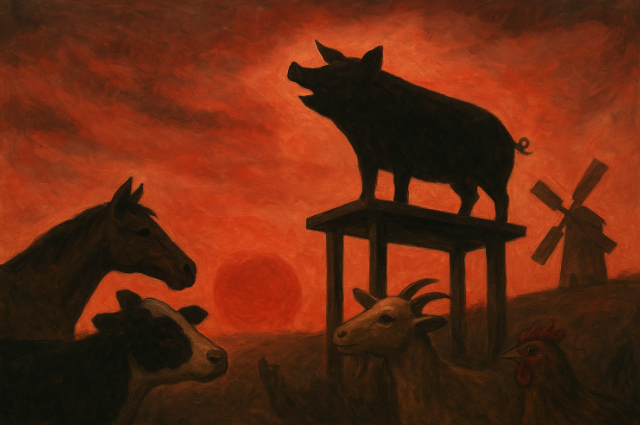
Many literary giants of the industrialisation era have endeavoured to portray the massive changes and giant developments of that tumultuous time through long written stories that we call today ‘Novels’. Whenever you pick a book from the 18th or 19th century, in almost all books you find a central idea that refers to a big theory or reform that emerged in the society of that epoch, the writer has written the novel based on it.
Stacks of novels written in that era have successfully made a great position in the genre of literature in modern times. These books have also proved themselves worthwhile for those who seek to form a vivid idea of that era or who aim to become literary giants.
One of the most popular novels worldwide from the industrialisation era is, I think, Animal Farm, which succinctly and precisely sketches the existing figure of English society of the 19th century by narrating a story about an animal farm.
This worthy book came to my attention while talking on a call with my guide, Aswim Saeed. One evening, as I was reporting to him the activities I was performing those days (he had gone on holiday), for my reading improvements, I told him that the next book I was thinking of reading after Kafka on the Shore was 1984.
“The writer is George Orwell, am I right?” he asked in a soft yet high-pitched voice.
“Yes, absolutely, he has written it,” I said with sheer eagerness, wanting to know quickly what he was going to say next.
“He is a well-acclaimed and popular writer across the globe, and the strangest coincidence is that he was born in Bihar, though he wasn’t a real Indian. He has written many books in English literature. But most people consider his Animal Farm and 1984 as the greatest masterpieces of his entire life,” he said slowly.
“What is Animal Farm? To be honest, I don’t have any idea about it. In short, I have not yet made its acquaintance,” I said with slight bewilderment and a blabbering voice.
“Okay, man, don’t be so downcast. I think now you can read both books, one after another, this month or week.”
“Sure, if Allah wills, I’ll read it thoroughly within one week.”
Conveying my greetings, I ended the call and, right at that moment, advanced directly to the library. I ran my eyes through all the shelves and at last, after 10 minutes, I found it in the English novel section, inserted between Elif Shafak’s books (The Forty Rules of Love and The Architect’s Apprentice). Without dawdling in the library for something unnecessary, I quickly darted to the librarian, registered it in my name, came back to class, and opened the first page of Animal Farm to read.
On reading the first paragraph, I got a kind of genuine urge to read it without a break. Though I had other preoccupations, it took me four days to finish reading it. I can still say with certainty that I read it with the same curiosity that was aroused by my guide during our call.
Critical Review of the Book
Story
The book begins with the story of Old Major, who stands on a rostrum and gives a powerful speech about gaining freedom from the owner of the farm. He reminds the other animals how terribly their ancestors were treated in the past years, and he reiterates the current inequalities and oppressions being carried out by the owner. Then he elaborates, explaining how mercilessly they are being exploited to fulfil their master’s insatiable desires.
At last, he argues that now he is very old and weak, and his life is on the verge of ending. “After my death,” he says, “you should rise against this monarch. You should achieve your own freedom; you must be the rulers of yourselves. No more can we bear such cruel burdens on our shoulders. You should hatch the conspiracy against him. Expel him from our society.”
After urging them to snatch their freedom from the owner, he dies within a day or two. Now, under the leadership of Napoleon and Snowball, the animals strive hard and, after many relentless efforts, succeed in throwing the farm owner out of the farmhouse.
Now, all the animals are overwhelmed with joy at gaining freedom. They are happy with the certainty that no longer will they have to toil for others’ benefit, and they can now enjoy whatever and as much as they want. The pigs, being intellectually more talented than the other animals, crown themselves leaders and pass equal laws for everyone, whether pigs or rats.
Everyone is privileged with equal opportunities. Their laws reflect equal treatment for all: everyone will have the same food, no one will sleep in the master’s felt bedsheets, and for subsistence, everyone must work. Those with four legs can stay here. Likewise, seven laws are written on a script and pinned to the wall at the entrance gate.
Time passes. Circumstances change. The idea of exploiting others begins to grow in the minds of the intellectual pigs. They begin paving the way toward fulfilling their bad intentions. Their first step is when Napoleon, with the help of some animals, hurls a series of accusations at the leader Snowball. As a result, Napoleon is thrown out of the farm.
Then, with the passage of time, the pigs begin amending the constitution under the leadership of Napoleon. One day, they tell the animals that they rule the entire farm, always think about their development, and ensure their safety, so they need a separate, comfortable room to discuss matters of development.
Similarly, a few days later, they bring a new amendment: they need decent food at the dining table to stay healthy and energetic for the animals’ progress. Gradually, everything begins to change. They erase the laws one after another until only one law remains, a phrase that affected me the most in this book:
“All animals are equal, but some animals are more equal than others.”
Step by step, Napoleon and the other pigs reach the pinnacle of their dreams by exploiting the other animals very badly. While doing so, they ensure no one becomes aware of their evil deeds, otherwise, they might be overthrown. So, he (Napoleon) covers himself in a box of lies and presents himself as a visionary leader of the farm.
Moreover, to sustain his popularity, he kills many animals that seemed to have information about his evil actions.
My Personal Reflections
The book, from beginning to end, leads us to understand one core concept: that at all times and in all places, you will always find tyranny existing in some form. You will always come across people (often intellectuals) in a place who want to exploit others—whether they are vulnerable people, poor people, the downtrodden, soft-hearted individuals, or sometimes even the educated.
This book reveals how some people or individuals fight against the injustices of a government, or aim to overthrow an entire system, not for personal benefit, but solely to secure the freedom and rights of civilians. The example in the book is Old Major, who, for years, raised his voice against the farm owner, instigating every possible protest or demonstration to snatch freedom from him. Sadly, when they were on the verge of gaining independence, he died.
Later, another example of a good wisher is Snowball, who stands up and puts himself in charge of the whole farmhouse. His eyes had witnessed every act of oppression. He had worked alongside Old Major, thus shared the pain of his comrades. He had dreamt, along with Old Major, of many reforms for Animal Farm. But eventually, he ends up with a bad public image.
The rapacious pigs took the fruits of their efforts. This is a result we often still see today, or have read about in books and history.
Isn’t this right?
As we read in historical texts, at every place where someone stands for truth and genuine development, there is always someone born whose goals are the antithesis of social reform. These leaders (demagogues) want everything for their own benefit. Their insatiable and selfish goals lead to the destruction of a fair society.
The example in this book was Napoleon, who dreamed only of fulfilling his personal ambitions, unlike Old Major and Snowball, whose dreams were for the betterment of all. Napoleon went beyond all limits to satisfy his evil desires—he rebranded the constitution, hurled false accusations at others, expelled animals from the farm, and killed many who stood against him.
He presented himself as a good, honest leader while becoming a parrot of lies. He covered up all truths about himself from the eyes of animals like Boxer, keeping him in illusion and exploiting him mercilessly day and night.
He (Boxer) had once exchanged a vow with himself to stand in support of Napoleon, thinking he was a good leader. But Boxer, unaware of the ruler’s(Napoleon's) evil deeds, laboured day and night for the construction of the windmill. Once Boxer grew old, feeble, and fragile, the ruler sold him to a butcher.
When the animals raised their voices in protest, he lied, saying that Boxer had been sent to a sanatorium for recovery, but he never came back.
This book clearly shows the system of a corrupt government and how far its leaders can go to exploit others for personal gain. Orwell wrote this book especially to reflect the living conditions of England at that time.
I would recommend this book to everyone interested in politics and social affairs—to understand, read, and explore deeply.