
Setting the Stage for Political Competition
"Honest disagreement is often a good sign of progress." - ‘Mahatma Gandhi’
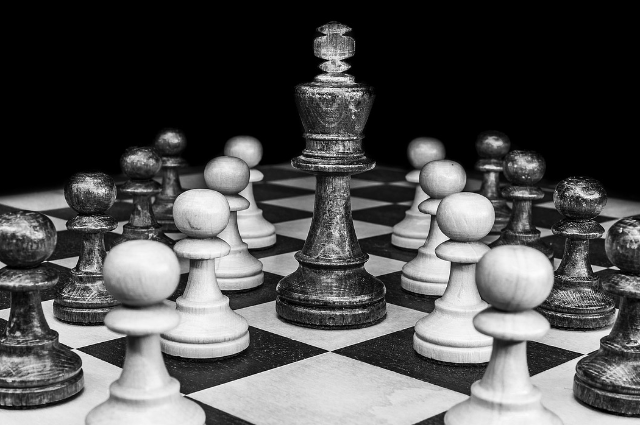
Now, imagine a game of chess: The board is set, the pieces are in their places, but there's only one player. Sure, the player can move the pieces around, but there's no challenge, no strategy to it, no real game. It's just a series of arbitrary movements. Much like thinking without an opposing view or challenge.
Just as the game of chess really begins when there's an opponent making moves, thinking starts when there's an opposing view or idea. This opposition acts as the catalyst for deep, critical thinking. It is the spark that ignites the fire of thought; this is the challenge that dares us to question, analyse, evaluate, and form arguments.
It is more than an intellectual exercise or a strategic game. As we shall learn from history, opposition has always played the role of the "other team" that forces profound contemplation of the mind, thereby bringing about fundamental alteration of perception. From the Cold War to the Scientific Revolution, from the Abolitionist Movement to the Manhattan Project, and from the Feminist Movement to the ongoing fight against climate change, opposition has driven human progress.
Politics is often likened to a game-a battleground of ideas, ideologies, and strategies where two opposing teams face off to win. But what happens if one team refuses to play by the rules-or worse, if the game is rigged in favour of one side? Politics, in its purest form, requires competition-not for the sake of rivalry, per se, but to ensure a system of checks and balances. Democracy, like any sport, thrives on the idea of opposition; it's the opposing team that keeps the ruling party in check, preventing it from getting too powerful, too complacent, or too corrupt.
In India, with democracy enshrined in the Constitution, a strong and healthy opposition is required. Take away the competitive political environment, take away the opposing team to push back, and the game of politics loses its integrity. What we see happening today is quite the opposite: not only is the opposition being sidelined, but it is being silenced. This article will discuss the role of opposition in Indian democracy, the methods the ruling party uses to undermine it, and the dangers that occur when the political game is unfair.
The metaphor of the game holds great relevance here-there needs to be a balance of offence and defence, strategy, and execution in democracy, just like in any sport. Without opposition, there can be no game at all.
1. Democracy in India and the Role of Opposition
You have remarked on the importance of the opposition, but it would be helpful to explain why democracy cannot function properly without an effective opposition**. In a democratic system such as India's, the opposition party is not just an adversary; it is an integral part of the system and helps to check any imbalance in the distribution of powers.
Evidence: India’s Constitution gives the opposition the right to question the decisions of its government. As the Rules of Procedure in the Indian Parliament emphasise, opposition has a legitimate right to ask questions, raise motions, and even demand debates on important issues. This is an important safeguard to ensure that the ruling government does not become opaque.
Explanations: In the absence of any formidable opposition, decisions are taken by the ruling party pertaining only to their interests and not to the needs of the people. Opposition ensures a system of checks and balances, which essentially forms one of the major principles of any democracy.
Indian democracy is based on a multi-party system, and its purpose is to provide a forum for varied voices. The framers of the Indian Constitution believed that the strength of a democracy rests in the free flow of ideas, and such a system should exist where no single party would enjoy the monopoly of power beyond a certain period.
This multi-party framework ensures that no single voice monopolises power. The opposition, in this sense, is both a check and a *balance* to the ruling government. It keeps the ruling party answerable, challenges decisions, and provides alternate visions of governance. Without vigorous opposition, the very essence of democracy would be compromised.
Consider the political system of the Soviet Union in 1932, or that of Mussolini's Italy, a single-party rule that oppressed all forms of opposition, culminating in authoritarian rule. Far from totalitarian, as the situation in India is today, the danger lies in the eventual, gradual undermining of opposition space—something indeed we can already witness in increasing efforts to silence the voices of dissent.
Take, for instance, the Citizenship Amendment Act protests of 2019. Opposition parties like the Indian National Congress and the Aam Aadmi Party came out in strong opposition to this law, stating that it was discriminatory against Muslim citizens since it granted fast-tracked citizenship to only non-Muslim refugees from neighbouring countries. However, the ruling party disregarded these concerns, labelling the opposition's criticisms as anti-national. This is a prime example of how the opposition can act as the voice of reason, but when their voices are drowned out by those in power, the very essence of democracy is compromised.
Another example is the government's attitude toward economic policy. For instance, critics have cited the 2016 demonetization move as a policy that hit the poor and the working class disproportionately hard, with absolutely no gains to show in the long term. However, the opposition that raised valid concerns was often dismissed as obstructive, even unpatriotic.
These examples represent how Indian democracy, which was proud of multi-party participation and open debate, now sees a reduction in the space available for the opposition.
2. Government Strategies Against Opposition: Silencing the Critics
When any government tries to silence or weaken the opposition, it erodes democracy by prohibiting dissent and any challenges to the status quo. The result could be authoritarian practices where one party controls the state in all aspects**.
Evidence: For instance, opposition leaders in India have been harassed, falsely accused, and taken to court in the recent past. In 2019, a defamation case was filed against Rahul Gandhi, the president of the Congress Party, over his remarks on the Prime Minister. Similarly, many cases have been registered against Arvind Kejriwal, the Chief Minister of Delhi, linked to his political activities. These cases appear to be politically motivated to divert attention away from or discredit opposition leaders rather than take action on the issue.
Explanation: In doing so, these tactics distract the public from actual policy issues and shift the conversation toward personal attacks on political leaders. This undermines democratic institutions and makes it more difficult for the public to ascertain the truth. Under unrelenting threats and pressures, political leaders ultimately stop speaking out against corruption or unpopular policies.
There is a saying in the world of politics: "Power corrupts", and absolute power corrupts absolutely. The longer a party remains in power, the greater its tendency to dominate the political narrative-even at the expense of democratic institutions. In recent years, India's ruling party has taken a series of steps that are explicitly designed to weaken opposition forces-turning what should be a healthy, competitive game into one tilted heavily in favour of the ruling team.
Vote manipulation has been one of the most alarming tactics on the part of the ruling government. In India, political parties have long used religious and caste-based vote banks to maintain their power base. For example, the BJP has repeatedly depended upon the Hindu vote bank, even using religious issues to rally people behind their banner. In this scenario, opposition parties that stand for secularism or question the ruling party's stories are promptly marginalised or even branded as "anti-national."
Another form of manipulation comes in the form of electoral promises: the ruling party frequently abuses the machinery of the state to manipulate voters by making false promises or by using government resources to influence the vote. Large-scale media campaigns, frequently based on overtly biased narratives or even misinformation, are a prime example.
But probably the most dangerous tool in the ruling party's arsenal has been legal intimidation. Sedition laws and defamation suits have been used time and again by the Indian government to muzzle the opposition. A sedition law, enacted to protect national security, has more often than not been used against activists and critics of the government. Those who oppose the government over its policies find themselves enmeshed in endless legal wrangles that eventually sap all resources and stifle their voices.
A prominent example is the defamation case against Rahul Gandhi. In 2019, Gandhi was convicted of defamation for remarks he made about the surname Modi; however, this is indeed a common surname. The highly politicised case has been viewed as a stern warning to other opposition leaders who dare attack the government.
The ruling party also resorts to religious polarisation as a major dividing electoral strategy. This allows the government to mobilise religious sentiments on many occasions, fanning old flames of tension. As highlighted before, the ruling party referred to opposition leaders as "anti-Hindu" and "anti-national." All this breeds a dangerous political climate where any criticism of the government is presented as an attack on the nation itself.
3. The Dangers of Silencing the Opposition: A Threat to Democracy
Democracy, by nature, is founded on pluralism-the possibility of various viewpoints and ideologies existing side by side, competing for support. The opposition is to come up with alternative ideas, check the power of the ruling government and hold it accountable. Disabling the opposition will definitely weaken the very foundations of democracy.
The dangers of silencing the opposition are not limited to the immediate repercussions on political discourse but come in the form of long-term harm caused to the very fabric of society. Where there is no credible opposition, the government functions without any checks, and its decisions are devoid of scrutiny by the public. It thus provides a conducive setting where the government can legislate on laws without concern for the implications that such legislation could have, since nobody would raise concerns or criticise such decisions.
In addition, if opposition is systematically suppressed, then public trust in democracy is undermined. People begin to feel that their voices are no longer being heard, leading to disillusionment and apathy. This sets the stage for the rise of authoritarianism, where power is concentrated in the hands of a few, and the will of the people becomes irrelevant.
A good example is the crackdown on civil liberties and the media over recent years. India's democracy risks becoming a shadow of its former self with opposition leaders jailed or silenced and critical media outlets forced into compliance-or shut down.
4. Religious Polarisation and Manipulation of Votes
The other important point to highlight is the use of religion and vote manipulation by some political parties, often trying to turn elections into religious or caste-based contests. Such tactics certainly undermine the very principles of democracy and create rifts within society.
In the 2019 Lok Sabha election, the ruling party heavily resorted to religious polarisation, especially by appealing to Hindu voters. Prime Minister Narendra Modi's "Hindu nationalist" stance was a key theme during the election, which critics say fueled communal tensions. There have also been accusations of manipulation of some parts of the electoral process to favour particular parties.
Polarised electioneering on religious lines divides people, besides distracting attention from real issues like education, health, and economic development. The opposition, in pointing out these tactics, serves to expose such manipulation and educates the public about the true nature of these games.
5. Contradictions in the Political Game: The Battle Between Power and Accountability
Most puzzling about modern Indian politics are the contradictions between what the system is meant to represent and what it has become. While India's democracy demands healthy competition between the ruling party and the opposition, the ruling party seeks to make the political game unfair in its quest for power by eliminating its competition.
This is the paradox: a democracy that needs an opposition to function properly, and a ruling party that does its best to eliminate it. It is as if the ruling party were engaged in a sporting competition where its objective is not to win by merit, but rather to ensure that the other team would never be able to compete at all. In such a case, politics becomes less about policy and more about power struggles.
While the ruling party tightens its grip on the political landscape, the opposition becomes increasingly precarious. The contradiction between the ideals of democracy and the reality of the authoritarian power grab could lead to the death of democracy, where the government rules with impunity and the people lose their voice amidst the noise of one-sided politics.
6. Erosion of Public Trust and Political Apathy
One of the results of this silencing of opposition is the erosion of public faith in the democratic process. In the event that the opposition cannot speak out or voice their apprehensions, the public will lose confidence in the political system and eventually become politically apathetic. It's like people think their vote doesn't matter, which is really bad news for democracy. The year 2014, when the ruling BJP won a landslide majority in the general elections, was the harbinger of a political stability era. The voter turnout for the 2019 election had decreased, particularly in the case of younger voters. People were highly cynical about the political processes, believing that elections are rigged or the voices of opposition don't matter. A lack of confidence in the system leads to disengagement from the political process, which only strengthens the hand of the ruling party. Fewer onlookers and players in the game means the balance of power is disrupted. 7. How the Opposition Helps Expose Political Games The key player in exposing political games is the opposition. Without the opposition, we do not know about the secrets or corruption happening right behind closed doors. Therefore, one of the important roles of the opposition is to challenge, question, and investigate what the government does. Mainly, opposition parties and investigative journalists brought the 2012 corruption scandals, such as the 2G scam and CWG scam, into the limelight. The opposition broadly highlighted and condemned these events, which led the public to take to the streets, demonstrating their outrage and eventually forcing changes in government policies. Even in cases involving the opposition's own missteps-such as the National Herald case concerning top Congress leaders Sonia Gandhi and Rahul Gandhi-the opposition can be brought into public scrutiny. We would never have accountability for government actions without opposition. A situation arises where corruption and bad governance have become the norm when the ruling party can act without any checks.
Democracy Returns to Its Roots
The game of politics in India must not be allowed to deteriorate to a 'game of thrones'. True democracy calls for a dynamic and respectful exchange of ideas. It requires a strong opposition that can challenge the ruling party, hold it accountable, and provide alternatives when needed. If we are to keep democracy alive in India, we have to get back to the principles on which it was founded.