
Himachal Pradesh, the "Abode of Snow," is a state often defined by its serene landscapes and the quiet resilience of its people. Like any other region in India, its daily news cycle is usually a mix of the mundane and the critical: reports on criminal activities, updates on developmental infrastructure projects, political manoeuvring, and local sports achievements. The newspapers are often filled with statistics and dry reports that inform but rarely move the soul. Yet, amidst the cacophony of routine headlines, there are rare incidents that defy logic and touch the very core of our humanity. These are the stories that evoke deep empathy, put a tearful smile on your face, and linger in your thoughts long after you have folded the newspaper.
This is one such story. It emerges not from the corridors of power, but from the simple, dusty paths of a small town. It is a narrative that sounds more like a carefully crafted Bollywood script or a magical realism novel than a real-life event. However, this is no fiction. It is a beautiful, startling reality that reminds us that truth is often stranger—and more poignant—than fiction.
The Boy from the Hills
The year was 1980. In the quiet, picturesque village of Nadi, nestled within the Sirmour district of Himachal Pradesh, lived a 16-year-old boy named Rikhi Ram. Life in the 80s in rural Himachal was simple but arduous. Rikhi spent his childhood rooted in the soil of his village, his days filled with the scent of pine and the sweetness of mangoes that grew beside the narrow, winding paths of his home. He was a son of the hills, familiar with every turn of the valley and every shadow cast by the setting sun.
However, beauty does not always fill the stomach. Rikhi belonged to a lower-middle-class family where financial stability was a constant struggle. The pressure to contribute to the household income weighed heavily on his young shoulders. Driven by a sense of duty, the teenager made the difficult decision to leave the comfort of his home. He travelled to Yamunanagar in the neighbouring state of Haryana, hoping to find work that would allow him to send money back to his parents.
The Void: A Life Erased
In Yamunanagar, Rikhi found employment at a hotel, working long hours to make ends meet. Fate, however, had a cruel twist in store. While travelling with a colleague to Ambala, Rikhi was involved in a catastrophic road accident. The impact resulted in a severe traumatic brain injury.
When he woke up, the world was a blank slate. The injury had caused profound amnesia. Rikhi Ram effectively ceased to exist in his own mind. He had no memory of the mango trees in Nadi, no recollection of his parents, and no knowledge of his own name. In an era long before mobile phones, the internet, or instant messaging, he was untethered from his history.
Back in Himachal, his silence was deafening. His family waited for letters that never came. Eventually, his parents and siblings travelled to Haryana to find him. They searched hospitals and police stations, their hope dwindling with every passing day. Dejected and broken, they were eventually forced to accept the unbearable conclusion that Rikhi was missing, perhaps lost forever.
The Rebirth: Becoming Ravi Choudhary
With no past to anchor him, the boy formerly known as Rikhi drifted. He eventually moved to Mumbai, the city of dreams, which often serves as a refuge for lost souls. Here, a friend gave him a new identity to match his new life: he became "Ravi Choudhary."
Survival in the metropolis was brutal. In his initial days, Ravi took on menial jobs, surviving day-to-day, a man without a history simply trying to build a future. As the years turned into decades, he moved away from the chaos of Mumbai and settled in Nanded, a historically significant city in Maharashtra. He found stable work at a college and began to put down roots.
In 1994, Ravi married Santoshi. Together, they built a life filled with love and normalcy. They had three children—two daughters and a son. To his family in Nanded, he was simply Ravi, a hardworking father and husband. They had no reason to suspect that half of his life was locked away behind a mental wall. For over forty years, Rikhi Ram remained dormant, hidden beneath the persona of Ravi Choudhary.
The Trigger: The Echoes of 2025
Life continued peacefully until the early months of 2025. In a twist of irony that defies probability, Ravi met with another accident involving a head injury. But this time, the trauma didn't erase memories; it unlocked them.
As he recovered, strange, faded visions began to invade his waking hours. He didn't see the streets of Nanded; instead, he saw narrow mountain paths. He saw a specific courtyard of a house. He saw mango trees. He saw a place called "Sataun," a town he logically shouldn't have known, located a few kilometres from Nadi Village.
Initially, Ravi dismissed these flashes as hallucinations or side effects of the medication. But the visions were persistent and specific. The pull of the mountains was becoming impossible to ignore. He confided in his wife, Santoshi, describing the detailed geography of a place he hadn't visited in 45 years. Together, they decided to investigate the ghosts of his past.
The Digital Investigation
Determined to find answers, Ravi enlisted the help of a tech-savvy student from the college where he worked. They sat down in front of a computer and typed "Sataun" into Google. The search engine confirmed that the place existed in Himachal Pradesh.
Digging deeper, they found a phone number listed for a café in the Sataun area. The phone belonged to a man named Rudra Prakash. With trembling hands, Ravi dialled the number. When Rudra picked up, Ravi began to describe the village, the paths, and the landmarks from his visions.
On the other end of the line, Rudra was initially sceptical. A stranger calling from Maharashtra claiming to know the intimate details of a remote village sounded like a scam. However, the desperation and accuracy in Ravi's voice convinced him to listen. Rudra agreed to make inquiries. As the word spread through the tight-knit community of Sirmour, it eventually reached M.K. Chaubey, a relative of the long-lost Rikhi Ram. Chaubey listened to the details—the names of family members, the descriptions of the house—and realised the impossible had happened. The dead had come back to life.
The Homecoming
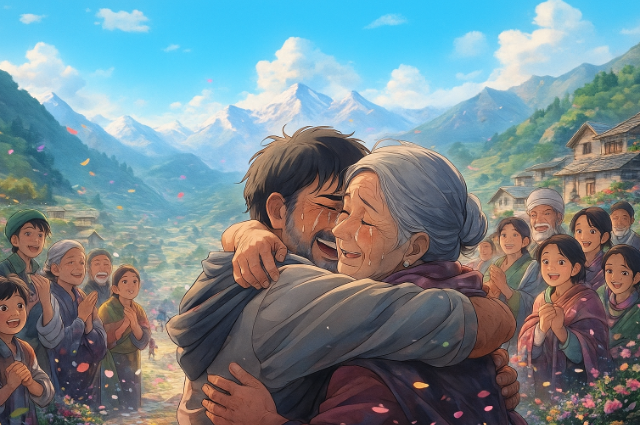
On November 15, 2025, the timeline that broke in 1980 finally reconnected. Ravi Choudhary, now holding the memories of Rikhi Ram, travelled back to Himachal Pradesh.
The scene at the village was nothing short of a festival. His siblings—Durga Ram, Chander Mohan, Chandramani, Kaushalya Devi, Kala Devi, and Sumitra Devi—gathered to receive him. They were no longer the children he had left behind; they were graying elders, their faces lined with the passage of time.
As Rikhi stepped onto the soil of his homeland, the village erupted. The air was filled with the sounds of traditional musical instruments. Villagers showered him with flowers, tears streaming down their faces. It was a celebration of resilience and the enduring power of blood ties.
However, the reunion was tinged with profound sorrow. Rikhi’s parents, who had spent decades waiting for their son, had passed away without ever knowing his fate. They died with the heavy burden of his disappearance, never getting to see the man he had become.
The Mystery of the Mind
This incredible incident forces us to look at the human brain with renewed awe. How can a memory remain dormant for four decades, only to be jolted awake by a second trauma?
We spoke to mental health expert Dr. Aaditya Sharma to understand the medical perspective. "The brain is a complex archive," Dr. Sharma explains. "Though nothing is impossible, such cases of memory restoration after a second injury—often called 'restorative trauma' in pop culture—are rarely documented in clinical literature. The memories were likely never 'gone,' but rather the access pathways were severed. The exact cause can only be known after a thorough medical investigation of the brain."
A Story for the Ages
Rikhi Ram’s journey from Nadi to Nanded and back again is a testament to the unpredictable nature of life. It serves as a reminder to cherish our history and our loved ones, for we never know what turns our own stories might take. For the villagers of Nadi, the return of the prodigal son is not just news; it is a miracle that will be told for generations to come.