
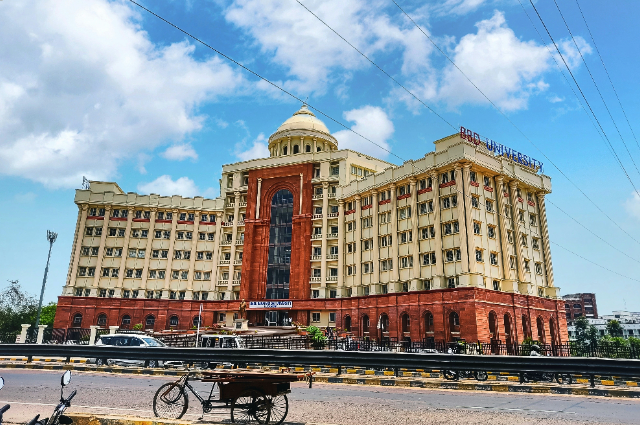
There is something deeply symbolic about a state building a skyscraper 2,000 kilometres away from its own people. It is not just concrete rising into the sky. It is a statement. A confession. Perhaps even a contradiction. In January 2026, the Bihar government approved the construction of a 30-storey Bihar Bhawan in Mumbai, a towering structure costing ₹314.20 crore, located on prime land in the Mumbai Port Trust area. Officially, it is described as a welfare initiative—a relief centre for cancer patients from Bihar who travel to Mumbai’s Tata Memorial Hospital. But beneath the official language lies a deeper question that refuses to stay quiet: Is this building truly about patients, or is it about power?
To understand the emotional gravity of this project, you have to see the journey of a patient from Bihar travelling to Mumbai. A cancer diagnosis in Bihar often comes with two pains. The first is the illness itself. The second is the realisation that treatment may not exist nearby. Thousands of families board trains with borrowed money, carrying medical files and fragile hope. When they reach Mumbai, they do not arrive in comfort. They arrive exhausted, disoriented, and often homeless. Many sleep on pavements near Tata Memorial Hospital, waiting weeks for appointments. In this context, a building that offers 240 beds, shelter, and basic medical support feels like mercy carved into architecture.
The government presents Bihar Bhawan as exactly that—a humanitarian intervention. The building will include dormitories for patients and attendants, medical rooms, cafeterias, and modern facilities designed to ease suffering. On paper, it appears compassionate. It acknowledges reality instead of pretending it does not exist. It recognizes that migration for healthcare is not temporary; it is structural. Bihar Bhawan becomes a bridge between need and survival.
But compassion alone does not silence criticism.
Because the same building that promises relief for patients also includes 178 rooms reserved for officials and VIPs. Nearly equal space is allocated not to the sick, but to the powerful. Conference halls, administrative suites, and official accommodations raise uncomfortable questions. Critics argue that the project is less a shelter for the vulnerable and more a monument for bureaucratic convenience. The numbers themselves tell a story. Two hundred forty beds for patients. One hundred seventy-eight rooms for officials. The balance feels uneasy, like welfare sharing space with privilege under the same roof.
This is where the debate shifts from architecture to ideology.
The most powerful criticism is not about Mumbai at all. It is about Bihar itself. Why, critics ask, is ₹314 crore being spent on a building in another state instead of strengthening healthcare infrastructure within Bihar? Why must patients travel across the country in the first place? The existence of Bihar Bhawan in Mumbai is, in many ways, an acknowledgement of absence. Absence of specialised cancer hospitals. Absence of accessible treatment. Absence of systemic investment.
It is easier, perhaps, to build a hostel near a good hospital than to build a good hospital at home.
This paradox is not unique to Bihar. Across India, poorer states depend on healthcare hubs like Mumbai, Delhi, and Chennai. But Bihar’s skyscraper makes the dependence visible in concrete form. It institutionalises migration instead of eliminating its cause. It accepts the journey instead of questioning why the journey exists.
The political dimension deepens the controversy further.
In Delhi, the Bihar government has already maintained buildings like Bihar Bhawan, Bihar Niwas, and Bihar Sadan—spaces that function as administrative hubs and temporary residences for officials and visitors. The planned demolition and reconstruction of Bihar Niwas has sparked accusations of political legacy erasure. Opposition leaders claim that rebuilding projects are sometimes motivated not just by modernisation but by the desire to replace previous political footprints with new ones. Buildings, in this sense, become instruments of memory control. Whoever builds them writes their name into physical history.
Mumbai adds another layer: regional identity.
Some local leaders and activists in Maharashtra have questioned why valuable land in Mumbai should be used for another state’s infrastructure. Mumbai is already a city struggling with space. Housing shortages, overcrowding, and inequality define its urban landscape. The idea of allocating prime land to an external state government raises concerns about fairness. For some, Bihar Bhawan represents cooperation between states. For others, it represents competition over scarce urban resources.
Yet amid all this political noise, the human reality remains quietly powerful.
Imagine a father sitting beside his daughter’s hospital bed in Mumbai, knowing he has nowhere to sleep. Imagine a mother cooking food on a footpath because hospital cafeterias are too expensive. Imagine families living in temporary shelters for months while fighting a disease that has already taken everything else. For them, Bihar Bhawan is not politics. It is survival. It is dignity restored in small ways—a bed, a roof, a place to exist without humiliation.
This is the emotional truth that complicates the debate.
The building is both necessary and troubling. Necessary because patients need it. Troubling because its existence reflects systemic failure. It solves the symptom, not the cause. It offers relief, not transformation.
Infrastructure always carries meaning beyond its function. Roads reveal priorities. Bridges reveal connections. Skyscrapers reveal ambition. Bihar Bhawan reveals dependence. It reveals the invisible flow of citizens moving away from their own state in search of care. It reveals the silent contract between governments and citizens—one that promises protection but sometimes delivers adaptation instead.
The real question, then, is not whether Bihar Bhawan is good or bad. It is whether it represents progress or compromise. Is it a step toward supporting vulnerable citizens, or is it an acceptance that vulnerability will continue?
Perhaps it is both.
History often moves through contradictions. Systems evolve slowly. Governments respond to immediate suffering while struggling to address deeper structural problems. Bihar Bhawan stands at this intersection—part welfare, part political symbol, part architectural confession.
Its walls will hold two kinds of people. Patients who arrive carrying fear. Officials who arrive carrying authority. One group seeking healing. The other is maintaining governance. Both exist within the same structure, separated not by floors, but by purpose.
And somewhere in that vertical distance between a hospital bed and a conference room lies the answer to the question India continues to ask itself: who is development really for?
References
- Government of Bihar Cabinet Approval Records, January 13, 2026
- Official Bihar Government Infrastructure and Resident Commissioner Reports
- Mumbai Port Trust Land Allocation and Infrastructure Planning Documents
- Healthcare Migration Studies related to Tata Memorial Hospital
- Urban Development and Interstate Guest House Infrastructure Reports
- Public Policy Discussions and News Coverage on Bihar Bhawan Mumbai Project (2026)