
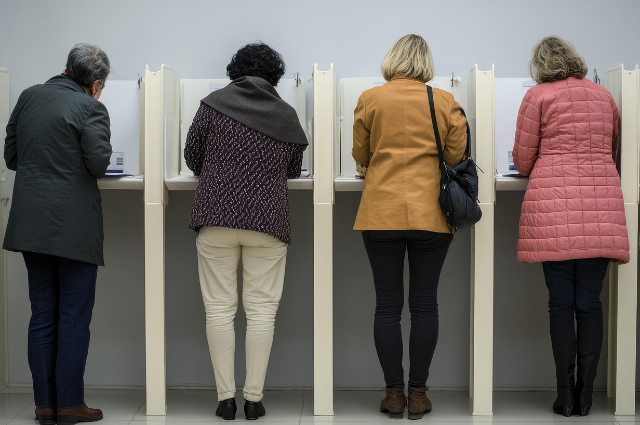
India loves voting like it’s a sacred ritual. Flags, slogans, speeches, drama—full Bollywood. But there’s one button on the EVM that doesn’t care about your party, your ideology, or your family’s political legacy. One button that says, quietly but brutally: “No.”
That button is NOTA. And every election, people press it like they’re slamming a door on bad options. The fantasy is simple: If enough people press NOTA, the system will collapse and reboot. Like a political Ctrl+Alt+Delete.
Cute dream.
But does it actually work like that?
No. And that’s exactly why NOTA is both powerful and pathetic at the same time.
NOTA—“None of the Above”—is a voting option that lets a citizen officially reject every candidate in the fray. It didn’t exist in India forever. It arrived in 2013 after the Supreme Court, in PUCL v. Union of India, directed the Election Commission to provide a way for voters to reject candidates while protecting secrecy. Before this, if you hated everyone, you had to use Rule 49-O: you’d tell the polling officer you’re not voting for anyone, sign a register, and basically announce your political disappointment out loud. That was not “democratic freedom,” that was public humiliation with paperwork. NOTA fixed that. Now your rejection stays private.
That privacy matters more than people admit. Because in India, voting isn’t always just voting. Sometimes it’s a performance. Sometimes it’s pressure. Sometimes it’s fear. NOTA gave people the right to show up without being forced to “choose a side” they don’t believe in.
So yes, NOTA is a real right.
But here’s the part people don’t like hearing: NOTA is not a weapon. It’s a receipt.
Legally, in Lok Sabha and State Assembly elections, NOTA does not change the result. Not even a little. If NOTA gets a million votes and the top candidate gets ten votes, the candidate still wins. NOTA does not trigger a re-election. It does not disqualify anyone. It does not cancel the election. It simply exists as an official number that says: people rejected the choices.
This is the core scam feeling around NOTA. It looks like a protest button, sounds like a protest button, feels like a protest button… but it behaves like a silent complaint box that nobody is required to open. Democracy handed you a “reject” option, then removed the part where rejection has consequences. That’s why critics call it toothless. Because it’s basically saying: you are free to hate us, just don’t interrupt the outcome.
So why do people still press it? Because emotionally, NOTA feels clean. It feels like self-respect. It feels like refusing to marry the “lesser evil.” It feels like a statement: “I won’t reward garbage by choosing which garbage smells less.”
But elections aren’t therapy. They’re math.
And in electoral math, NOTA has a messy side effect: it can accidentally help the worst candidate win. Here’s how. Elections often come down to strong loyal vote banks versus divided anger. When angry voters choose NOTA instead of backing the strongest opponent, they split the anti-incumbency mood. The strongest party’s loyal base stays intact, while the protest vote disappears into a number that changes nothing. That’s why NOTA sometimes behaves like a strange secret ally of powerful candidates—not because it supports them, but because it refuses to fight them.
This is where NOTA becomes dangerously misunderstood in 2026. Because the mood of the country right now isn’t just dissatisfaction. It’s distrust. People don’t just hate candidates; they hate the menu itself. The same recycled faces. The same parties acting like constituencies are family property. Criminal allegations on candidates becoming “just background noise.” Tickets handed out like loyalty rewards.
And when the menu is trash, NOTA becomes tempting. It lets you say: “I am not participating in this circus.” Except—you are. You showed up. You pressed a button. You are participating. You’re just not changing the winner.
But don’t get it twisted: NOTA isn’t pointless. It’s just not the superhero people imagine. Because NOTA’s real power is not legal. It’s psychological.
High NOTA numbers embarrass parties. They expose bad candidate selection. They reveal voter disgust in an official, measurable way. And politics is a game of perception. Parties can ignore tweets. They can ignore protests. They can ignore outrage on Instagram. But election numbers? Those are permanent scars on record.
There have been several cases where NOTA votes were higher than the victory margin. Meaning, the number of voters who rejected everyone was literally larger than the number separating the winner and runner-up. The winner still wins—yes. But it changes the nature of that win. It turns it into a technical victory, not a trusted one. That matters because legitimacy is currency in politics.
Imagine someone wins by 700 votes. But 8,000 pressed NOTA.
That win is not a victory speech. That’s a survival story.
And sometimes, that survival story becomes the opposition’s biggest weapon in the next election. NOTA doesn’t overthrow leaders today, but it plants doubt about them tomorrow.
Now here’s the most interesting part—this is where NOTA stops being just “symbolic” and starts sounding like a threat. In some local body elections, certain state election rules have treated NOTA more aggressively. Haryana, for example, has discussed and implemented approaches where NOTA is treated like a “fictional candidate” in municipal polls, meaning candidates need to beat NOTA to win. In such frameworks, if NOTA becomes the top choice, the election can be forced into a re-poll.
That is the NOTA people want across India.
That is the NOTA that would actually shake parties.
Because imagine this: you field a corrupt candidate, and the public votes NOTA so hard that the election gets cancelled and the same rejected faces can’t contest again. That would force parties to stop treating constituencies like dumping grounds for criminals and nepotism. That would change candidate selection overnight. That would turn NOTA from a protest into a punishment.
But at the national level? NOTA has none of that bite.
So can NOTA force a systemic reset in Indian politics? Not right now. Not in its current form. A reset requires consequences. And Indian national politics doesn’t do consequences for parties—it does consequences for people.
Right now, NOTA is a powerful symbol but a weak tool. It gives you voice, not power. It gives you a way to register disgust, not a way to stop the result. It’s democracy’s way of saying: “We hear you.”
And then immediately continuing with: “Anyway.”
Still, NOTA is not useless. It’s a mirror. And India desperately needs mirrors.
Because the biggest lie Indian elections sell is that you’re always choosing between “good and bad.” Often, you’re choosing between “bad and worse.” And NOTA exposes that reality in the cleanest way possible. It tells the political class: this isn’t a mandate, it’s a compromise. It tells the system: your candidates are not inspiring loyalty, they’re surviving on lack of alternatives. And the more people press NOTA, the louder that truth becomes.
Here’s the real final verdict: NOTA is not a reset button. It’s the alarm.
It doesn’t burn the building down.
It doesn’t rebuild it.
But it screams that something inside is rotting.
And if enough people hear that alarm and stop accepting trash options like it’s normal… that’s when the reset begins. Not from NOTA alone. But from what NOTA represents: a country that’s done being emotionally blackmailed into choosing the lesser evil forever.