
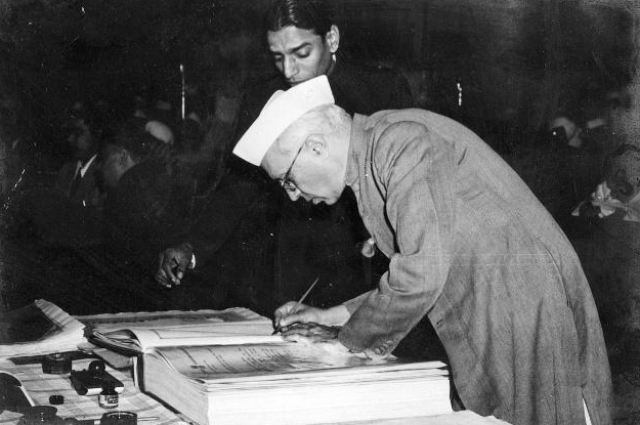
On January 24, 1950, India wasn’t just finishing a document. She was finishing a destiny.
The Constitution of India was finally ready to be signed — after years of debates, drafts, disagreements, revisions, sleepless nights, ideological wrestling matches, and a kind of emotional exhaustion that only a newly born nation can understand. The pages weren’t just paper. They were the stitched-up skin of a country that had survived Partition, riots, displacement, and the brutal identity crisis of “Who are we now?”
And yet… on the day everything was supposed to be perfect, ceremonial, historic, immortal — something tiny, almost silly happened.
A signature problem.
Not a “court-case scandal” problem. Not a “constitutional breakdown” problem. Just a very human, very awkward, very India-coded “oops” moment that somehow still made it into the story of our democracy.
And honestly? That moment tells you more about power, protocol, ego, and hierarchy than half the chapters in civics books ever could.
Because the day the Constitution was ready to be signed, Jawaharlal Nehru was the first one to sign it.
And that wasn’t how it was supposed to happen.
The moment that felt like a movie scene but wasn’t scripted
Picture this.
The room is serious. The air is thick with history. People are dressed like it’s the final scene of a national epic. The Constitution lies there in its final form — beautifully handwritten, illuminated, artistic, dignified. You could almost hear the future humming inside it.
And Nehru, being Nehru — charismatic, confident, emotionally charged, slightly dramatic in the most leader-like way possible — steps forward and signs.
First.
Now in a normal setting, if someone signs something first, you’d be like “okay cool, next person.” But this isn’t a college farewell card or your friend group’s “who’s paying for pizza” pact. This is the Constitution. And in formal protocol, the highest authority signs first.
At that time, Dr. Rajendra Prasad, as the President of the Constituent Assembly (and soon to become the first President of India), was supposed to sign first.
But Nehru already did.
And suddenly the room had that quiet panic vibe — the kind where nobody wants to say anything because everyone knows it’s a mess but also… it’s Nehru. Like, do you correct him? Do you cough politely? Do you pretend the ink didn’t happen?
This wasn’t a legal crisis. The Constitution wasn’t invalid because of the order of signatures. But symbolically? It mattered.
Because symbolism is the soft power that runs entire nations.
The “signature fix” that became an accidental metaphor
So what happened next is honestly the funniest thing ever in the most dignified way possible.
They couldn’t erase Nehru’s signature. They couldn’t redo the page. They couldn’t reprint it like a school assignment. The document was sacred. The moment was official.
So the solution had to be… practical.
And that’s when Dr. Rajendra Prasad had to do something that no one dreams of doing on a day that’s supposed to be about glory.
He had to squeeze his signature above Nehru’s.
Yes. Literally.
If you look at the original document today, his signature sits cramped at the very top, slightly tilted, placed in whatever little space was left — like someone trying to write their name on the last line of an attendance sheet when the teacher already filled it up.
It’s awkward. It’s tight. It looks like he had to adjust his wrist mid-sign.
And it’s kind of poetic, isn’t it?
Because even in the birth moment of Indian democracy, hierarchy insisted on being respected… even if it meant making the topmost authority physically bend into the tiny space left by the more popular leader.
That one squeezed signature became history’s most subtle reminder: power and popularity aren’t the same thing.
Why did it matter so much if Nehru signed first?
Let’s be clear: Nehru wasn’t trying to disrespect anyone. He wasn’t pulling a villain move like “I’m the main character, bye.” It was likely excitement, momentum, human impulse — the same energy as when someone cuts a cake too early because they’re hyped.
But the problem is, protocol is not about feelings. Protocol is about order.
In a country like India, where systems were being built from scratch, the order of who signs first wasn’t a small matter. It was meant to show who holds what position in the constitutional structure. It was a way to send a message to the entire nation:
“This is bigger than personalities. This belongs to the institution.”
And yet Nehru’s signature going first accidentally made it seem like the Constitution was being claimed by the executive leader rather than being formally endorsed by the constitutional head.
Even if nobody said it out loud, that’s exactly the kind of symbolism that makes people uncomfortable in state ceremonies.
So yes, they fixed it. Not because the Constitution needed saving, but because the optics did.
The real-life vibe behind “who goes first” in India
This may look like a cute anecdote, but it’s actually a perfect micro-example of a very Indian truth:
We are obsessed with “who goes first.”
Who enters first. Who speaks first. Who sits where. Who gets introduced first. Who is on the banner in bigger font. Who is in the front row. Who holds the mic first. Who cuts the ribbon.
I’ve seen it happen in the smallest events too — school annual days where the principal gets offended if someone forgets to invite them on stage first, family functions where elders will literally pause the entire ritual because someone younger stepped ahead, college fests where organizers panic if the chief guest isn’t welcomed in exact order.
It’s almost funny until you realize how deeply it’s tied to status and respect.
And the Constitution signing moment was basically the national version of that.
Except the “chief guest” was the future Prime Minister of India, and the “principal” was the first President of India.
And the attendance sheet? It was the damn Constitution.
Dr. Rajendra Prasad: the man who didn’t make drama but made history
What makes this story even more interesting is the personality of Dr. Rajendra Prasad himself.
He wasn’t the loud kind of leader. He wasn’t the headline-hunter. He wasn’t trying to be dramatic. He was known more for steadiness than spectacle.
And that’s why this cramped signature stands out.
It’s not just ink. It’s restraint.
Because imagine the ego pressure in that moment. If it were some other powerful man, he might have made a scene. He might have demanded the page be redone. He might have paused everything for protocol correction and embarrassed Nehru publicly.
But that didn’t happen.
Instead, the fix was quiet, clean, and done in seconds.
That tells you something about leadership too: sometimes the strongest people don’t raise their voice, they just adjust the situation and move forward.
This tiny mistake actually reveals a huge truth about Indian democracy
Here’s the part that hits harder when you think about it.
Nehru was the face of independent India for the public. He was magnetic. He was admired. He was “India’s hero” in many eyes. Even today, he’s one of those names that people fight over like it’s a sports rivalry.
Rajendra Prasad, on the other hand, was the constitutional figure. Less glamour, more grounding.
So when Nehru signs first, it’s like popularity walking ahead of protocol.
And when Prasad squeezes above him, it’s like the Constitution reminding everyone: “Boss, respect the structure.”
That moment is basically India in one frame — emotions, personality, charisma, crowd-energy… and then the system quietly pulling the reins back.
Because democracy works best not when leaders are flawless, but when institutions are strong enough to handle human slip-ups.
A case study in symbolism: how small gestures shape big authority
Political scientists love to talk about how institutions are built not just by laws, but by symbols.
Take the swearing-in ceremonies of presidents and prime ministers across the world. The way someone holds the book, the oath wording, the order of seating, the handshakes — these things are not random. They are deliberate performances of authority.
In India, this is even more intense because we were emerging from colonial rule. The British ran their administration with extreme formality. Titles, ranks, and protocol were how empire maintained dominance.
So when India became independent, we inherited some of that obsession with order, but we also needed it, because without order, a new nation can fall into chaos very fast.
This “signature fix” is a tiny case study of that idea: you don’t just make a Constitution, you stage its legitimacy.
And staging legitimacy means even the signatures must sit in the right order.
Even if one had to be squeezed in like a last-minute exam answer.
The chaos inside the calm: real human energy in nation-building
People sometimes imagine our freedom leaders as these perfect, statue-like personalities who never made mistakes and spoke only in polished speeches.
But nation-building isn’t clean. It’s messy. It’s deeply human.
A leader signs too early. Another adjusts. A room full of people pretends nothing happened. History moves forward anyway.
And honestly, I love that.
Because it proves something comforting: India’s democracy wasn’t built by robots or angels. It was built by humans — excited humans, stressed humans, proud humans, tired humans — trying to do the right thing in a moment too big for any one person.
That cramped signature is still speaking to us
Today, when you look at that signature of Dr. Rajendra Prasad — tilted, tight, forced into a small space above Nehru’s — it almost feels like the Constitution itself is whispering:
“Respect the seat, not the celebrity.”
And that’s a lesson India still struggles with.
We still worship personality over principle. We still cheer louder for power than for process. We still confuse noise with authority.
But that squeezed signature? It’s proof that our foundations tried. Our foundations cared. Our foundations were obsessed with getting the hierarchy right — not to boost ego, but to keep the system steady.
So yeah, Nehru signed first. It was awkward.
But the Constitution survived.
Because that’s the point.
A country doesn’t become great because nobody makes mistakes. A country becomes great because when mistakes happen, the system can still hold.
And in that tiny space above Nehru’s name, Dr. Rajendra Prasad left more than a signature.
He left a reminder.
That even the most powerful man in the room must still fit inside the Constitution.
. . .
REFERENCES:
- National Archives of India (NAI) – Archival material and preserved constitutional records (original Constitution pages and related documentation).
- Parliament of India / Constitution of India (Official Portal) – Background on adoption, signing, and official constitutional timeline.
- Constituent Assembly Debates (Official Records) – For context on the Constituent Assembly, signing phase, and closing procedures.
- SANSAD TV / Rajya Sabha TV Features – Episodes and historical explainers discussing Constitution signing & key figures.
- PIB (Press Information Bureau) – Government of India – Articles/features released around Constitution Day and constitutional history.
- Nehru Memorial Museum & Library (NMML), New Delhi – Historical archives and collections related to Nehru-era documentation.
- Books (standard history references):
- India’s Constitution: Origins and Evolution (scholarly references on drafting & adoption)
- The Framing of India’s Constitution by B. Shiva Rao (primary compilation source)
- Reproductions of the signed Constitution page (for the signature placement) in reputable history columns and archival photo features published during Republic Day/Constitution Day coverage.