
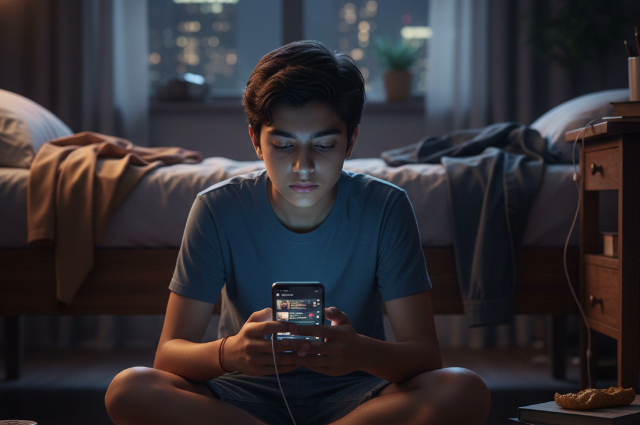
There’s a new kind of ache in contemporary Indian fiction, quiet, pixel-lit, and anxious, and it’s being written in the tight, urgent lines of short stories and personal essays. Young protagonists in these works don’t always weep by the riverside or write confessional letters; they scroll, they perform, they curate their suffering into profiles. Literature has always been a mirror; what’s new is that the mirror is a phone, and the cracks are algorithmic.
Across India, social media isn’t just background noise for adolescents anymore it’s a shaping force. Recent studies tie heavy screen use and short-video consumption to rising anxiety, depression, and sleep disruption among Indian youth, and these findings are showing up in fiction with unnerving literalness. One 2024 study of almost 1,400 young people found depression and anxiety symptoms in significant proportions, and linked social-media use and poor sleep to worse outcomes the clinical statistics underscore what contemporary writers are dramatizing on the page.
New literary forms flash fiction, linked micro-stories, personal essays published on Substack and longform websites, and curated short-story collections are best suited to depict the fragmentary attention economy teenagers live in. Where a novel might attempt to map a long arc, a micro-story hits like a notification: instant, addictive, and sometimes, after the second or third hit, disorienting. Writers are using form as theme. Stories composed of chat transcripts, app notifications, and image captions do more than experiment; they mimic the lived interiority of a generation whose inner monologue is a thread of updates.
Take the trend of short collections and online anthologies that center “digital adolescence.” Editors and writers now foreground screen-mediated experiences ghosting, FOMO, parasocial crushes in ways that interrogate how identity is constructed and consumed. The Himalayan Writing Retreat’s recent roundups and various contemporary anthologies have included stories that treat online spaces as both playgrounds and prisons for young people trying to form selves. These platforms act as vital incubators for work that feels immediate and unrehearsed.
A useful case study one that’s less about a single canonical volume than about a constellation of recent short-story work is the small but growing archive of Indian pieces that center “reels,” “likes,” or the compulsive refresh. Many of these stories don’t moralize. They render how digital habits seamlessly bleed into relationships: a lover ignored because a trending video must be watched; a friendship that survives only through comment threads; a teenager modeling bravery for followers while privately collapsing. This narrative economy is mirrored in recent sociological and psychological research into short-video addiction and reels culture research that documents precisely how platforms incentivize brief rewards and repetitive engagement.
What sets the best of this new fiction apart is realism married to craft. Instead of using the internet merely as a plot device, writers are investigating the psychic architecture of life online. For example, some stories pivot on the peculiar grammar of shame: the humiliation of a private photo going public; the slow erosion of self-esteem from algorithmically amplified comparison. Others go internal exploring sleeplessness after doomscrolling, the blunted emotional response that comes from consuming trauma as content, and the dissociation that follows endless self-curation. These are not abstract debates but lived experiences for many Indian adolescents and literature is documenting it with specificity and tenderness.
There’s also a pedagogical impulse in many of these collections. Short essays interspersed with fiction confessional pieces by clinicians, helplines, or educators ground the narratives in public-health reality. That mirrors the academic and clinical work being published: scoping reviews and intervention studies aimed at children and adolescents trying to reverse digital dependency. Those papers show that telling the story isn’t enough; the story’s circulation can prompt resources, classroom conversations, and policy awareness. When fiction and scholarship talk to each other, the result is both human and actionable.
But there are critical caveats. First: representation doesn’t automatically equal solution. Literature can illuminate trauma without offering therapeutic answers; it can confirm experiences without fixing underlying structural problems like insufficient mental-health services, unequal access to offline community, or parental digital literacy. Second: there’s a risk of moral panic, where narratives about “digital ruin” eclipse nuanced accounts of how technology can also connect isolated youth to communities and resources. The best short stories avoid binary thinking: they show how screens can be both lifeline and trap, scaffold and snare.
What might a reader take away? For educators and parents, these collections can be diagnostic: they reveal patterns of behavior and language the memes, the slang, the ways adolescents talk about themselves that adults might otherwise miss. For writers and critics, the new work is an invitation to innovate formally: to fold notifications into narration, to let typographic play echo attention shifts, to use fragmentation as a moral instrument. For adolescents themselves, seeing these traumas on the page can be radical; it normalizes the experience of being shaped by platforms and validates the messy work of disentangling identity from metrics.
If Indian literature of the next decade wants to remain honest, it will need to keep listening to the screens it once dismissed. The short story quick, sharp, and able to mutate at the pace of a trending sound is proving itself the perfect vessel for the unfiltered life. Because when trauma lives in fifteen-second loops, our stories must learn to loop, too but with an ending, or at least a pause, that lets us breathe.
References
- The Times of India. (2024). Study links heavy social media use with rising depression and anxiety among Indian teens. The Times of India.
- The Himalayan Writing Retreat. (2024). Best Contemporary Indian Short Stories: Digital Life, Youth Culture & Modern Storytelling. Himalayan Writing Retreat Blog.
- SSRN (Social Science Research Network). (2023–2024). Research papers on reels culture, digital addiction, and the psychological effects of short-video consumption among Indian youth. SSRN Electronic Journal.
- EnglishJournal.net. (2024). Essays and reviews on virtual romance, identity formation, and youth psychology in digital spaces. English Journal Online.
- MDPI – Multidisciplinary Digital Publishing Institute. (2023–2024). Scoping reviews and intervention studies on digital dependency in children and adolescents. MDPI Journals