
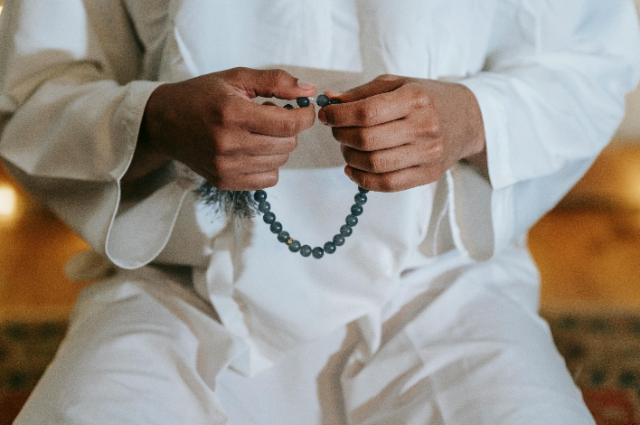
At the edge of Unava village in Gujarat’s Mehsana district stands the Mira Datar Dargah, a shrine unlike any other in India. For centuries, families have arrived here with fear clenched in their chests: a son speaking to unseen figures, a daughter screaming through the night, a mother frozen in silence. To them, the cause is clear—spirit possession. The Dargah, dedicated to the martyr Hazrat Saiyed Ali Mira Datar, has long been believed to be the final authority on such afflictions, often called the “Supreme Court” for jinn possession.
Every day, thousands gather within its compound. Some shout in pain, some laugh without reason, some sit unmoving for hours. What families describe as possession, psychiatry recognizes as paranoid schizophrenia, bipolar disorder, hysteria, or severe psychosis. For decades, these two explanations—faith and medicine—stood on opposite sides, each refusing to acknowledge the other. That conflict left patients untreated, stigmatized, and often chained to rituals that drained families emotionally and financially.
Mental health programs in rural India have repeatedly failed because they attempted to replace belief with science. Doctors spoke in diagnostic terms, while families spoke in spiritual ones. Clinics remained empty, while shrines overflowed. The failure was not of medicine, but of approach.
The transformation at Mira Datar began with a social worker, not a psychiatrist. Milesh Hamlai, founder of the Ahmedabad-based NGO Altruist, understood this divide personally. His own brother lived with schizophrenia, and Hamlai witnessed how families struggled between hospital advice and social stigma. He observed a striking contradiction: psychiatrists waited in clinics, while thousands of mentally ill patients crowded religious spaces, never seeking medical help because they believed their suffering was spiritual.
Hamlai’s breakthrough was simple yet radical. Instead of educating patients, he educated faith healers. Instead of challenging belief, he worked within it.
This led to the innovation now known as the “Divine Referral.” The process begins exactly as families expect. A patient is brought to the Dargah. The Mujavir performs the ritual and recites prayers. Faith is neither questioned nor interrupted. Then comes the turning point. The healer hands the family a referral slip and tells them that the spirit is strong, and that prayers will work faster if the patient also takes “dava” from the clinic inside the shrine.
The clinic, supported by the government and run with Altruist’s guidance, provides psychiatric evaluation and antipsychotic medication. To the patient, these are not medical pills. They are spirit-weakening tools that assist the prayer. Treatment compliance rises instantly. Resistance disappears.
This model succeeds because it reframes medicine rather than opposing belief. Psychologically, it avoids confrontation and reduces cognitive dissonance. The Mujavir acts as a gatekeeper of trust, legitimizing treatment in a way no doctor could achieve alone. Socially, it dismantles stigma without shaming families for their beliefs.
The collaboration faced early resistance. Healers feared losing authority and income. Doctors worried about compromising scientific integrity. The conflict over credit—who cured the patient—was resolved through humility. Doctors allowed healers to receive recognition, openly attributing recovery to the Dargah’s blessing. The result was cooperation instead of competition.
Since 2008, the program has treated more than 38,000 patients. Families spend less time and money staying near the shrine. Violence linked to untreated psychosis declines. Recovery becomes possible without cultural alienation. The model has been cited by the Supreme Court of India as a best-practice example and featured on national platforms such as Satyamev Jayate.
The Mira Datar experiment proves that mental healthcare does not need to erase tradition to be effective. In deeply religious societies, belief can be transformed into a bridge rather than a barrier. Sometimes, healing begins with a prayer. Sometimes, it is completed with a pill. At Unava, the two walk side by side.
. . .
References:
- Altruist
Hamlai, M. (Founder). Altruist NGO, Ahmedabad, Gujarat.
Field-based mental health intervention integrating faith healers with psychiatric care at Mira Datar Dargah.
Source of program structure, referral model, and treatment statistics. - Mira Datar Dargah
Historical and ethnographic accounts of faith healing practices at the shrine dedicated to Hazrat Saiyed Ali Mira Datar.
Used for contextual background and patient demographics. - Shields, L., et al. (2016).
How can mental health and faith-based practitioners work together? A case study of collaborative mental health in Gujarat, India.
Transcultural Psychiatry.
Provides analysis of collaboration between psychiatrists and faith healers, including trust-building mechanisms. - Hamlai, M., et al. (2021).
Unique collaboration of modern medicine and traditional faith-healing for the treatment of mental illness: Best practice from Gujarat.
Case study analyzing patient data (2008–2018) from Mira Datar Dargah, including interviews with treated patients. - Supreme Court of India
Judicial observations referencing the Mira Datar mental health collaboration as a model for culturally sensitive psychiatric care. - Satyamev Jayate (Season 3, Episode 5: Nurturing Mental Health)
National media documentation featuring interviews with Milesh Hamlai and visual coverage of the clinic inside the Dargah. - National Institute of Mental Health and Neurosciences (NIMHANS).
Reports on schizophrenia, bipolar disorder, and culturally sensitive psychiatric interventions in India.
Used for clinical framing of symptoms described as “possession.”