
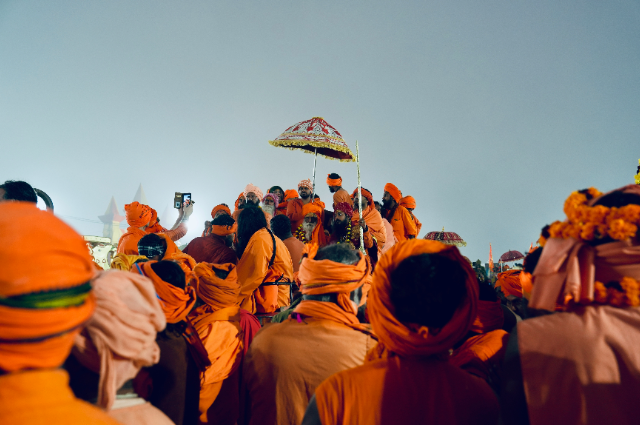
India doesn’t just breathe politics. It chants it, sings it, carries it in temple bells and election slogans, mixes it with holy ash and TV debates. In this country, faith is not only devotion—it is also influence. Sometimes gentle, sometimes loud, sometimes sacred, sometimes strategic. And the Shankaracharya controversy at the Magh Mela in Prayagraj became one of those moments where religion stopped being just prayer and quietly stepped into the arena of power.
To understand why this incident exploded into headlines, you have to first feel the scale of the Magh Mela. Every year, millions of devotees gather at the Sangam—the confluence of the Ganga, Yamuna, and the mythical Saraswati—to take a ritual dip believed to cleanse sins and grant spiritual merit. The day of Mauni Amavasya is the most sacred and the most crowded, the kind of day where faith becomes a river of human bodies moving in one direction. In 2026, authorities were operating under maximum alert because crowd surges at such gatherings have historically posed stampede risks.
In the middle of this charged spiritual atmosphere, Swami Avimukteshwaranand Saraswati, who uses the title Shankaracharya of Jyotirmath, was moving toward the Sangam with a traditional procession. What happened next was less about one road being blocked and more about two worlds colliding. Officials stopped the procession near the restricted zone, citing safety protocols and movement restrictions during peak crowd hours. The incident triggered a standoff that would last days and dominate the national conversation.
From the administration’s side, the reasoning sounded procedural. When millions are gathered in a tight geography, even a small unauthorised movement can spiral into chaos. Authorities argued that access through restricted routes and unscheduled processions could increase stampede risk and disrupt carefully planned crowd management. India has painful memories of religious gatherings turning tragic because of mismanaged crowds, so officials tend to prioritise control, sometimes at the cost of sentiment.
But faith does not operate on bureaucratic language. For the Swami and his followers, the stoppage was not just a logistical pause—it felt like humiliation. Soon after the confrontation, the Mela administration issued a formal notice asking him to explain why he was publicly using the title “Shankaracharya,” pointing to an ongoing legal dispute over the legitimacy of that designation. That single document shifted the situation from a traffic issue into a question of religious authority itself.
The title Shankaracharya is not decorative. It carries centuries of spiritual hierarchy and institutional weight within Hindu traditions. The dispute over who is the rightful head of the Jyotirmath has existed for years and is linked to cases referenced in court proceedings. When the administration invoked that legal ambiguity in the middle of a sacred festival, it turned a practical disagreement into a symbolic confrontation between state power and spiritual legitimacy.
The reaction from the Swami’s camp was intense. His legal team responded with a detailed reply demanding that the notice be withdrawn, calling it arbitrary and insulting not just to him but to the larger religious tradition. Statements from his side framed the issue as an attack on faith rather than a procedural enforcement. The conflict escalated into a public standoff, and warnings of legal action entered the conversation.
As always in India, the moment religion meets authority, politics arrives like an uninvited but inevitable guest. Leaders from different parties began reacting. Some defended the administration’s duty to maintain law and order during a massive gathering. Others positioned the incident as disrespect toward a revered religious figure. The story quickly transformed from a local dispute into a narrative about cultural dignity, governance, and ideological identity.
This is where the idea of religion as soft power becomes visible. Soft power is influence without force—the ability to shape public emotion, identity, and loyalty. In India, religious figures hold moral authority that can mobilise large communities. When such a figure is seen as being mistreated, the reaction is not limited to one ashram or one district; it spreads through television debates, social media discussions, political speeches, and everyday conversations. The emotional capital of faith becomes a political resource.
The situation stretched into a prolonged face-off, with additional notices and warnings related to camp arrangements. Eventually, after days of tension, the Swami left the fairgrounds earlier than expected, showing how a spiritual gathering had turned into a site of administrative negotiation. Later developments indicated attempts from officials to ease tensions and handle the matter respectfully, revealing that both sides understood the symbolic sensitivity involved.
What makes this incident bigger than a festival disagreement is the layered meaning behind every action. The administration believed it was enforcing safety rules in one of the world’s largest religious gatherings. The religious side felt that centuries-old traditions were being subjected to modern bureaucratic permission. Political actors saw an opportunity to frame narratives about cultural respect, governance, and ideological legitimacy. And the public—especially devotees—experienced it as something deeply emotional, because when faith is interrupted, it doesn’t feel like a policy issue; it feels personal.
India has seen similar patterns before. From temple entry debates to disputes over religious processions in crowded cities, the recurring tension is always the same: where does devotion end and regulation begin? A secular state is expected to treat all faiths equally, yet it also has the responsibility to prevent disasters in gatherings where millions assemble. That balancing act is emotional, historical, and often political.
The Shankaracharya controversy is a clear example of how symbolic authority can rival administrative authority without either side intending a full-scale conflict. A blocked path became a bruised identity. A notice became a narrative. A ritual pause became a national debate. That is the strange poetry of Indian public life—where a holy dip can turn into a constitutional conversation overnight.
Religion in India rarely shouts; it resonates. It moves through memory, tradition, and collective belonging. That is why it functions as soft power—because it doesn’t need force to influence millions. When political spaces intersect with sacred ones, even a small procedural decision can echo across the country.
In the end, the Magh Mela incident was not simply about whether one procession should have been allowed. It revealed something deeper about modern India—how ancient titles still carry real authority, how legal ambiguity can ignite emotional reaction, and how politics often rides on the currents of belief. The river at the Sangam keeps flowing, indifferent to human arguments, but on its banks, the ongoing interaction between faith and power continues—sometimes calm like prayer, sometimes sharp like protest, always reminding us that in India, spirituality is never just private. It is public energy, cultural identity, and a real form of influence.
. . .
References:
- India Today – Coverage on Prayagraj Magh Mela Shankaracharya controversy (Jan 2026)
- Times of India – Report on notice regarding the use of the Shankaracharya title
- Hindustan Times – Reports on Magh Mela standoff and administrative actions
- The Indian Express – Coverage on legal responses and eviction notice developments
- Republic World – Explanation of the Magh Mela row and administrative reasoning
- ABP Live and regional coverage on the notice and title dispute context
- IANS and other news agencies report referencing the ongoing legal ambiguity around the Jyotirmath Shankaracharya position