
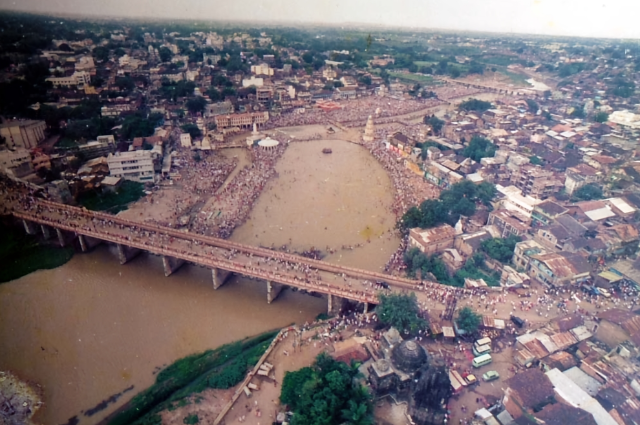
India doesn’t do anything halfway, especially not faith. When this country celebrates belief, it doesn’t settle for a cozy little gathering. Nope. It summons millions, folds mythology into everyday life, paints the streets with saffron dust, and sets the rivers shimmering with humanity’s oldest prayers. And nowhere does this harmony of devotion play louder than in the Kumbh Mela, particularly in its Nashik and Prayagraj avatars.
These two cities, one resting against the gentle Sahyadris, the other embracing the confluence of sacred rivers, host some of the largest social events on planet Earth. And while their landscapes differ, their cultural heartbeat syncs like twin drums in the same cosmic procession.
Let’s walk through the similarities between these two cities that draw millions in devotion.
The Mythology That Binds Them
Both Nashik and Prayagraj rise into the spotlight every Kumbh season, glowing like ancient cities wrapped in a modern pulse. Despite their geographical differences, they become mirror-worlds during the Mela, two massive heartbeats thumping to the same rhythm of belief, community, and cosmic timing.
The Kumbh Melas in Nashik and Prayagraj trace their identity to the timeless story of the Samudra Manthan, the legendary churning of the celestial ocean. When the pot of amrit (immortality nectar) surfaced, a celestial chase broke out. Drops fell at four sacred places: Haridwar, Nashik, Ujjain, and Prayagraj.
Nashik and Prayagraj share that divine spotlight; they’re drenched not just in myth but in the idea that some ancient splash of immortality still shimmers in their waters. Both Melas run on the same cosmic timer: the alignment of Jupiter, the Sun, and the Moon. Astrology decides the date; humanity follows like moths to a divine flame.
Pilgrim Waves That Turn Into Human Oceans
If there’s one thing Nashik and Prayagraj share beyond mythology, it’s the sheer magnitude of human presence. Imagine millions moving with a single intention, not chaotic, not frantic, but strangely harmonious, like a tide obeying the pull of a spiritual moon. Both cities witness something more than crowds; they witness a collective pilgrimage, a mass movement powered by centuries of faith.
People arrive from everywhere, villages tucked between hills, metro skylines, neighboring countries, and even distant continents. And somehow, both Nashik and Prayagraj absorb this rush with the same warmth. The streets become corridors of devotion, the ghats transform into living riversides of emotion, and even the air hums with chants that rise and fall like ancient breathing.
In both Melas, the crowd isn’t just a number; it’s a story. Every face adds a verse to the epic, every step ripples through the river of collective consciousness.
The Sacred Dip: The Heartbeat of Both Melas
No matter how vast these events grow, everything circles back to one sacred act, the holy dip.
In Nashik, devotees step into the Godavari with folded hands and trembling hearts. In Prayagraj, they enter the Triveni Sangam, where the Ganga, Yamuna, and Saraswati whisper three different stories into a single stream.
That moment when the water touches the skin, it’s as if centuries of prayers rise in a single breath. Millions believe the river will wash away the weight they’ve carried and the sins of a lifetime. These dips don’t purify just bodies; they cleanse histories, memories, and mistakes. Both Kumbhs become sanctuaries where people come to reset their souls.
The Naga Sadhus: The Spectacle of Spiritual Majesty
If the Kumbh Mela had a pulse, the Naga Sadhus would be its thunder.
You see them in both Nashik and Prayagraj, ash-covered, fearless, radiating a kind of ancient intensity that feels almost unreal. Their arrival during the shahi snan procession is nothing short of electric. Drums pound, conch shells echo, and thousands watch in awe as these ascetics, detached from worldly possessions, yet carrying a universe within, lead the bathing ceremony.
Their presence ties the two cities together with an invisible spiritual thread. In Nashik and Prayagraj, they command the same reverence, curiosity, and fascination. They are living symbols of India’s oldest discipline, walking reminders that spirituality can be fierce, raw, and beautifully unapologetic.
A Cultural Tapestry Shared by Both Cities
While the spiritual core remains central, both Melas bloom into cultural carnivals that feel almost like parallel universes. The similarities are striking in both Nashik and Prayagraj:
Devotional music floats through the air from predawn bhajans to late-night kirtans.
Langars and community kitchens serve food with a generosity that melts the heart.
Folk artists and storytellers bring mythology alive in vibrant, playful ways.
Market lanes buzz with handmade crafts, rudraksha beads, religious texts, and the irresistible aroma of street food.
Spiritual discourses by revered saints draw crowds hungry for wisdom.
Both cities transform into learning grounds, marketplaces, temples, and open-air theatres all at once, a living, breathing festival of devotion and human culture.
The Temporary Mega-City Phenomenon
Every Kumbh transforms Nashik and Prayagraj into temporary megacities. Rows of tents, makeshift markets, medical camps, lost-and-found centers, sanitation hubs, and security posts spring up like magic.
Astonishingly, these cities aren’t just hosting pilgrims; they’re building fully functioning urban ecosystems from scratch, capable of handling millions with efficiency, faith, and chaos in perfect balance.
For a few weeks, these spaces become self-contained universes:
Streets buzz with life yet never lose their spiritual undertone.
Temporary hospitals and help centers operate around the clock.
Volunteers, police, and organizers manage the flow with remarkable coordination.
The 2019 Prayagraj Kumbh stands as the world’s largest temporary city, a documented case study by the Uttar Pradesh government and Harvard researchers for its impressive urban planning.
Similarly, Harvard University’s “Kumbh Mela: Mapping the Ephemeral Megacity” project analyzed and celebrated this extraordinary feat of temporary urban design.
Shared Purpose: Renewal and Reflection
At its heart, the Kumbh isn’t just a festival. It’s a social and spiritual reset.
Both Nashik and Prayagraj become spaces where:
Devotees wash away sins and past burdens.
Strangers connect through shared devotion.
Communities rediscover empathy, generosity, and patience.
The physical gathering mirrors an inner pilgrimage. Millions of souls moving together remind each other that life is not just survival, it’s renewal, reflection, and collective rhythm. Have we ever truly witnessed devotion on this scale, where the social and spiritual intertwine so seamlessly?
The Legacy That Ripples Beyond the Mela
The impact of these social events stretches far beyond the rivers. Economically, culturally, and socially, both Nashik and Prayagraj reap long-lasting effects:
Local economies flourish with tourism, trade, and craft sales.
Spiritual and cultural knowledge is passed down to younger generations.
Artists, writers, photographers, and researchers capture moments that continue inspiring the world.
The 2013 Allahabad Kumbh is often hailed for its exceptional crowd management and even received UNESCO recognition, a testament to how effectively the city handled one of the largest human gatherings in history.
At the same time, the 2015 Nashik Kumbh Mela stampede, where 11 people tragically lost their lives, remains an important reminder of the need for continuous improvement in crowd-management strategies.
These events, both the successes and the tragedies, shape evolving policies, safety protocols, and urban planning frameworks for future Melas.
Twin Heartbeats of Humanity
Nashik and Prayagraj may lie hundreds of kilometers apart, but during the Kumbh Mela, their similarities shine brighter than their differences. Both host colossal gatherings, honor timeless myths, let rivers carry away the weight of human existence, and transform into living tapestries of culture, devotion, and community.
When the dust settles, the rivers calm, and the pilgrims disperse, one truth remains: the Kumbh Mela is not just a festival, not just a social event, it’s a celebration of humanity itself, played out in twin heartbeats across two sacred cities.
REFERENCES
- 2019 Prayagraj Kumbh – Case study by the Uttar Pradesh Government & Harvard University.
- Harvard University project: “Kumbh Mela – Mapping the Ephemeral Megacity”.
- 2013 Allahabad Kumbh – UNESCO recognition & crowd‑management success.
- 2015 Nashik Kumbh Mela stampede – Incident with 11 casualties highlighting crowd‑management challenges.