
We live in an era where comfort and convenience exist at just a click; food arrives at our doorstep faster than we can cook, information is available before we even finish typing, and opportunities are far greater than ever before. And still, we find reasons to complain. A delayed message irritates us, slow internet frustrates us, and even the success of someone else becomes a reason to doubt our worth. We measure our happiness not by what we have, but by what we don’t. We chase material success without stopping to appreciate the blessings quietly present in our lives: a family that loves us, a safe home, food on our plate, and the freedom to live openly. Gratitude has become rare, patience feels outdated, and faith in the process of life and in God is fading. In a world that teaches us to run, but rarely teaches us to pause, we keep running, demanding and expecting more, rarely realizing that the life we complain about today is the life someone else is praying for.
Have you ever read about the life of Anne Frank and the millions of Jews during World War II? If you have, and if you truly remember what they went through, maybe you would hesitate before complaining about your own life. Because the life we call “normal” today, freedom, safety, comfort, family, and dreams, was something they couldn’t even imagine having. For them, survival itself was a luxury.
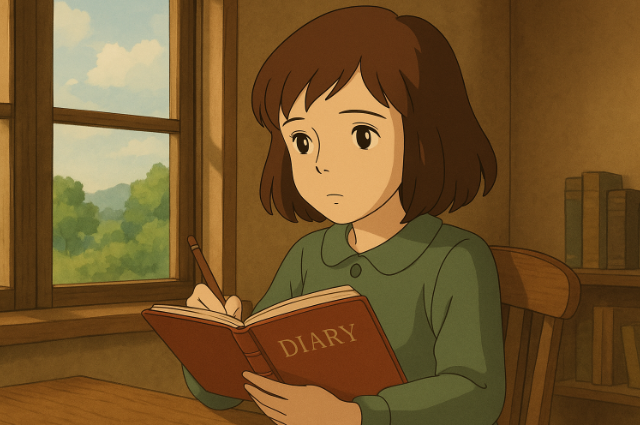
Their biggest struggle wasn’t success, recognition, or material comforts; it was simply to stay alive for one more day. Every moment was filled with fear, uncertainty, and the constant possibility of being discovered and killed. Anne Frank captured these hardships most honestly and heartbreakingly through her diary, the only friend she had, the only place where she could share her thoughts, her fears, and her hopes when the world outside didn’t allow her to speak or even breathe freely.
Adding gratitude to life will make complaints disappear
INTRODUCTION TO HER LIFE
Anne Frank was a young German-born Jewish girl whose life became one of the most defining human stories of the Holocaust. For the first five years of her life, she lived with her parents and older sister, Margot, in an apartment on the outskirts of Frankfurt. But the rise of Nazi persecution forced the family to flee Germany. The Franks moved to the Netherlands in hopes of safety, and Anne joined them last in February 1934, after staying briefly with her grandparents in Aachen.
For a short while, it seemed as if life might return to normal. Anne attended school, made friends, and dreamt of becoming a writer. But that peace was short-lived. In 1941, German forces occupied the Netherlands, and the Frank family once again found themselves facing danger. Restrictions on Jews increased rapidly; schools, jobs, and simple freedoms disappeared one after another. By 1942, Jews across the country were being deported to concentration camps and killing centers.
HARDSHIPS AT “SECRET ANNEX”
On July 5, 1942, the family received a letter summoning Margot to a forced-labor camp. Otto Frank, who had been preparing a secret hiding place for months, knew the time to disappear had come. The very next day, on July 6, the Frank family entered the hidden section of his business building in Amsterdam.
When life became unsafe for Jews in the Netherlands, Anne Frank and her family were forced to disappear overnight. On the morning of 6 July 1942, they walked quietly through the streets of Amsterdam, not to school, not to a holiday, but to a hidden space above Otto Frank’s office, where they hoped to survive. Public transport was forbidden for Jews, so Anne, her parents, and sister walked for kilometers, carrying only the fear of the unknown. To the outside world, their home was left in chaos, as if they had escaped suddenly. A note was even left behind to mislead the Nazis. Every detail was a matter of life or death.
The space became known as the Secret Annex, a small, blocked-off section concealed by a bookcase so no one would ever know there were eight lives hiding behind it. Only a handful of trusted people- Miep Gies, her husband Jan, Bep Voskuijl, her father Johannes Hendrik Voskuijl, Victor Kugler, and Johannes Kleiman- risked everything to help them. They brought food, news, and hope, knowing that if they were discovered, the punishment would be death. Every knock on the door could have ended everything.
In the Annex, life was not peaceful. Seven people shared tight rooms, rationed food, and constant fear. The Van Pels family joined first, and later, a dentist, Fritz Pfeffer. Anne was glad to have more people to talk to, but living together in a prison without walls created conflicts; arguments over food, space, and personality differences. She shared a room with Pfeffer and felt invaded; she clashed with Auguste van Pels; she felt that the adults were often selfish. And yet, she also found comfort in human connection, a shy friendship that turned into a brief romance with Peter van Pels, her first kiss. Even in hiding, she was a teenager, longing to grow, to love, to live.
What kept her heart alive was writing. Her diary became her friend, the only place where she could speak freely, dream loudly, cry quietly, and stay human in a world that refused to see her as one.
Life inside the annex was both ordinary and extraordinary, eight people living in cramped rooms, always afraid of the faintest sound that might alert the outside world. Alongside the Franks lived the Van Pels family and Fritz Pfeffer, making every day a test of patience, hope, and survival. Yet amid hunger, fear, and silence, Anne continued to dream.
She turned to her diary, addressing her entries to “Dear Kitty,” as if writing to a trusted friend. Through her words, she recorded not only the terror around her but also laughter, arguments, small joys, and her hopes for the world after the war.
Anne’s final diary entry was dated August 1, 1944. Three days later, the unimaginable happened: the Gestapo discovered the annex. The family was arrested, sent first to Auschwitz, and later Anne and Margot were transported to Bergen-Belsen, where both died in early 1945, just weeks before the camp was liberated.
Yet her voice survived.
Miep Gies, one of the Dutch individuals who risked their lives to help the hidden families, preserved Anne’s diary after the arrest. When Otto Frank became the only surviving member of the annex, she handed the diary back to him, and the world soon came to know Anne’s words.
Anne Frank’s story goes far beyond tragedy. It is a reminder of how one young girl, with nothing but a notebook and a belief in goodness, managed to speak for millions of silenced lives. Her diary continues to teach the world about the horrors of the Holocaust — and the resilience of the human spirit.
Even in the darkest of times, she held onto hope. As Anne famously wrote: “I still believe, despite everything, that people are really good at heart.”
Even after facing the darkest side of humanity, Anne Frank still believed that “people are really good at heart.” Just imagine, she held on to hope in a world where kindness was almost impossible to find. But we, living in safe homes and surrounded by good people, still find reasons to complain. “He didn’t behave well,” “she didn’t treat me right,” “they didn’t respect me.” We point fingers so easily, yet how often do we look within? Before questioning how others treated us, do we ever ask ourselves: Had I treated them well?
Maybe gratitude begins when judgment ends, when, instead of expecting perfection from others, we learn to appreciate their efforts.
The Final Days of Anne Frank
Just before her death, Anne Frank was enduring the horrific conditions of the Bergen-Belsen concentration camp after her arrest in August 1944. She and her sister, Margot, were battling typhus, a disease that spread rapidly due to the severe shortage of food, medicine, and clean water.
After their hiding place was discovered, Anne, her family, and the others were deported to multiple concentration camps, ultimately ending up in Bergen-Belsen. The camp was overcrowded, unsanitary, and filled with suffering, where countless prisoners died from illness, starvation, and exhaustion.
When a typhus epidemic broke out, both Anne and Margot became infected. Margot died first, and Anne followed just a few days later. She was only around 15 years old when she passed away in early 1945 — just weeks before the camp was liberated by Allied forces.
CONCLUSION
Gratitude doesn’t demand a perfect life; it teaches us to see the beauty in an imperfect one. Anne Frank lived with fear, yet found hope. We live with comfort, yet search for reasons to be unhappy. Maybe the change begins with us. If we start appreciating instead of comparing, loving instead of judging, and thanking instead of complaining, life will quietly become richer, without anything actually changing except our perspective.
How is your viewpoint towards life now? Is it really as cruel or harsh as what the Jews suffered?
If you are even a little impacted by this article, then just implement it in your life and feel the change yourself. Life doesn’t need big actions; even a small change can make a huge difference.