
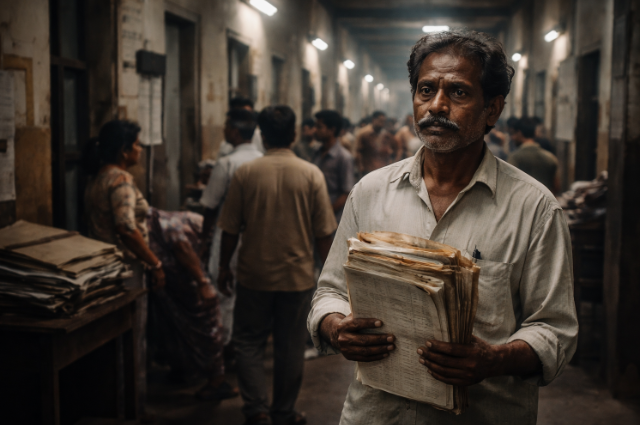
In a country where paperwork often speaks louder than people, the life of Lal Bihari Mritak stands as one of the most unsettling and humane stories of modern India. It is not a story about escaping death but about surviving it while breathing, walking, and speaking. For nearly nineteen years, the Indian state officially believed Lal Bihari did not exist, even as he stood in courtrooms, government offices and streets demanding to be seen. His story sits at the intersection of tragedy, dark humour, and quiet resistance, and it forces us to confront how fragile identity can be when it is reduced to ink and files.
Lal Bihari was born into an ordinary life in the Azamgarh district of Uttar Pradesh. He was a handloom weaver, a profession rooted in patience and skill, and he owned a small piece of ancestral land. In 1975, when he was just twenty years old, he approached a bank for a loan, hoping to improve his livelihood. Instead of financial help, he received a sentence that shattered his reality. The bank rejected his application because, according to government records, he was already dead. At first, it sounded like a clerical error, but it soon became clear that this death had been carefully manufactured.
The truth behind his official death was painful and intimate. Lal Bihari’s uncle had bribed a local revenue official to register him as deceased. The motive was simple and brutally common in rural India. Land. By declaring Lal Bihari dead, the uncle became the legal heir to the property. The amount reportedly paid for this erasure was a few hundred rupees. With that small bribe, a young man’s legal existence was wiped out. This was not an accident of bureaucracy but a deliberate misuse of power that revealed how easily systems can be bent against the vulnerable.
What followed was not immediate outrage or swift justice. Lal Bihari did what most people would do. He approached officials. He filed applications. He went to court. He brought witnesses and documents and even himself as proof. None of it worked. Files moved slowly, hearings were postponed, and officials passed responsibility from one desk to another. Over time, Lal Bihari realised something devastating. The system was not built to listen to individuals, especially when correcting an error meant admitting failure. Once the state declared him dead, the burden of proof fell entirely on the living man to fight a lifeless record.
Being officially dead meant being excluded from society in ways that are difficult to imagine. Lal Bihari could not own property, vote, receive government benefits or take loans. Even the police refused to acknowledge him. In one of the most absurd moments of his life, he discovered that the law could not even arrest him because, on paper, he did not exist. He had become a ghost trapped among the living, invisible to the very institutions meant to protect him.
After years of silence, frustration and humiliation, Lal Bihari understood that quiet suffering would not bring justice. He needed visibility. If the system refused to acknowledge him as a person, he would force it to confront the contradiction. He began to act in ways that were impossible to ignore. He organised a mock funeral procession for himself, marching through the streets and asking the government to complete the ritual if it truly believed he was dead.
The act was shocking, but it carried a sharp logic. A society that trusted records over reality needed to be confronted publicly.
In another desperate attempt to be recognised, Lal Bihari kidnapped his own cousin, the son of the uncle who had taken his land. His intention was not violence or ransom. He wanted to be arrested. An arrest would require paperwork, and paperwork would require acknowledging that he was alive. The police refused, stating that they could not arrest a dead man. The irony was cruel and complete. Even crime could not restore his existence.
One of the most painful moments in his struggle involved his wife. Lal Bihari asked her to apply for a widow's pension, claiming that her husband was dead. The application was rejected because Lal Bihari was standing right there alive. He demanded that the rejection be given in writing. That letter became one of his most important documents. A denial meant to prevent fraud turned into proof of life. In a system obsessed with paperwork, survival depended on collecting contradictions.
Perhaps the most powerful and symbolic chapter of his struggle came when Lal Bihari decided to contest elections. He filed nomination papers to stand against some of the most powerful political figures in the country, including Rajiv Gandhi and V P Singh. He never expected to win.
Winning was irrelevant. By contesting elections, the Election Commission was forced to verify his identity. A dead man could not legally stand for office. Each form, each signature and each acknowledgement became another small victory in his long fight to exist.
As the years passed, frustration turned into bitter clarity. Lal Bihari officially added the word Mritak, meaning deceased, to his name. He began signing letters as Late Lal Bihari Mritak. This was not an act of surrender but a form of protest. By wearing his injustice as a name, he forced people to confront the cruelty of a system that could declare a living man dead and then move on. His name became a reminder that identity is not always something we own. Sometimes it is something we must fight for.
After nineteen years, six months, and twenty-three days of struggle, a district magistrate finally reviewed his case seriously. On June 30 1994, Lal Bihari was officially declared alive in government records. There was no apology and no compensation for nearly two decades of lost life. Those responsible were not punished. Yet for Lal Bihari, recognition itself was a victory. The state had finally acknowledged what he had known all along. He existed.
What surprised many people was his response after winning. He chose not to immediately reclaim his land or seek revenge. He said that the struggle had given him a greater purpose. During his years of fighting, he had discovered that he was not alone. Thousands of people across India had been declared dead on paper by greedy relatives or corrupt officials. Elderly widows, farmers laborers and migrants lived as legal ghosts, unable to access rights or justice.
This realisation led to the creation of the Mritak Sangh or Association of Dead People. The organisation became a space of solidarity for those erased by bureaucracy. It helped members navigate courts, write petitions, and survive in a system that had abandoned them.
What began as one man’s fight turned into a collective movement exposing a hidden but widespread form of injustice.
In 2003, Lal Bihari received the Ig Nobel Peace Prize for what was described as prolific post-mortem activism. The award recognised how unusual forms of protest can reveal serious flaws in governance. Even then, the irony continued. Travel and documentation issues made it difficult for him to attend the ceremony. Death on paper has long shadows.
Today, India has moved into a new era of digital identity. Aadhaar biometrics, centralised databases, and the Digital Personal Data Protection framework promise efficiency and accuracy. Paper deaths may be harder to create, but the core lesson of Lal Bihari’s life remains relevant. When identity is controlled entirely by systems, errors become more dangerous, not less. Digital exclusion, data manipulation, and identity theft are the modern versions of the same old problem. A person locked out of records can still be denied food, healthcare, and justice.
Lal Bihari Mritak’s story matters because it is not extraordinary. It is terrifyingly ordinary. It reveals how easily power can erase the powerless and how survival sometimes requires absurd courage. His life asks a simple but uncomfortable question. What does it mean to be alive? Is it breath or recognition? Is citizenship a right or a database entry?
Lal Bihari did not defeat death. He defeated indifference. In doing so, he left behind a lesson that remains deeply human. A society must never allow paperwork to outweigh people. Because the moment it does, the living begin to disappear quietly.
. . .
References:
- Wikipedia Lal Bihari Mritak: https://en.wikipedia.org
- This source documents his legal struggle, the correction of his death records, the formation of the Mritak Sangh and his Ig Nobel Peace Prize recognition.
- Ig Nobel Prize Official Archive: https://www.improbable.com
- This archive confirms the 2003 Peace Prize and highlights how unconventional civic resistance can expose serious institutional failures.