
I’ve spent a long time watching the wellness world twist itself into increasingly strange shapes, but the last few years have felt different. Something subtle has changed. What used to be about balance, sleep a little more, drink some water, take time to breathe, has shifted into this hyper-optimisation mindset where every moment of your life is supposed to be measured or disciplined. It’s like self-care turned into a second job, one that expects quarterly performance reviews.
Nothing captures this shift better than the whole “dopamine detox” trend. It started with a fairly normal idea: reduce compulsive digital habits. Log off a bit. Stop chasing notifications like crumbs. Reasonable enough. But online, reasonable things rarely stay that way.
Pretty quickly, the message morphed into something harsher, more ascetic:
Avoid pleasure so you can fix your brain.
That sentence still makes me uneasy. There’s something bleak about it, as though joy itself has become suspect.
A lot of people took it literally. Too literally. And suddenly, music, snacks, conversations, hobbies, things that help us feel alive were rebranded as “dopamine traps.” A normal neurochemical got blamed for everything from burnout to boredom to existential dread.
Where It Started, and Where It Went Off the Rails
The original premise wasn’t bad. Therapists sometimes introduce “stimulus breaks” to help people who can’t stop refreshing feeds or toggling between apps. It’s more about noticing impulse loops than cutting joy from your diet.
But algorithms don’t reward nuance. They reward extremity. And so the gentler idea became a kind of challenge culture, the sort of thing you see plastered over thumbnails: “7 Days of No Dopamine,” “Monk Mode,” “Zero Stimulation Experiment.”
The idea spread so widely, so quickly, that it stopped being a suggestion and started looking like a moral stance. The more you restricted, the more disciplined you appeared. The more ascetic you became, the more “optimised.” Pleasure wasn’t just distracting; it was wrong.
When Self-Help Turns Into a Cage
People rarely set out to restrict themselves to misery. They start by wanting clarity. Less noise. A break.
But there’s a certain personality type, perfectionists, people who have been burnt out for years, folks who think they’re always a few habits shy of becoming a better version of themselves, for whom restriction feels like control.
That control quickly becomes a trap.
They start asking:
Is this allowed?
Is this too stimulating?
Am I ruining my progress by listening to music while I cook?
The whole thing becomes a sort of moral scoring system: silence is “productive,” stimulation is “weak.”
It’s a strange, modern kind of asceticism, self-denial dressed up as self-improvement.
Evan’s Story: A Case That Stayed With Us
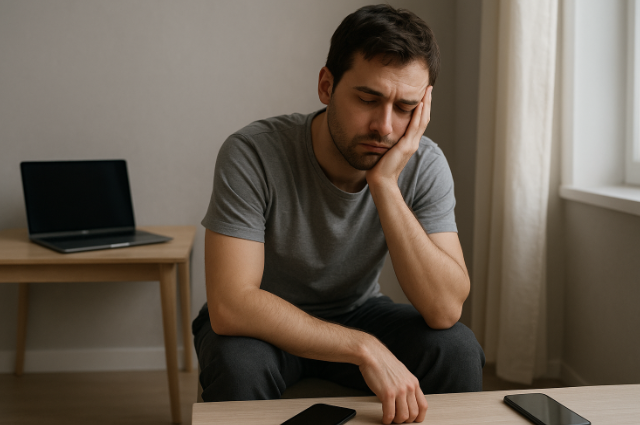
Evan was 28, working remotely in a small apartment with too many screens and not enough sunlight. He was exhausted after a long product launch and scrolling through videos at 2 a.m. when he found a guy preaching the gospel of dopamine fasting. The man looked calm in that eerie way people do when they’ve convinced themselves they’ve solved the human condition. Evan felt the opposite of calm, so he latched onto the idea.
He decided to do a 30-day “deep detox.”
And when he said detox, he meant it.
No social media. No music. No shows. No calling friends just to talk. No snacks, because flavour apparently counted as stimulation. No podcasts on walks. No books, because they could be “engaging.” He even tried not to make eye contact with people on the street.
His days became unbelievably quiet. He ate in silence. Worked in silence. Walked in silence. At night, he would sit in his living room with the lights low and do nothing, don't meditate, don't journal, just… endure the absence of anything.
During the first week, he told himself he felt “disciplined.” But by the second week, things took a turn. He started noticing little spikes of panic whenever he caught himself wanting something: music, company, a laugh. He interpreted each impulse as proof that he was “addicted to dopamine.”
Friends said he sounded distant, flat, almost metallic. He turned down every invitation, terrified that a single fun evening would “overstimulate” him. And loneliness, which he’d had before, now had room to echo.
By week three, he reported feeling detached from reality, like everything around him was muted. Even the colours looked washed out. He kept thinking he was failing the detox somehow, that his emotional numbness meant he wasn’t “cleansing” properly. The thing meant to “fix” him ended up hollowing him out.
The Psychology Behind What Happened
Evan’s experience wasn’t a mystery. It’s what happens when people misunderstand dopamine as “pleasure juice” and treat it as the root of all modern suffering. Dopamine isn’t pleasure, it’s motivation. It’s engagement. It’s how we learn and respond to the world.
If you starve your brain of stimulation, you’re not purifying it.
You’re stressing it.
Total deprivation doesn’t soothe the nervous system; it agitates it. Humans need some level of sensory, social, and emotional input just to feel anchored. Locking yourself into rigid rules can mimic obsessive patterns, not liberate you from them. And social isolation is one of the most reliable stressors we know.
Evan didn’t break himself. The framework broke him.
Why These Trends Keep Happening
Dopamine detoxing isn’t the first extreme wellness trend and won’t be the last.
There are a few reasons they keep popping up:
They use science-y language that sounds legitimate even when oversimplified.
Algorithms amplify the extreme version because moderation doesn’t go viral.
People are desperate for relief, and simple explanations feel comforting.
Optimisation culture rewards self-punishment, as if suffering is proof of seriousness.
So we end up in a world where ordinary human impulses, wanting rest, wanting joy, feel suspicious.
A More Humane Alternative
The antidote to overstimulation is not deprivation. It’s rhythm. Its intention.
Instead of deep detoxes, people usually need:
breaks woven into the day
walks that aren’t silent punishments
conversations that remind them they exist
creative hobbies that spark something quiet and good rest without guilt, stimulation without fear. Pleasure isn’t the enemy.
Overuse is the issue.
And moderation, though less dramatic, is infinitely kinder.
Anna Lembke – Dopamine Nation (2021)
Lembke, a psychiatrist who specialises in addiction, explores how modern life constantly bombards us with small hits of pleasure, notifications, sugar, and entertainment and how that overload can quietly throw our emotional balance off. The book isn’t about cutting out joy, but about understanding why chasing stimulation can leave us feeling emptier over time. She uses real patient stories to show what happens when we swing too far toward either indulgence or deprivation, and makes a case for finding a steady middle ground.
Mark Fisher – “When Optimisation Becomes Religion,” The Atlantic (2023)
In this article, Fisher looks at how self-improvement culture has slowly turned into something almost spiritual, except that the rituals involve productivity hacks, restrictive routines, and treating everyday habits as moral tests. He writes about the pressure to constantly optimise (your sleep, your focus, your happiness) and how that pressure can become its own kind of burden. The piece captures the cultural moment where wellness stops being supportive and starts becoming a measuring stick people use against themselves.
Mark Fisher's article is conceptually based and has archives of articles related to this topic; it can be found on the Internet easily by many different authors as well.
The Takeaway:
If the dopamine detox trend teaches us anything, it’s how hungry people are for relief, and how quickly that hunger can be exploited by ideas that promise control at the cost of joy.
But well-being isn’t about policing yourself.
Or eliminating anything that feels good.
Or turning your life into a sterile landscape of “correct choices.”
A healthy brain doesn’t fear dopamine.
A healthy life makes room for meaning, rest, connection, and pleasure without treating any of it as a moral failure.
References: