
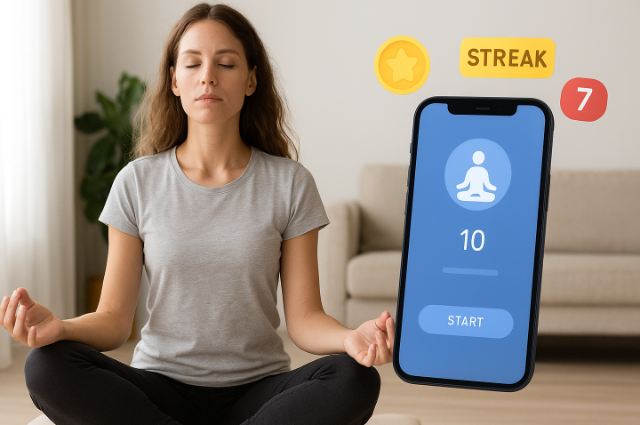
Mindfulness used to be simple. Sit down. Breathe. Notice what’s going on inside without trying to fix or perfect anything. For many people, it was the one space in life where they didn’t have to perform or keep score.
Then came the apps
What started as a well-meaning attempt to make meditation accessible has slowly taken on the tone of everything else in our digital lives. Notifications. Daily streaks. Levels. Locked content. Premium upgrades. It’s hard to ignore the irony: something meant to help us detach from the pressure of productivity has become yet another space where we’re nudged to “keep up.”
And the deeper I look into this trend, the more complicated it becomes, not just technically, but ethically.
When Mindfulness Starts To Look a Lot Like a Mobile Game
If you’ve ever used one of the major meditation apps, Headspace, Calm, or similar, then you know how it goes. You open the app, expecting a gentle moment, and before you even start breathing, you’re shown a streak count or a tiny badge congratulating you for showing up.
But why does mindfulness need badges?
A piece from Skeptical Inquirer, titled “Hooked on Mindfulness: Hidden Design Tricks Make Meditation Apps Addictive,” digs into this. It turns out many introspection apps borrow the same design psychology as mobile games and social platforms. They use small rewards, streaks, and timing tricks to keep you coming back, not necessarily because it’s good for your well-being, but because it boosts engagement numbers.
What really stuck with me from that piece was the idea that meditation, something meant to reduce craving, can become something we crave. Not because it’s helping us, but because the app is built to make us feel like we’re falling behind if we don’t check in.
The trouble is: mindfulness isn’t supposed to punish you when you miss a day.
The Heart of the Issue: Calmness Becomes a Product
Mindfulness apps aren’t inherently bad. They’ve helped millions of people who might otherwise never try meditation. But the moment calm becomes a commodity, the dynamic changes. It’s no longer simply guidance; it’s a business model.
A systematic review in JMIR Mental Health examined randomised controlled trials involving Headspace and Calm, and the results were surprisingly inconclusive. The apps helped some people with depression or anxiety, but the benefits were inconsistent, and many of the studies had conflicts of interest because the companies themselves helped fund them.
And there’s an ethical question sitting right between the lines of that research:
How fair is it to charge vulnerable people for relief that might not actually be effective or that might only feel effective because of clever design?
When you’re stressed or lonely or burnt out, you’re not in the best headspace (pun unintended) to evaluate whether a subscription is worth it. And these apps know that. It’s why almost every meditation app gives you a “free trial” at the exact moment you feel your worst.
A Closer Look at Headspace and Why It Raises Eyebrows
Headspace is the one most people are familiar with, so it’s a good example of how the issue manifests in real life.
At first glance, the app feels warm and friendly. Soft colours, cartoon clouds, a soothing narrator. But that same Sceptical Inquirer article points out that Headspace uses design patterns that resemble what game developers call dark patterns, little nudges that encourage repetitive use.
Badge-earned.
Streak maintained.
Milestone unlocked.
You’re rewarded for showing up, not for actually growing. And if you miss a day? A small but palpable sense of guilt sneaks in.
A separate academic article from the Design Society points out the same thing: mindfulness apps use subtle persuasive techniques that push users to behave more like customers than learners.
Something about that feels off
Then there’s the question of who these apps are really built for. A review from the Social Science Research Council argues that mindfulness apps reflect a “cleaned up,” Westernised version of meditation, one that works well for marketing but strips away cultural roots.
It’s mindfulness as a lifestyle accessory, not a transformative practice.
Why This Matters for Personal Growth
Whether or not we realise it, gamified mindfulness subtly reshapes what we think growth looks like. Instead of progress being felt in calmer reactions, softer thoughts, fewer spirals and then it becomes something we measure numerically.
Maybe you know the feeling:
You meditate because the app suggests it.
You finish a session and immediately look at the streak. You feel more successful if the counter goes up. You feel slightly ashamed if it doesn’t. That’s not self-awareness. That’s self-tracking.
Mindfulness turns into something you “complete,” rather than something you live. And when a practice becomes something to perform for an app, it loses the very thing that made it healing in the first place.
A More Human Way to Approach Mindfulness in a Digital Age
I’m not telling anyone to throw away their apps. They can absolutely help, especially as a friendly starting point. But here’s a more grounded approach, one that respects the spirit of mindfulness rather than the algorithms behind it:
1. Ignore the streaks.
Streaks reward behaviour, not awareness. Break them on purpose sometimes.
2. Use the app for guidance, not the validation.
Let your internal state, not the app’s design, tell you how you’re doing.
3. Don’t let notifications replace intuition.
Meditate when you notice the need, not when your phone tells you to breathe.
4. Keep your practice partly offline.
A 5-minute sit without your phone can sometimes be deeper than a 15-minute guided session.
5. Let mindfulness be imperfect.
Real growth is messy, uneven, and deeply human, nothing like a progress bar.
References:
- https://skepticalinquirer.org
- https://mental.jmir.org
- https://just-tech.ssrc.org
- https://www.cambridge.org