
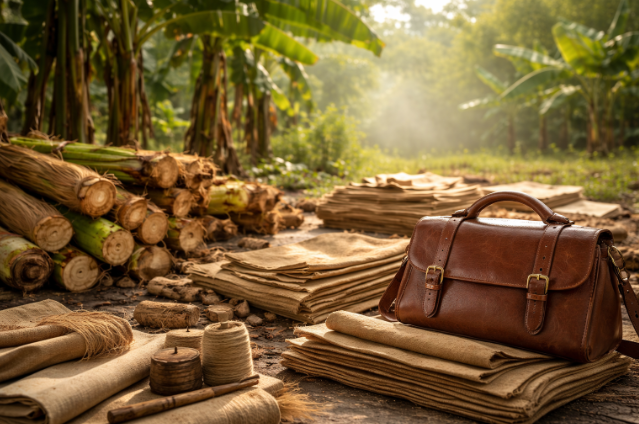
In the quiet hours after harvest, a banana field tells a complicated story—the fruit leaves in crates are bound for markets and kitchens. What stays behind is the rest of the plant, a thick stem that once carried the weight of a full bunch. The banana plant fruits only once, so the stem has no second act in farming. For generations, it has been burned or left to rot, treated as an unavoidable burden of feeding the world. That habit has a hidden cost. When this waste decomposes, it releases methane, a gas far more damaging to the climate than CO2. The numbers are stark. For every one kilogram of bananas eaten, about ten kilograms of plant waste are left behind. Multiply that by the global appetite for bananas, and the scale of the problem becomes impossible to ignore.
Fashion has long been part of this story, even if it did not realize it. Traditional leather relies on animal hides and chemical-heavy processing that consumes enormous volumes of water and leaves behind toxic residues. Many alternatives labeled vegan leather rely on plastic coatings that shed microplastics and age poorly. Against this background, a new material has emerged from an unlikely source. Banana leather is not a trend built on novelty. It is a patient response to waste, water, and dignity in work. It sits at the heart of what designers are calling the Earth Core approach for 2026, a way of wearing materials that are honest about where they come from and gentle about where they go next.
The transformation begins with curiosity and care. Young innovators like Jinali Mody looked at banana stems and saw strength rather than refuse. The science is simple and elegant. Banana stems are rich in long fibers that have evolved to hold up heavy fruit. These fibers can be extracted, cleaned and bound together using natural gums and starches. Instead of chromium or lead salts, the process relies on plant-based binders. The fibers are pressed into sheets and finished with natural pigments. The result looks and feels like high-quality leather. It even carries a soft, earthy scent that many users describe as calming rather than chemical.
This process is sometimes called magical, but it is better described as attentive. It listens to what the material already wants to be. There is no rush to force uniformity. Slight variations in texture are accepted as proof of origin. In a fashion system often obsessed with perfection, banana leather offers a different value system. It rewards restraint and respect.
The environmental gains are measurable. Producing a bag from animal leather can require more than ten thousand liters of water when tanning and finishing are counted. Banana leather can be made with about five hundred liters of water for a similar item. Toxic wastewater is eliminated. Because the raw material is agricultural waste, no extra land is cleared, and no animals are harmed. The climate benefit is twofold. Methane emissions from rotting stems are avoided, and the energy-intensive steps of conventional tanning are bypassed.
Yet the most humane impact may be economic. For farmers, the banana stem has always been a problem to manage. Banana leather turns that problem into an asset. Farmers can sell the stems to processors and earn a meaningful supplement to their income, often around thirty percent more over a season. This matters in regions where margins are thin and volatility is high. The exchange also restores dignity. Waste becomes contribution. The field is no longer the end of the value chain but its beginning.
The social dimension of this material is inseparable from its aesthetics. Earth Core style is not about looking rustic or making a statement through sacrifice. It is about quiet confidence. A jacket made from banana leather carries a story of water saved and hands paid fairly, but it does not need to shout. The material drapes well and ages gracefully. Small creases form with use, much like traditional leather, but without the guilt that often accompanies it. Designers are experimenting with footwear, bags, and even furniture coverings, finding that the fiber structure offers durability alongside flexibility.
Comparisons with conventional leather reveal why this matters. Animal hides require chemical tanning that introduces pollutants into rivers and soils. Communities living near tanneries often face health risks linked to contaminated water. Banana leather avoids these pathways entirely. Compared to plastic-based alternatives, it also sidesteps dependence on fossil fuels and the problem of microplastic shedding. In this sense, banana leather is not simply an alternative. It is a course correction.
The work of Jinali Mody and her peers has drawn global attention. Recognition from environmental bodies is not just symbolic. It brings funding, mentorship, and visibility that help scale solutions responsibly. Seeing a young woman with a background in science and sustainability build a business from farm waste reshapes what entrepreneurship can look like. It signals to students and farmers alike that innovation does not always arrive from distant labs. Sometimes it grows in familiar fields.
This movement is part of a wider wave of youth-led climate solutions. In Kenya, invasive water hyacinth is being transformed into biodegradable packaging. In the United States, compact systems recycle household water into clean drinking water. These projects share a philosophy. They meet people where they are. They reduce harm without demanding perfection. They turn local problems into local value. Banana leather fits naturally into this pattern. It is place-based and scalable at the same time.
From a design perspective, Earth Core style asks wearers to slow down. It favors pieces that are meant to last and be repaired. Banana leather responds well to care. Natural conditioners can extend their life, and when it finally wears out, it returns to the soil without leaving a plastic trace. This end-of-life honesty is rare in fashion. It closes a loop rather than hiding it.
There is also an emotional layer. Wearing something made from waste invites reflection on consumption. A bag once carried bananas that fed someone. Now it carries books, tools, or groceries. The continuity is comforting. It reminds us that materials have journeys and that we are part of them. Humane fashion is not only about reducing harm. It is about restoring relationships between people, land, and objects.
Skeptics sometimes ask whether banana leather can meet global demand. The answer depends on intention. It is unlikely to replace all leather overnight, and it should not try to. Its value lies in demonstrating what is possible when waste streams are respected. As infrastructure improves and knowledge spreads, production can grow without undermining the principles that make it meaningful. Partnerships with farmer cooperatives and local processors are key. Transparency is essential.
Education will also play a role. When consumers understand that most so-called vegan leather is plastic, they can make more informed choices. Banana leather offers a clear alternative. It is plant-based, low-water, and non-toxic. Communicating these facts without moral pressure is part of the humane approach. People are more willing to change when they feel invited rather than judged.
Looking ahead to 2026, Earth Core style is less a forecast than a reminder. The future of fashion is not elsewhere. It is already present in fields, rivers, and workshops. Banana leather shows that beauty can emerge from care. It aligns environmental responsibility with economic justice and tactile pleasure. It asks designers and wearers to pay attention to what has been overlooked.
In the end, banana leather is not about replacing one luxury with another. It is about redefining luxury itself. Clean water, fair pay, breathable air, and materials that tell the truth. Wearing nature in this way is not an act of trend following. It is an act of respect.
references:
- The Banofi Leather official site https://www.banofileather.com
- United Nations Environment Programme https://www.unep.org