
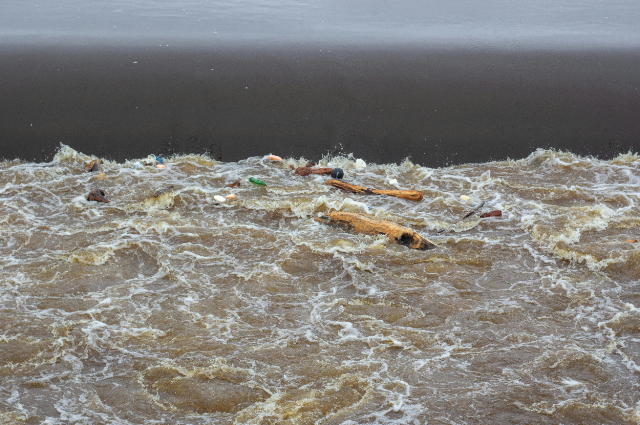
Water has always been called blue gold. Precious. Sacred. Life-giving. In India, we worship rivers, build cities around lakes, and trace our civilisation along water lines. Yet the reality running through our taps tells a darker story. Blue gold has turned brown, and the crisis is no longer hiding in rural droughts alone. It’s in urban kitchens, school bottles, hospital wards, and groundwater pumps.
In 2026, India continues to sit near the bottom of global water quality rankings. According to international assessments referenced by national policy bodies, India ranks around 120 out of 122 countries in global water quality indices. That number feels distant until you unpack it. Nearly 70% of India’s water is estimated to be contaminated, and roughly 200,000 deaths every year are linked to unsafe water access.
This is not just scarcity. It’s toxicity.
An ongoing case study lies in the findings of the Central Pollution Control Board (CPCB). Its national water quality monitoring reports consistently show hundreds of polluted river stretches across India. Rivers like the Yamuna, Sabarmati, and stretches of the Ganga routinely exceed safe biochemical oxygen demand levels, indicating heavy sewage and industrial contamination. These are not isolated events. They are patterns recorded year after year.
Take Delhi’s Yamuna stretch as an example. Despite multiple clean-up missions, over 70% of the river’s pollution load originates from untreated sewage and effluents entering through drains. Residents who live along the river see foam floating like snow, a chemical froth produced by detergents and waste discharge. It looks almost surreal. It is deeply dangerous.
This crisis affects people differently, but no one is untouched.
In rural India, groundwater contamination is often invisible but deadly. States like Rajasthan, Bihar, and parts of Telangana report high levels of fluoride and arsenic in groundwater. Long-term exposure leads to skeletal deformities, dental fluorosis, and organ damage. These are not sudden illnesses. They are slow, life-altering conditions that lock families into cycles of medical debt and lost income.
Urban India experiences it differently. Here, water flows, but trust doesn’t. People invest in RO systems, bottled water, and tanker deliveries. They pay twice, once through taxes and again through private filtration. For middle-class households, it’s an inconvenience. For low-income communities, it’s a risk calculation. Boil it or drink it? Spend on medicine later or filtration now?
The Composite Water Management Index (CWMI) released by NITI Aayog has described India as facing its ‘worst-ever water crisis’. Nearly 600 million people live under high to extreme water stress. Per capita water availability has fallen below the water-stress threshold and continues to decline.
And then there’s groundwater.
India extracts more than a quarter of the world’s total groundwater. In states like Punjab and Haryana, agricultural over-extraction has pushed water tables dangerously low. As aquifers deplete, quality deteriorates. Deeper layers often contain higher salinity and heavy metals. The result is a double crisis, less water, and so much worse.
Economically, the cost is staggering. Projections suggest that poor water management could shave up to 6% off India’s GDP by 2050 if significant reforms are not implemented. That loss isn’t abstract. It translates into lower agricultural productivity, rising healthcare costs, reduced workforce efficiency, and infrastructure strain.
What makes this nightmare more complex is the gap between data and decay. India has monitoring systems. It has missions like Jal Jeevan that aim to provide piped water access. It has river rejuvenation programs. Yet contamination persists because infrastructure often focuses on delivery, not source protection.
Urbanisation plays a quiet role here. Cities expand faster than sewage systems. Informal settlements discharge untreated waste. Industrial clusters operate with weak enforcement. Rivers become convenient disposal channels. And once polluted, water bodies require massive, sustained investment to restore.
For ordinary citizens, the impact is psychological, too. Water used to be neutral. Now it comes with doubt. Parents worry about what children drink at school. Travellers carry bottles everywhere. Public taps are approached cautiously.
This erosion of trust has a social cost. When public water systems fail, privatisation creeps in. Bottled water becomes normalised. Access becomes tied to income. Water shifts from being a public right to a market commodity.
Yet this isn’t a hopeless story.
Some states have shown measurable progress in water management practices. Gujarat, Andhra Pradesh, and Madhya Pradesh have historically ranked higher in domestic indices for water governance. Rainwater harvesting initiatives in Tamil Nadu have demonstrated how policy intervention can recharge groundwater effectively. The blueprint exists. Implementation remains the challenge.
The way forward requires more than pipelines. It requires treating wastewater before discharge. Enforce industrial regulations strictly. Restoring wetlands that act as natural filters. Monitoring groundwater extraction in real time. Most importantly, it requires transparency. Citizens deserve to know what’s in their water without having to decode technical reports.
Blue gold cannot remain a slogan while brown water flows.
India’s water quality rank is not just a statistic to debate. It is a signal. A warning that development without ecological accountability collapses inward. A reminder that growth measured in highways and skyscrapers means little if the water beneath them is unsafe.
The arithmetic is simple. Contaminated water leads to illness. Illness leads to economic loss. Economic loss deepens inequality. And inequality fractures trust.
Navigating this nightmare demands urgency. Not outrage for a week, but sustained reform. Because water is not optional. It is the quiet infrastructure of life.
And until blue gold truly runs clear again, India’s growth story will carry an asterisk written in brown.
. . .
References: