
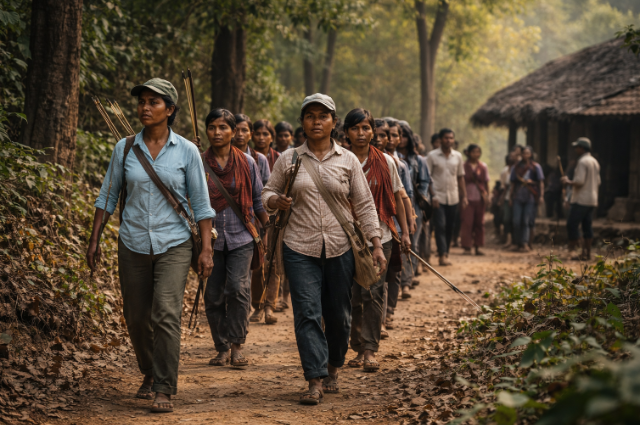
There are festivals we wait for every year. Then there are those rare ones that arrive like comets, quiet, powerful, and almost mythical. Jani Shikar, also known as Mukka Sendra, belongs to that second world. It’s not just a celebration, it’s memory, resistance, gender reversal, and ancestral pride stitched together. And it happens only once every twelve years, which means most people, if they’re lucky, will see it no more than six times in their entire life.
Jani Shikar is rooted among the Oraon (Kurukh) tribal communities across Jharkhand, Odisha, Chhattisgarh, and parts of Bihar. On the surface, it looks like a hunting festival led entirely by women. But underneath, it honors one of the most astonishing chapters of tribal history, where women stepped into roles meant to break them and instead carved their own legend.
The story goes back nearly five hundred years, to Rohtasgarh Fort in present-day Bihar. The Oraon community had just celebrated Sarhul, their spring festival. The men had danced, sung, and shared hadia, the traditional rice beer. By dawn, they slept deeply, unaware of the danger moving toward them.
Invaders, often described as Mughal or Turk forces, had studied this pattern. They chose the morning after the celebration to attack, calculating that the village would be defenseless.
Except, it wasn’t.
Three women, Sinagi Dai, and her companions, Kaili Dai and Champa Dai, refused to surrender to fear. Instead of hiding, they did something radical. They gathered the women, dressed themselves like men, tied turbans, and picked up weapons. Bows. Spears. Axes. Whatever they could carry.
From the fort walls, thousands of ‘soldiers’ appeared.
The invaders hesitated.
The women fought.
And not once, but three times, they pushed the attackers back.
Eventually, a spy noticed something the battlefield missed: the way the ‘soldiers’ washed their faces, the way they moved, the unmistakable softness of gestures. The truth surfaced, and the fort was taken. Yet the story didn’t end here. The memory remained, carried like a secret flame across generations as a reminder that power can come from unexpected places, and that courage is not assigned by gender.
Every twelve years, that flame is relit.
When Jani Shikar arrives, the village flips its rules. Women become hunters. Men stay home, cook, care for children, and keep the fires going. Women step out with authority. They wear men’s clothing, once traditional garments, now often shirts, trousers, and caps, and they move in disciplined relays from village to village.
It is not chaos. It is choreography.
One village receives them, washes their feet, feeds them, and then passes the responsibility onward. The hunt used to mean chasing animals. Today, to protect wildlife, animals like goats or pigs are symbolically set aside. The ritual remains, but the violence softens. The meaning, though, stays fierce.
Perhaps the detail that lingers most deeply is the mark of three dots.
After the final battle at Rohtasgarh, captured women were branded across the forehead to shame them. Instead, the Oraon people transformed those marks into symbols of honor. Even today, some women wear three tattooed dots proudly, not as wounds, but as memory. A way of saying we remember who we were, and we are not done.
Jani Shikar is not merely nostalgia. It carries questions into the present.
What happens when we flip our roles?
What truths about power, care, and responsibility come to the surface?
How do communities hold history without getting stuck inside it?
Watching this tradition, you realize it’s not celebrating violence. It’s celebrating readiness, presence, and courage. It reminds daughters and granddaughters that they are never helpless, and reminds men that strength is not lost when they take care of the home. In a world that keeps boxing us into rigid roles, this festival gently disrupts the script.
And yes, it also carries controversy. Some activists criticize hunting elements. Others worry about romanticizing history. But conversations around change only exist because the tradition still breathes. Rituals that have no meaning don’t spark debate. Rituals that hold power do.
The next Jani Shikar is expected around 2029. Villages are already aware that something sacred is approaching. Elders tell stories. Young girls listen. Some smile shyly, imagining themselves walking with bows across their shoulders, moving with friends from one village to another, carrying not weapons, but memory.
What moves me most is how quietly philosophical this festival is.
It says bravery isn’t loud.
It says history belongs to everyone, not only rulers and kings.
It says standing up once can echo for centuries.
In a time where most festivals feel commercial, rushed, and curated for pictures, Jani Shikar remains intimate, rooted, and deeply human.
And maybe that’s why it still matters.
Because somewhere between myth and memory, it keeps asking us
What kind of courage will we pass on?
References:
- Clad in men’s dress, Jharkhand tribal women celebrate hunting festival ‘Jani Shikhar’ | Hindustan Times
- Jani Shikar: The Powerful History Of Adivasi Women Warriors