
To most people, Indonesia means one thing today: the largest Muslim-majority country on the planet. Indonesia is often viewed through the prism of Islam, with 240 million Muslims. But beneath that same identity, there is another story, a story carved in volcanic stone, preserved in temple walls, whispered through epics that will not die.
Before mosques dotted the islands, Indonesia was home to powerful Hindu and Buddhist kingdoms. Kings had Sanskrit titles. Kings enacted the Ramayana in their courts. The temples reached to the sky with marvellous exactness. History could have been different, and Indonesia today might look very different.
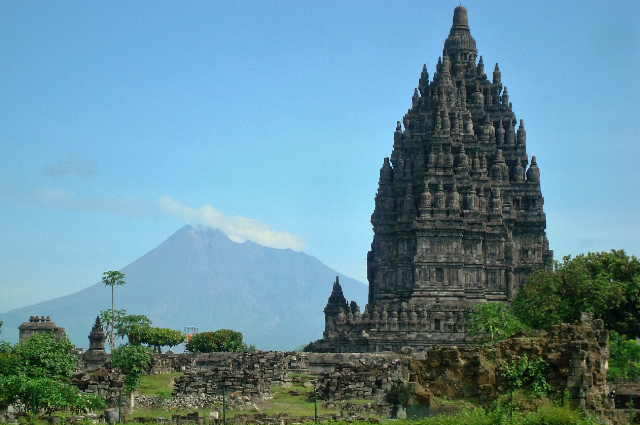
The reminder of that forgotten chapter is Prambanan, which is the largest Hindu temple in Indonesia and one of the grandest in Southeast Asia. Standing in Central Java, its towering spires are dedicated to the Hindu Trimurti, which is Shiva, Vishnu, and Brahma. Built in the ninth century during the reign of the Hindu Mataram Kingdom, the complex once consisted of around 240 temples, making it a monumental expression of Hindu philosophy, architecture, and political power.
Walking through Prambanan today is almost a surreal experience. Outside the walls of the temple is a country in which the public life of the great mass is moulded by Islam. Inside the temple, the stone reliefs tell the story of the Ramayana, one of the greatest epics of Hinduism. All the carvings are of Rama, Sita, Hanuman and Ravana. Each sculpture in the temple acts as a reminder that Indonesia’s roots run much deeper than the country’s current identity.
This isn't just an archaeological site. It's evidence that civilisations don't simply disappear. They evolve.
One of the most fascinating real case studies is the continued preservation of Prambanan despite Indonesia's religious transformation. Islam gradually spread across Indonesia between the 13th and 16th centuries, mostly through trade, local rulers, and cultural exchange. As new Islamic sultanates emerged, many Hindu kingdoms started declining, and temples like Prambanan slowly fell into neglect. Earthquakes and volcanic activity added to the destruction, leaving the complex buried beneath vegetation and rubble for centuries. Restoration only began during the early 20th century, and in 1991, UNESCO recognised Prambanan as a World Heritage Site. Today, it is one of Indonesia's most-visited cultural landmarks to serve as a site of Hindu worship during festivals such as Maha Shivaratri.
This year, the temple gained international attention when Indian Prime Minister Narendra Modi visited Prambanan with Indonesian President Prabowo Subianto. India also announced to provide support for restoration efforts, highlighting the centuries-old civilizational links between the two countries.
But Prambanan is only part of the story.
The Hindu kingdoms of Mataram and later Majapahit once controlled large parts of the Indonesian archipelago. The Majapahit Empire, flourishing in the 13th and 14th centuries, is still remembered by many Indonesians as one of the greatest political powers in their history. Its influence stretched across much of maritime Southeast Asia, and many modern national symbols, including Indonesia's motto Bhinneka Tunggal Ika (Unity in Diversity), trace their origins back to Majapahit literature.
Although Indonesia is a Muslim-majority country, Hindu culture never fully disappeared. Traditional shadow puppet performances continue to retell the Ramayana and Mahabharata. Sanskrit-derived names remain common throughout the country. The national airlines, universities, and military institutions all use Garuda as a symbol of national pride, and in Bali, Hinduism thrives openly while preserving rituals passed down for centuries.
This coexistence questions the assumption that religious change necessarily wipes out cultural identity.
For Indonesians, Prambanan is more than a mere Hindu monument. It is part of their national heritage. Children come here to study history while tourists love its architecture. Artists perform the Ramayana Ballet in front of its illuminated backdrop. Even those who do not practise Hinduism often view the temple as a sign of Indonesia's diverse history, not a relic of one religion.
This is a significant outlook for today’s people.
In an era when identity is reduced to a religious or political label, Prambanan reminds Indonesians that civilisations are layered. A country can embrace one faith and still celebrate another chapter in its history. That acknowledgement strengthens cultural confidence.
It also offers an important lesson beyond Indonesia.
Across the world, heritage sites are increasingly caught in ideological debates. Ancient monuments are sometimes viewed through the lens of present-day politics rather than historical context. Prambanan quietly resists that impulse. It stands as proof that preserving history does not require preserving the politics that once surrounded it.
Prambanan’s survival also suggests the importance of restoration. The complex was repeatedly damaged by earthquakes in 2006, but restoration work has been patiently continued over decades. Each reconstructed stone is beyond conservation, and it’s a promise to memory.
Visitors find the experience deeply moving, even though many come looking for another temple. They head home knowing they have explored the remnants of an empire that moulded Southeast Asia long before the modern state emerged.
Perhaps that's why Prambanan continues to fascinate historians, travellers, and pilgrims alike. It tells a story that refuses to fit into simple narratives.
Indonesia is proudly Muslim today. That reality is undeniable.
Beneath that identity lies another inheritance that was carved into stone over a thousand years ago. It is not hidden because people chose to forget it. It is hidden because history is often far more complex than the labels we give nations.
Among those ancient stones, the soul of a Hindu kingdom still stands, not in opposition to modern Indonesia, but as one of the many foundations upon which it was built.
References: