
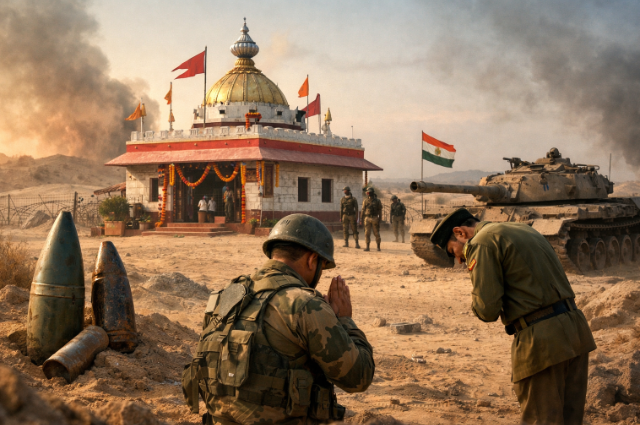
In the middle of the harsh Thar Desert, where the wind scrapes the land raw, and the border feels uncomfortably close, stands a small temple that refuses to behave like history expects it to. Tanot Mata is not grand in scale. There are no towering spires or elaborate carvings meant to impress. And yet, this quiet shrine near the India-Pakistan border has witnessed something that armies, engineers, and historians still struggle to explain.
We tried to erase it. Twice
And twice, it remained standing.
Tanot Mata sits just a few kilometres from the border in Rajasthan, close enough that gunfire once echoed through its walls. During the Indo-Pak wars of 1965 and 1971, this temple found itself directly in the line of attack. What followed turned Tanot Mata into what many now call ‘The Miracle Temple’.
The first chapter of this story unfolded during the 1965 war. Pakistani artillery units launched an intense barrage toward Indian positions near the Tanot post. Around three thousand shells were fired into the area.
Roughly four hundred and fifty of them fell directly inside the temple complex, many landing in the inner courtyard itself.
None of them exploded.
Not one.
Soldiers on both sides were stunned. Shells designed to detonate on impact lay scattered like abandoned metal toys. Some were partially buried. Some sat exposed under the sun. All of them were live. All of them failed.
Among Indian soldiers stationed there, another layer of belief quietly took root. Many later spoke of the Goddess Tanot appearing in their dreams, telling them to stay put, to not retreat, and promising protection if they held their ground near the temple. Fear softened into resolve. The temple became more than a structure. It became a shield.
Six years later, history returned for a second test.
The 1971 war brought the famous Battle of Longewala, one of the most dramatic tank battles in modern Indian military history. Once again, Tanot Mata lay dangerously close to the fighting. Tanks roared across the sand. Explosions tore through the landscape. And yet, the temple emerged untouched. Not a crack.
Not a fallen wall.
Today, unexploded shells from both wars are preserved inside the temple museum. Visitors can stand inches away from them, reading plaques that quietly state where they were found. For pilgrims, these are not just relics. They are evidence.
The most astonishing part of the story, however, comes from across the border.
Pakistani Brigadier Shaukat Ali, who was involved in the 1965 operations, reportedly became deeply unsettled by what he witnessed. After the war, he visited Tanot Mata himself. He didn’t come as a conqueror or sceptic. He came in reverence. As a gesture of respect, he donated a silver chhatra to the temple, acknowledging a force he felt could not be explained by military logic alone.
That single act says more than any speech ever could.
Of course, not everyone accepts the story as divine intervention. Scientists and sceptics offer alternate explanations. The desert sand around Tanot is unusually soft and deep. Some argue that the shells may have sunk at angles that prevented their fuses from triggering. Others suggest manufacturing defects or faulty ammunition.
But even those explanations falter when faced with scale. One shell failing is plausible. Dozens might be a coincidence. Hundreds failing in the same zone, across two different wars, under different conditions, stretches probability thin.
And probability is exactly where belief often steps in.
For the Border Security Force, which manages the temple today, Tanot Mata is woven into daily life.
Soldiers posted there often carry a pinch of sand from the temple grounds in their pockets. Not as superstition, they say, but as faith. Something grounding. Something human. In a place where danger once came unannounced, belief offers calm.
This faith has a real impact on people.
For soldiers, Tanot Mata is a reminder that courage isn’t always loud. It can be quite confident. For locals, the temple is proof that their land holds stories larger than borders. Tourism has grown, bringing pilgrims, historians, and curious travellers who leave changed, carrying the story forward.
Emotionally, the temple challenges how we understand conflict. War is meant to destroy. Tanot Mata reminds us that sometimes, even in the middle of violence, something remains untouched. That idea is powerful. It softens the hard edges of history and introduces humility where certainty once ruled.
There’s also something deeply human about the way both armies responded. On one side, soldiers prayed.
On the other hand, a commander bowed. In a world obsessed with proving who is stronger, Tanot Mata quietly suggests that strength may not always belong to those holding weapons.
Whether you approach this story spiritually or scientifically, it refuses to be dismissed. The shells are real.
The wars are documented. The temple still stands.
And perhaps that’s why this story continues to travel across generations.
Because at its heart, Tanot Mata isn’t asking us to choose between faith and reason. It simply asks us to sit with the mystery. To accept that not everything bends to logic. That some places hold memory, belief, and protection in ways we don’t yet know how to measure.
In a desert shaped by borders and battles, a small temple stood still while the world shook around it. And when guns fell silent, even the enemy came back not with anger, but with reverence.
So maybe the real question isn’t why the Pakistani Army bowed to this Goddess.
Maybe it’s what it says about us, that in the middle of war, faith was the one thing both sides understood?
References:
- Tanot Mata Temple - Wikipedia
- This temple in Rajasthan stood against thousands of bombs: The untold story of war, faith, and
- Indian Army - Times of India
- Battle of Longewala - Wikipedia