
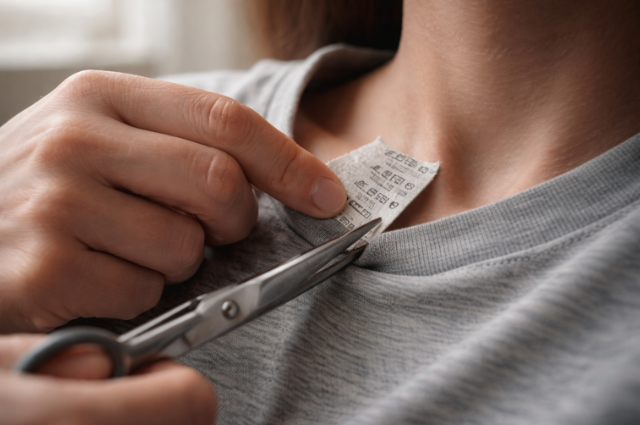
If you’ve ever had to cut a clothing tag out the moment you put something on, you already understand a tiny part of this story. That sharp itch that refuses to fade, the way it hijacks your attention until you can’t think of anything else. Now imagine that feeling not as an occasional irritation, but as a constant companion. Imagine the world itself coming with scratchy tags attached.
This is often how everyday life feels for autistic people.
A helpful way to understand autism is to think of it as a different operating system. If most people’s brains run on one familiar system, an autistic brain runs on another. Nothing is broken. Nothing needs fixing. The rules are simply different. Information is processed differently, sensations land differently, and social interactions follow a different internal logic. Problems arise not because the system is wrong, but because the world is built almost entirely for one operating system.
One of the biggest differences shows up in what many autistic people call ‘volume control’. Most brains automatically filter out background noise. The hum of a refrigerator fades into nothing. The buzz of a tube light disappears. For autistic brains, that filter works differently. Sounds, textures, lights, and smells often arrive at full volume. A fridge can sound like a jet engine. A classroom can feel like a stadium. A clothing tag can feel like sandpaper scraping skin.
This experience is known as sensory overload. When too much sensory information hits at once, the nervous system goes into survival mode. It’s not drama or overreaction. It’s biology. The brain is flooded. Some autistic people respond by withdrawing or shutting down. Others seek intense sensations like rocking, spinning, or pressing against something firm. These actions help regulate the nervous system, bringing the volume down to a tolerable level.
This sensory difference affects daily life in ways many people never see. Shopping malls, offices, weddings, public transport, and places designed to feel normal can become exhausting or even painful. Over time, the constant effort to endure overwhelming sensations can lead to anxiety, burnout, and isolation.
Another layer sits quietly beneath this: social translation.
Most people learn social rules the way they learn a language they grow up hearing. Eye contact, sarcasm, small talk, and polite exaggeration come naturally. Autistic people often don’t get this instruction automatically. Instead, they have to learn it consciously, like memorising grammar rules in a second language.
Many autistic individuals value directness. They say what they mean and mean what they say. To them, honesty feels respectful. But in a world that often prioritises social cushioning over clarity, this directness can be misread as rudeness or coldness. Add to that the mental effort required to constantly decode facial expressions, tone changes, and unspoken expectations, and social interaction becomes tiring fast. This is
why many autistic people talk about a ‘social battery’. It drains quickly, not because they dislike people, but because translation takes energy.
A well-documented case study that helps illustrate this is Temple Grandin, an autistic scientist and professor of animal science. Grandin has spoken openly about how her sensory experiences shaped her life. Loud noises felt physically painful to her, and social interaction required deliberate learning rather than instinct. Yet those same differences allowed her to notice details others missed. Her ability to think visually helped revolutionise livestock handling systems worldwide, making them more humane and efficient. Grandin’s work is now used globally, impacting millions of animals and reshaping agricultural practices. Her story shows how autistic perception, when supported rather than suppressed, can create real-world change.
Routine and deep focus are another misunderstood part of the autistic experience. The world can feel unpredictable and overwhelming, so routines provide safety. They reduce uncertainty and conserve energy. Within this structure, many autistic people develop what are called special interests. These are not casual hobbies. They are deep, intense passions where focus becomes almost limitless. Whether it’s trains, coding, history, insects, or music theory, these interests often lead to expert-level knowledge.
This hyper-focus is not a flaw. It’s a strength. Many innovations, academic breakthroughs, and creative works exist because someone was allowed to go deep instead of being told to ‘diversify’ their attention. When schools and workplaces fail to recognise this, they lose out on enormous potential.
It’s also important to understand that autism is not a straight line. It isn’t a scale from ‘mild’ to ‘severe’. A better image is a soundboard or colour wheel. Different sliders exist for communication, sensory sensitivity, motor skills, emotional regulation, and cognition. One person might be highly verbal but sensitive to noise. Another might be non-verbal yet deeply empathetic and perceptive. These combinations are endless, which is why no two autistic people are the same.
The impact of misunderstanding autism is felt everywhere. In schools, children are labelled disruptive instead of overwhelmed. In workplaces, adults are overlooked because they don’t fit social expectations. In families, behaviours are punished instead of interpreted. This leads to mental health struggles, underemployment, and loneliness, not because autistic people can’t cope, but because the environment refuses to adapt.
But when small changes are made, the difference is enormous. Tagless clothing. Quiet rooms. Clear communication. Flexible routines. Acceptance of stimming and sensory tools. These adjustments don’t require massive resources. They require empathy.
The Scratchy Tag is a metaphor, but it’s also real. It represents all the small discomforts that pile up until living feels harder than it needs to be. When we stop dismissing those details, we start building a world that works for more than one operating system.
Because sometimes, what looks like a small thing from the outside is actually the loudest thing in the room.
. . .
References:
- Temple Grandin - Wikipedia
- Autism Spectrum Disorder - National Institute of Mental Health (NIMH) Sensory Integration in Autism Spectrum Disorders