
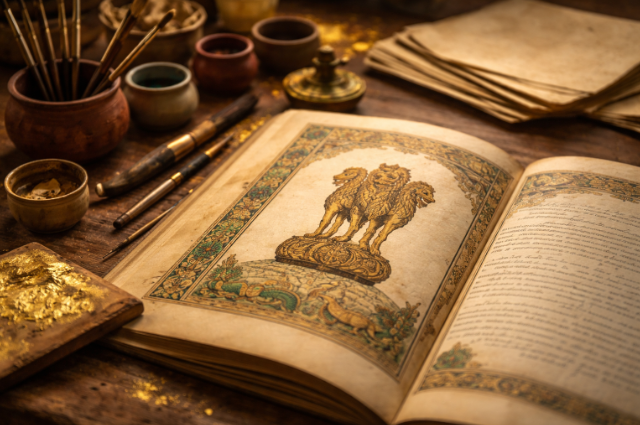
Every nation has a moment when it decides how it wants to be seen. For India, that moment arrived not only through debates and drafts, but through brushstrokes. Hidden inside the pages of the Indian Constitution is a quiet story of youth, patience, and faith. A story where the face of a new republic was shaped not by a committee or a decree, but by a 21-year-old art student sitting on a wooden bench at the zoo.
His name was Dinanath Bhargava.
In the late 1940s, as India prepared to give itself a Constitution, it was clear that words alone wouldn’t be enough. The document had to feel alive. It had to carry memory, dignity, and continuity. This responsibility fell to artists from Shantiniketan, the institution founded by Rabindranath Tagore that believed art was not decoration, but philosophy made visible. Leading the artistic vision was Nandalal Bose, one of India’s most respected modern artists. And when the time came to illustrate the most powerful symbol of the nation, Bose made a choice that would quietly shape history.
He trusted his student.
Dinanath Bhargava was just 21, still learning, still observing the world with that rare seriousness young artists carry. Yet Bose handed him the task of drawing the national emblem for the opening pages of the Constitution, the four Asiatic lions that would come to represent the Republic of India.
This wasn’t a symbolic assignment. It was monumental.
Instead of copying existing sculptures or relying on imagination, Dinanath did something deeply human. He went to the Alipore Zoo in Calcutta. Every day. For nearly three months. He sat for hours watching real lions breathe, stretch, yawn, pace, and rest. He studied their muscles, their stillness, their authority. He noticed how power didn’t always announce itself loudly, and how strength could exist even in calm.
Those long days at the zoo shaped what we now take for granted.
When you look closely at the lions in the Constitution, their mouths are not tightly shut. They are slightly open. It’s subtle, but deliberate. Dinanath didn’t want stone-faced symbols. He wanted a living presence. The open mouths suggested a nation that could speak, assert, and stand its ground. A republic that wasn’t silent or submissive.
Even the technique carried an intention. The Constitution was handwritten and illustrated on handmade paper, porous and delicate. To paint the lions’ manes, Dinanath used real gold leaf. But gold on handmade paper smudges easily. So he sealed the surface first with egg whites, a traditional method requiring patience and precision. This wasn’t about speed or efficiency. It was about care.
And then there’s the detail most people never notice.
His signature.
Dinanath didn’t sigh loudly. He tucked his name quietly into the corner of the pages he worked on. No announcement. No demand for recognition. Just a soft presence, like a whisper saying, ‘I was here.’
This is not a fictional tale or a romantic exaggeration. It is a documented chapter of the Constitution’s making. The original illustrated pages, preserved today, still carry those details. The gold still catches the light. The lions still breathe on paper.
What makes this story powerful is not just its beauty, but its impact.
The Indian Constitution is often discussed in terms of law, rights, and governance. Rarely do we talk about how it feels. Yet art shapes emotions long before logic steps in. Every time someone opens the Constitution, the first thing they encounter is not a clause or an article; they see an image. An image created by a young man who believed that a nation deserved to look alive.
For students today, this story lands differently. It reminds us that nation-building isn’t only done by leaders and lawmakers. It’s also done by artists, observers, and those willing to sit still and pay attention. Dinanath didn’t rush to ‘make history’. He watched lions breathe.
For artists, it’s a reminder that their work matters far beyond galleries. That art can sit at the heart of democracy. That beauty and meaning are not luxuries, but foundations.
For citizens, it quietly reframes how we see our Constitution. It’s not a cold legal text. It’s a handmade object, touched by real hands, shaped by real care. Knowing that a 21-year-old once carried the weight of the Republic on his shoulders makes the document feel closer. More human.
There’s also something deeply Indian about this story. The idea that a teacher would trust a student with such responsibility. That observation would be valued over authority. That patience would be rewarded over haste. These values are woven into the Constitution not only through words, but through process.
Today, when we talk about youth being disconnected or disinterested, Dinanath’s story stands as quiet proof to the contrary. Young people have always shaped India. Sometimes loudly, sometimes invisibly. Sometimes from Parliament halls, sometimes from zoo benches.
The lions he drew still stand guard over the Republic. They have seen governments change, crises unfold, rights challenged, and freedoms defended. Through it all, they remain steady. Not frozen. Alive.
And perhaps that’s the greatest legacy of a student at the zoo. He didn’t just draw a symbol. He gave India a face that could endure, speak, and breathe through time.
References:
- A Tribute to the Artist who Sketched and Illuminated India's National Emblem
- India’s State Emblem: A 2,300-Year Journey