
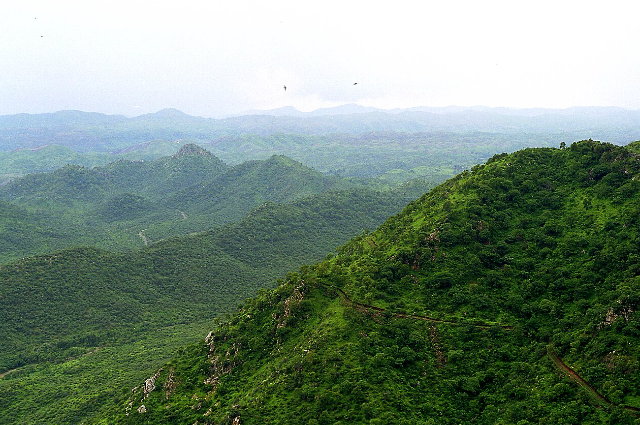
There’s quite an urgency in the way people talk about The Aravallis now. Not dramatic, not loud, but heavy. Like something everyone knows is slipping, even if they can’t see it clearly yet. When the Prime Minister announced the Aravalli Green Wall initiative recently, it felt less like a new idea and more like an admission for which we waited too long. This wasn’t just about planting trees. It was about holding together the last natural barrier standing between Delhi and the Thar Desert.
The Aravalli Range is older than the Himalayas. It has stood through centuries of climate shifts, invasions, cities rising and falling. For North India, it has quietly done one job incredibly well, slowing the desert, holding moisture in the soil, guiding groundwater, and softening the harsh winds that would otherwise carry sand straight into the plains. But over the last few decades, this ancient ridge has been chipped away piece by piece. Mining, construction, highways, real estate, and administrative loopholes have thinned it out until protection became patchy and fragile.
The movement to ‘save The Aravallis’ didn’t begin as a government project. It began with locals. Villagers are noticing their wells drying earlier every year. Farmers are watching their soil lose fertility. Environmentalists raising alarms as hillocks vanish from maps. In Delhi, the connection came through the air. Pollution levels were already choking the city, with winter smog turning toxic and summers bringing dust storms that sting your eyes and lungs. Scientists started pointing out something uncomfortable: weaken the Aravallis enough, and Delhi doesn’t just face pollution. It faces desertification.
We are already living with consequences. Delhi consistently ranks among the most polluted cities in the world. PM 2.5 levels regularly cross safe limits, not just in winter but now across seasons. Dust storms have become more frequent and intense. Breathing problems are no longer limited to the elderly. Children, young adults, and even athletes feel it. When the ridge erodes, sand travels farther. When vegetation disappears, there’s nothing to hold moisture or dust back. The air becomes harsher, drier, more hostile.
And it’s not only about Delhi. Communities across Rajasthan and Haryana are watching water tables fall. Forest cover fragments. Wildlife corridors break. People walk farther for water. Agriculture becomes riskier. The Aravallis were never just scenery. They were infrastructure, quiet, supporting life.
So when the Green Wall announcement came, it sounded hopeful. A plan to restore degraded land, create nurseries, revive water bodies, and rebuild forest cover across multiple states. But it also raised questions that are hard to ignore. Can a problem created over decades be fixed with plantations alone? What happens when restoration plans clash with mining interests or unclear land classifications? Who decides what counts as an Aravalli Hill and what doesn’t?
That question matters more than it sounds. Recent policy debates around redefining which parts of the Aravallis deserve protection caused deep concern among environmental groups and local communities. If only taller hills qualify as ‘real’ Aravallis, what happens to the lower ridges that still play a crucial ecological role? Can sand tell the difference between a protected hill and a declassified one?
People living in these regions have already started pushing back. Tribal groups, farmers, and activists have spoken out, not against conservation, but against conservation done without them. They fear that sustainability, if poorly designed, can become another excuse to control land without protecting livelihoods. It’s a valid fear. True sustainability cannot happen without the people who live on and around the land.
At the same time, doing nothing is not an option. The environment doesn’t wait for perfect policies. Every monsoon that rushes off bare slopes instead of soaking into the ground is a missed chance. Every illegal mine that goes unchecked weakens the ridge a little more. Every dust storm that blankets Delhi is a reminder that nature keeps its own accounts.
So what does a sustainable path actually look like here? It starts with respect for ecology, not optics. Planting trees matters, but planting the right native species matters more. Restoring water systems matters as much as forest cover. Sustainability means slowing water, rebuilding soil, and allowing the land to heal at its own pace. It also means transparency, that is, clear land records, strict enforcement against illegal mining and accountability that doesn’t dissolve after a press conference.
It also means asking uncomfortable questions. Are we serious about protecting the Aravallis if economic interests keep finding backdoors? Can urban India demand clean air without standing up for rural ecosystems that make that air possible? Can sustainability succeed if it feels imposed rather than shared?
For people, this isn’t abstract. It’s personal. It’s about whether a child can play outside without wheezing. Whether a farmer can rely on a well for one more season. Whether cities like Delhi remain livable in the decades to come. The Aravallis are not just a range of hills. They’re a line of defence, and once crossed, it’s hard to draw again.
The Green Wall initiative could become a turning point, or it could become another well-meaning chapter that failed to address the roots of the problem. The difference lies in how deeply we listen, how honestly we enforce, and how willing we are to treat nature as more than a backdrop to development.
The ridge is still there. Fragile, yet gone? No. The question is not whether we can save the Aravallis. The question is whether we are willing to change enough to deserve saving them.
. . .
References:
- '90% of Aravallis protected', govt clarifies amid mining criticism
- Tribal communities pledge to save Aravallis from destruction | Jaipur News - The Times of India
- 'Over 90% Of Aravalli Region Remain Protected': Centre Rejects Mining Push Charge
- Aravalli hills controversy explained, Supreme Court definition, political reactions, activists, ecology mining - India Today