
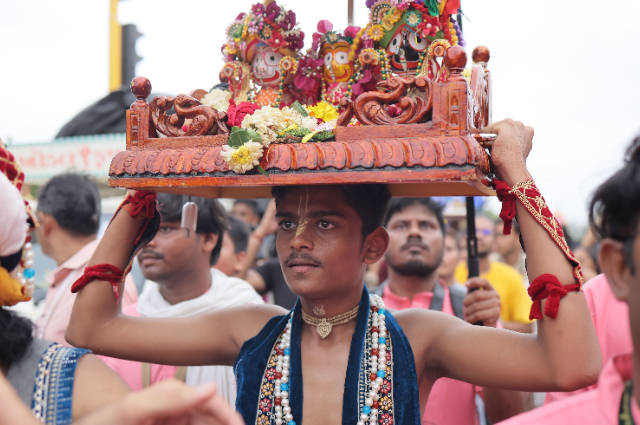
Every year during the Rath Yatra in Puri, millions of eyes follow three towering wooden chariots rolling slowly through the Grand Road. Most people know the largest one is Lord Jagannath's. Many recognise Lord Balabhadra's imposing chariot. But the smallest one, carrying Goddess Subhadra, often passes with far less attention.
Yet its name may hold the deepest lesson of the entire festival.
Subhadra's chariot is called Darpadalana, literally translated as the Trampler of Pride or the Crusher of Ego. It is not merely a poetic title. It is a philosophy carved into one of Hinduism's most celebrated festivals, reminding us that before devotion can truly begin, pride must first end.
In a world that constantly rewards status, achievement, and recognition, that message feels surprisingly relevant.
The Rath Yatra itself is unlike most temple rituals. Instead of devotees entering the temple, Lord Jagannath, Lord Balabhadra, and Goddess Subhadra leave the sanctum and travel nearly three kilometres to the Gundicha Temple in massive wooden chariots built anew every year. The journey symbolises that the divine reaches everyone, regardless of caste, wealth, or social standing. It is one of the rare occasions when millions can have darshan of the deities outside the temple walls.
Among these three magnificent chariots, Subhadra's stands quietly in the middle.
Her chariot, draped in striking red and black cloth, rises about forty-three feet high and moves on twelve wheels. Official Jagannath Temple traditions identify it as Darpadalana, though it is also known as Devadalana or Padmadhwaja in different traditions. The name Darpadalana comes from two Sanskrit words: darpa, meaning pride or arrogance, and dalana, meaning to crush or destroy.
But why is Subhadra connected with humbleness?
Subhadra is worshipped as Yogamaya or Adi Shakti in the Jagannath tradition and is the Divine Feminine, unlike her brothers. She is not seen as a warrior who conquers kingdoms, but as a force that melts the ego within. Pride rarely beats power. It is moderated by compassion, wisdom and surrender, qualities which Subhadra embodies.
Perhaps that's why her chariot occupies the space between Jagannath and Balabhadra.
It reminds devotees that before reaching the Divine, one must first pass through humility.
One of the most powerful real-life examples of this symbolism can be seen during the annual Rath Yatra itself.
The first servitor of Lord Jagannath, the king of Puri, the Gajapati Maharaja, performs the sacred ritual of Chhera Pahanra every year. The king in simple clothes sweeps with a golden broom the platforms of all three chariots and sprinkles sandalwood water. Before millions of devotees, the king performs the service usually rendered by a servant.
It is a remarkable reversal of hierarchy.
A king bows before God.
Power bows before devotion.
Status bows before humility.
For centuries, this ritual has remained one of the strongest living demonstrations that no position, title, or wealth places a person above another in the eyes of the Divine.
That lesson continues to shape the experience of millions who participate in the festival today.
Every year, over a million devotees gather in Puri to pull the ropes of the three chariots. Industrialists stand beside labourers. Politicians stand beside farmers. Tourists, monks, students, and families all pull the same rope.
For a few hours, social identity becomes almost irrelevant.
The act of pulling the chariot is not seen as helping the deity move. Instead, devotees believe they are allowing the Divine to pull them away from their own ego, attachments, and pride.
That emotional experience has a profound impact on people.
Many devotees describe Rath Yatra not simply as a festival but as a deeply personal spiritual reset. People travel from across India and abroad, carrying burdens that are invisible to everyone else: grief, failure, anxiety, illness, or regret. Standing in the crowd, they become one among millions, and strangely, that anonymity becomes comforting.
In everyday life, society constantly asks who we are.
What is your profession?
How much do you earn?
What have you achieved?
At Rath Yatra, none of those questions matters.
The only identity that remains is that of a devotee.
That is precisely what Darpadalana symbolises.
The trampling of pride is not about humiliation. It is about liberation.
When ego fades, comparison fades with it. So does the constant need to prove ourselves.
Perhaps that explains why Subhadra's chariot, despite being the smallest, carries one of the greatest spiritual messages of the festival.
Its black and red canopy also carries symbolic meaning. Black, often misunderstood, represents the cosmic feminine energy associated with Shakti, while red signifies strength, life, and divine power. Together they remind devotees that true strength does not come from domination but from inner balance.
A world has been created by social media where lives are curated, and success is measured by visibility, so it makes sense that pride has silently and gradually become a part of everyday living. We compare careers, appearances, vacations, relationships and accomplishments, forgetting that fulfilment cannot be compared to someone else’s journey.
Subhadra's chariot gives a gentle correction.
It demands we shed arrogance, not ambition.
There is a distinction.
Ambition makes us grow.
Pride tells us we've already gotten there.
That is why, perhaps, millions perform Darpadalana year after year with folded hands rather than with raised heads.
Sometimes the greatest journey is the ego's journey to humility.
And perhaps no chariot travels that distance better than the one known as the Trampler of Pride.
References