
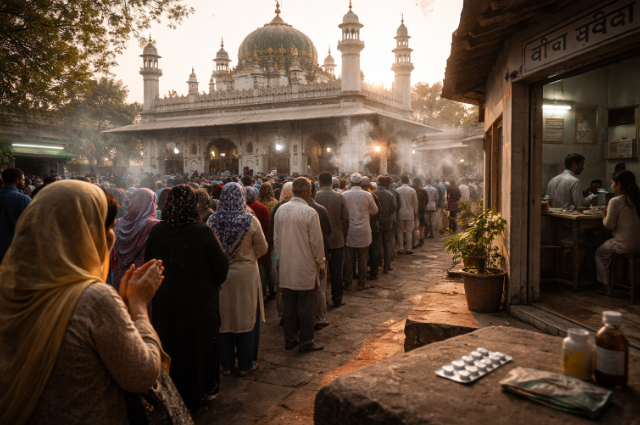
A body that is taken over by another entity, a quiet or hollering entrance of a creature that is dissimilar to the true holder of the body. They claim that the one taking over control of their humane bodies is none other than a jinn. It is a spirit that is possessing them, causing them to act differently from the usual self, taking over their sense of being and changing the course of their life as it is.
Thousands flock at the entrance. They either know quite well what is tormenting them or have no idea what's gotten into them. People who have come to become their own saviours or people with loved ones who have changed overnight line up to search for answers.
At Unava's Mira Datar Dargah, lost souls return home. Situated in the Mehsana district of Gujarat, this shrine specializes in cases of spiritual possession. The place is an honourary dedication to the martyr Hazrat Syed Ali Mira Datar. Famously known as the "Supreme Court" for spirit possession, the shrine holds mystical powers close to the divine.
However, when the topic of possession arises to act as explanation for behavioural changes, the scientific substitute of mental conditions comes in place. Mental disorders such as paranoid schizophrenia, hysteria or bipolar disorder cause a person to behave in abnormal ways. When such incidents occur, typically in rural or uneducated communal areas, the people suspect possession instead of reaching for the mental aspect of the problem because of the standards they've set in terms of superstitions.
When in rural India, the human mental condition is placed on a lower stepstone than faith, there rarely are any successful initiatives that strive to change the game for mental advocacy. But one such organisation, the Altruist NGO, which is led by Milesh Hamlai, understood how to curate methods in which there didn't have to be the conundrum of picking a choice. The Altruist NGO at its very core combines faith with science to convince rural people that both are equally important.
Their mechanism of curing "spirit possessions" is extremely interesting. Whenever a family brings a patient to the Dargah, a faith healer known as the Mujavir, performs an exorcism ritual. After the completion of the ritual, the family are advised to get medicine or dava from their clinic. The patient is given the medicine, which are antipsychotic pills disguised as "spirit weakening" pills. In this way, those who come to ask for help aren't asked to dispose of their faith and belief but are still given the scientific solution to their problem that they do not truly understand.
Milesh Hamlai watched empty medicinal clinics gather dust while those who needed the real treatment were gathering to find solutions at the Dargah. The patients weren’t aware of how their predicaments were a result of mental illness and not the spiritual voodoo they believed it to be. And teaching the crowd what was right from wrong was close to impossible, so he chose the smart way and trained healers.
Hamlai’s motive had a personal backstory. His own brother suffered from schizophrenia and therefore, he understood the problems these people had to undergo. This led him to begin the movement of faith based psychological treatment in Ahmedabad, Gujarat.
Altruist as an NGO has treated over 38,000 patients. It has become a highly successful and well-known performance model and has even been recommended by the Supreme Court of India as the best example for mental wellness practice centers.
When we look at the mastermind behind these mental health practitioners and the way both the mujavirs and patients do not have to go against what they believe in but still perfectly go hand in hand with the scientifically proven mental health treatment, it is visible that the major reason why it works so well is because of reframing and not misleading. The practice does not feed people lies or force them into something they do not agree to, but sheds light on their personal beliefs while still keeping in mind how they need to go forward with the treatment precisely. Because the patients do not see the doctors as their preferred means and mujavirs find them as competitors, the NGO created a harmonious union between both.
This collaborative effort turns a world of conflict in resolving mental illnesses into a sorted and undivided spiritual honour that cures those who need help but do not know of the right place to ask for it. With the Altruist NGO, Milesh Hamlai has devised the perfect formula for a shrine that welcomes everyone with open, offering government-aided free treatment that does collide with their spiritual holdings.
With the right kind of help and the true kind of offerings, there lies a world of mystical happenings that brings along medicinal aid of recent times.