
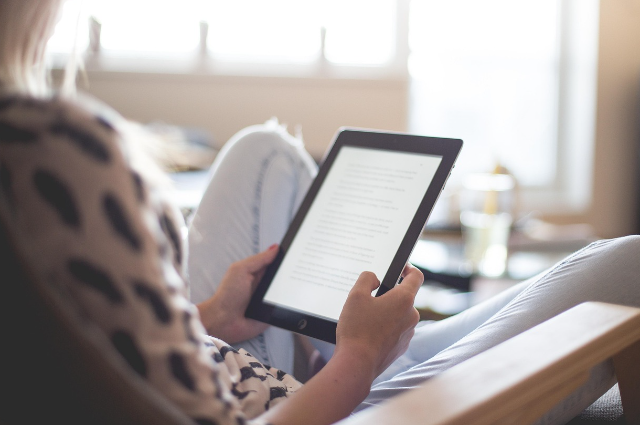
Our surroundings are digitalised to the core. Each simple task can be performed digitally and with minor contribution from physical methods that have seen time and ages. To make calls, pick up groceries, and submit assignments, we merely have to rely on digital media to get it all done quickly and efficiently without the hassle that performing these tasks manually involves.
It must’ve been a belief at a time that a book has to be an irreplaceable physical commodity. There could be nothing that could replicate the same feel, freshness of ink on pages and the very special scent that a book holds. Apparently, it was a wrong belief to uphold. While e-books aren’t as good at bringing the same feeling as the physical copy of a book does, the benefits they have make it a widely popular choice amongst readers as well as other users.
Because convenience is almost everybody’s number one priority nowadays, picking e-books seems like the obvious choice. They are portable and accessible, available within seconds at your fingertips. In an age where time is considered to be most precious, waiting around for a book to be delivered to your doorstep is just too much of a hassle.
An e-book doesn’t require that amount of work; you press a button, and there it is on your screen. Because of indefinite storage, multiple e-books can be supported on the same device, eliminating the need to create space for new books and being able to fit more than many within your pockets.
E-books are also cost-effective. Since they do not require the price of printing paper, ink, binding and distribution, e-books are extremely cheap compared to physical copies. For budget-conscious consumers, e-books are without a doubt the right choice to make.
Other than that, there are many environmental benefits that e-books offer. Without the need for physical printing paper and ink, environmental degradation and deforestation are prevented. A study conducted by the Cleantech Group revealed that an e-book has 7 per cent less carbon footprint as compared to a physical one. Eco-friendly techniques are supremely important to preserve the integrity of our beautiful planet and prolong the lifetimes of our own kind.
The most advantageous property of e-books over physical copies that attracts users and urges them to switch teams is their customizable nature. Readers can adjust screen brightness, font style, size, spacing or background colours according to their needs or wishes. Certain special e-books reduce the amount of eye strain, which is a winner with those who have headache problems and readers belonging to older age groups.
E-books also carry the advantage of having built-in dictionaries, thesauruses and other tools that make reading easier and more time-worthy for users. It provides a more knowledgeable reading experience that truly benefits the reader to a greater extent.
Despite all the advantages e-books have, there are still drawbacks that prevent them from becoming the complete and total replacement of physical books. The first of these drawbacks has to be the loss of the feeling that ink on paper captures. No amount of bookstore-based scent can bring the same magic to a reading experience that a book in hand does. It is a special feeling that only those who breathe and live reading know. E-books might be all that, but a physical copy is a true wonder unlike any other.
There also arise issues such as increased use of screens and over-reliance on technology, the initial high cost of e-readers and the unavailability of electronic devices in all homes. These are the major reasons that the takeover of e-books has not been successful just yet. Who knows what the near or perhaps far future might hold?
A study was conducted within five selected research institutes in Karnataka, India. 860 questionnaires were distributed, out of which 700 were duly returned. Amongst other factors reported was the e-book usage frequency. It was recorded that 370 scientists used e-books frequently, 139 moderately, 101 occasionally, while 90 users used them very frequently. The problems faced while accessing e-books were also asked, and lack of helpfulness, as well as not being in openable formats, turned out to be the major causes.
The study concluded that, although scientists were increasing their usage of e-books due to easy availability, pointing towards a good sign, their major complaint was the improper diversity of their institute’s library collections. Due to the luxury of access anywhere and everywhere, if this issue were to be sorted, the education institute could soon be overtaken by digital books as compared to physical ones that are too expensive, heavy and complex to deal with.
The integration of artificial intelligence and machine learning in the e-book reading experience is the major development that could revolutionise many industries directly affected by this change, such as publishing, education and amongst readers. Reading can be made more accessible and inclusive for individuals.
It is still a long way before we can collectively decide as a society that withholds such differing opinions and practices, which medium of reading is the true reality that the future will hold. For the time being, all we can do is rely on whichever medium is more accessible, cost-friendly and personally appealing to us. Evolution will continue and lead us to newer paths every day that change the outcome of the being of humankind.
References: