
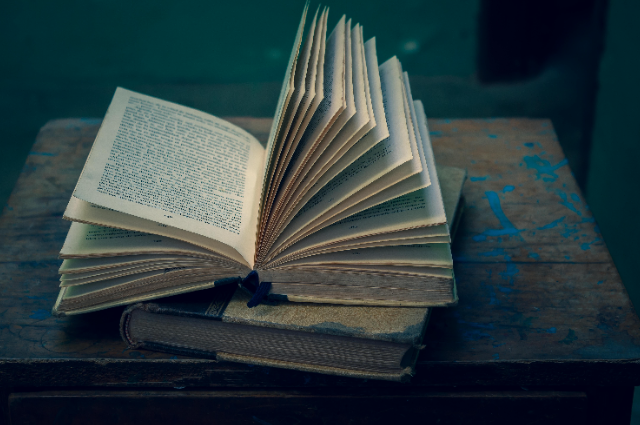
Literature is perhaps the oldest form of media that has entertained human for hundreds of years. Text on paper representing the truest secrets to understanding the lives we live, doors that open up to mystical worlds beyond our imaginations and the key to learning a wise person’s opinion, which we might or might not intertwine with our own philosophies. In simple words, literature is as fantastic as it is crucial, and its steadiness over time has proved this fact to be true.
Since its greatness is permeated into our brains as a society, other forms of media imitating or taking inspiration from literature pieces are a common feat. Even simpler forms of media that haven’t been around for too long for consuming, such as video essays, follow the epic trail left behind by literature. From dissecting novels to interpreting them in one’s own style using creative liberty is extremely popular nowadays.
Be it films, music or TV shows, literature, old or new, leaves a tr vace that ranges from being entirely a copy of a book or loosely being based on one. As varying forms of media have different formulas to appear appealing to consumers and at times even audiences that are poles apart, when one form is transformed into another, there are certain elements that are completely transformed or left out. These might be minor changes such as changing the breed of a character’s pet or a big one like altering the course of someone’s being entirely.
The readers’ community is an extremely passionate one. When they find a book that deeply touches them and becomes beloved within the community, they hold onto it dearly. That means every tiny detail printed between the front and back cover is priceless gold. These readers defend against criticism like the bravest warriors. After all, pen is mightier than sword and the revolution words bring graver than battle.
When so many people’s trust and devotion is at stake, the process of turning a book into a screenplay becomes a huge responsibility; heavy is the head that wears the crown of book to screen adaptation. But there is always tragedy involved in this process because when there is a crowd difficult to please waiting with the chins on their palms, watching every single move made by the director, actor, original author mildly or heavily involved in the creation process like the pawns, kings and knights on a chessboard; a single diversion from what the truly story that is too close to their hearts to sabotage is a heavy price to pay and matter of great concern.
Sometime a screenwriter changes the characteristics of a certain character, these changes can be made at a range of very small to too big to handle. The internet has recently been in a buzz about the screen adaptation of Emily Brontë’s “Wuthering Heights”. One of the characters, Heathcliff, who is described to have a dark skin tone in the classic novel is played by an actor with fair skin, sparking a debate on representation as well as appropriation.
This is a major conundrum in the movie world, but there have been cases where teeny-tiny, unnoticeable changes in an adaptation disappointed fandoms. An example of this situation that I can recall is the series adaptation of Holly Jackson’s “A Good Girl’s Guide to Murder” where instead of the Golden Retriever in the book, an Old English Sheepdog was casted. This naturally disappointed the fans who adored the little creature.
I speak entirely from personal experience here when I narrate the story of how I was disappointed by such an adaptation. About two summers ago, I came across this wonderful, beautiful, tragic book called “All the Bright Places” written by Jennifer Niven. I was dazzled by the intensity of how real the characters felt and how close I could feel them to existence. Naturally, I was delighted when I learned that there existed a movie based on the novel. What a dream it would be to witness the characters I had loved for so long show up on a screen and give life to what had only been my imagination.
I wouldn’t say that it was a bad film when it came to films. It was pretty decent, a well-done movie with warm and honest acting. But it just didn’t amount to what I had hoped for. I knew it well enough that for someone who hadn’t read the book, it would be a particularly stunning movie full of heartbreak and beauty, but for someone who had their expectations sky high, there was too much missing.
That makes me wonder, is it truly the failure of screenwriters in such cases or are we too in love with a book that no matter how high of a production its adaptation is, we’ll find something to criticize? But then again, there have been many cases when readers as an audience have been more than satisfied with TV adaptations.
It is precisely the task of understanding what the audience wants and giving it to them to make sure that the majority rejoices at these screenplay conversions instead of booing them. Screenwriters need to shift their focus because it is truly a very delicate matter when they decide to tamper with something that is already massively popular.
In conclusion, is it really a paradox of screenplays causing disappointment or with certain factors in mind, we can celebrate the joy that this phenomenon brings?