
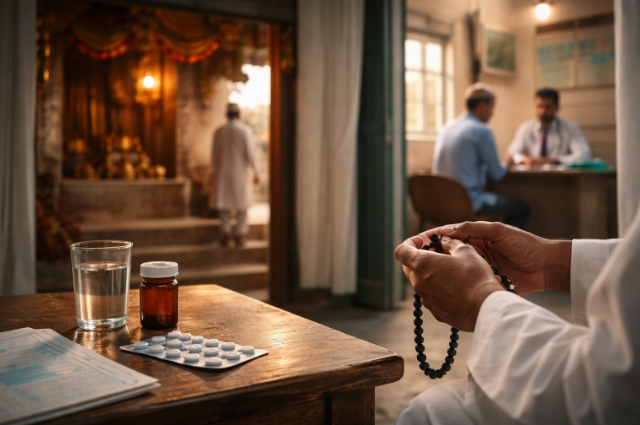
In rural India, mental illness will hardly visit a psychiatric hospital voluntarily. It is transported rather to shrines, temples, and dargahs, wrapped in fear, stigma, and supernatural faith. The existing disconnect between faith and medicine has, over decades, resulted in thousands of people with severe mental disorders not getting clinical treatment. The divide has, however, been addressed silently in the small town of Unava in the Mehsana district of Gujarat. At the Mira Datar Dargah, which is often referred to as the Supreme Court of spirit possession, faith never had to cede to science. Rather, it made it its strongest ally.
The Mira Datar Dargah is committed to Hazrat Saiyed Ali Mira Datar, a holy martyr who was believed to have divine powers of healing those who were attacked by Jinns and spirits. Thousands of families come every year, bringing relatives with hallucinations, paranoia, violent outbursts, dissociation, or extreme mood swings. Clinically, most of these patients would be treated as paranoid schizophrenic, bipolar, or brucehalinger. Such labels have little worth in societies where mental illness is seen as a spiritual intrusion but not a neurological malfunction.
The mental health practices that have been practiced in these settings have failed mostly because the mental health interventions are trying to substitute faith with medical rationality. Neurotransmitters are explained in posters. Physicians are opposed to possession. NGOs preach “awareness.” The outcome is resistance, mistrust, and empty clinics. This confrontational approach was rejected at Unava altogether, and this is what made the difference.
The psychiatrist who designed this intervention is not a psychiatrist, but a social worker: Milesh Hamlai, the leader of the NGO Altruist in Ahmedabad. The incentive of Hamlai was very personal. His brother was a schizophrenic, and Hamlai has personally experienced the torture that families go through when they are torn between doctors and social hatred. Another grave contradiction he observed was that the psychiatrists were just sitting around in their clinics, whereas the Dargah was full of lunatics who would never volunteer to get psychiatric assistance.
It was a radical simplicity of Hamlai. Rather than attempting to educate or convert the patients, he attempted to educate the faith healers. It was not the Mujavirs--custodians and ritual healers at the Dargah--that were a barrier, he saw; it was they who were gatekeepers. Trust, in the context of social psychology, is passed through the authority figures within a system of belief. Whoever possesses that gate possesses access to behavior change.
This gave rise to what is today called the main innovation of the project, the Divine Referral.
The process starts traditionally. A patient is taken to a family in the Dargah to get exorcised. The Mujavir does the prayers and spiritual intervention ritual that will be required. However, the healer does not send the family away or order them to take endless rituals, but gives them a straightforward referral slip. The teaching is accurate and striking: to make the Dua quicker, you need this Dava in the clinic that is beside yours.
The clinic is a government-subsidized mental health center based in Dargah compound and operated by psychiatrists. The Dava is a generic antipsychotic drug. Importantly, the patient will not view it as a form of psychiatric treatment. It is re-packaged as a weakening-of-the-spirit pill - medicine shots so that the prayer can be effective.
It is the reconsideration of the psychological masterstroke. The Cognitive Dissonance Theory posits that individuals are opposed to information that directly opposes their belief systems. Altruists evaded this by incorporating medicine in the belief system and not opposing it. Equally, the success can be explained by the Change Management Model by Lewin: there was no unfreezing imposed. Rather, change happened through the redefinition of meaning in a rather subtle manner without the cultural structure being changed.
The plan also solved two big crises that tend to disrupt partnerships between faith healers and doctors. The first was economic. Mujavirs also had the initial fears that the doctors would steal their customers. Hamlai responded to this by demonstrating that the clinic would take in the cases of violence or other severe cases that the healers had difficulties dealing with, hence their efforts were not duplicated. The second conflict was the ego, which takes credit for the cure. The doctors consented to withdraw. Improved patients took the initiative of crediting their recovery to the blessing of the Dargah. Such purposeful abandonment of credit turned out to be a general principle in the field of community psychology: the effect outweighs honor.
Since the program was launched in 2008, more than 38,000 patients have been treated in the program. It has been so successful that it has been used as a model mental health intervention to be emulated in other states by the Supreme Court of India. In addition to the improvement in clinical results, the project has generated some tangible economic gains. Families are no longer confined to Unava months on end, using money on repetitive rituals and accommodation. Quick recovery prevents debts, sustains lives, and reinstates dignity.
Mira Datar's model makes one reconsider the orthodoxy of public health. It shows that belief systems do not act as obstacles to treatment, but they can be delivery mechanisms. When understood as we should respect faith instead of disregarding it, it can serve as a back door to evidence-based care.
Unava represents a third way between cold clinical detachment and spiritual denial that is the linguistic mode of mental health discourse nowadays: it is the way of humility, cultural intelligence, and strategic empathy. It reminds us that there are moments when we need to walk through our minds and not argue with the belief because this is the best way to heal the mind.
. . .
References:
- Jain, S., Jadhav, S., & Littlewood, R. (2001). Spirit possession and mental health in South Asia: A cultural psychiatry perspective. Social Science & Medicine, 53(12), 1507–1518.
- Government of India. (2014). National Mental Health Programme: Community-based mental health care models in India. Ministry of Health and Family Welfare.
- Supreme Court of India. (2016). Judgment recognizing faith-based referral models in mental health interventions. New Delhi: Supreme Court Records.
- Sarin, A., & Jain, S. (2013). Healing at shrines: Collaboration between faith healers and psychiatrists in India. Indian Journal of Psychiatry, 55(2), 189–194.