
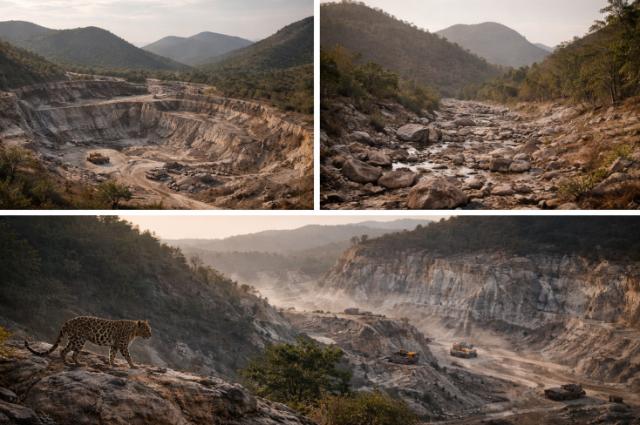
The Aravalli hills — a 2-billion-year-old mountain range stretching from Delhi through Haryana and Rajasthan to Gujarat— are at the heart of one of India’s most acrimonious environmental and economic conflicts in recent memory. Revered for their ecological functions, cultural history, and strategic geological composition, the Aravallis have also become the target of intense mining interest. Between Supreme Court judgments, political battles, and public protests, critics say an impending ₹40,000-crore battle over mineral riches versus land rights threatens not just the hills but its ecological future.
The Stakes: Minerals, Money, and Ecology:
The Aravalli range has a rich mineral profile-marble, quartzite, mica and feldspar are some of the great value deposits that feed India's booming construction and industry. In all, worth tens of thousands of crores, the resources keep the local economies whirring, while attracting heavy commercial interests. Government assessments and industry estimates suggest that demand for these minerals — particularly around fast-growing urban corridors like Gurugram and Jaipur — has transformed the hills into a high-value resource front, with local mining leases alone representing huge financial stakes.
However, estimating the exact value of minerals at stake — often quoted in media and political rhetoric as upwards of ₹40,000 crore — reflects not just current extraction but future economic potential and unregulated underground networks that have thrived for years. According to environmentalists, the money being raised from this project will have an extremely negative impact on biodiversity, groundwater recharge and climate stability.
Supreme Court Ruling: Redefinition Sparks Firestorm
In November 2025, the Indian Supreme Court adopted a new standard definition for identifying the Aravalli Hills for regulatory purposes. This definition may seem like a minor technical change, but it has had a massive impact on how these hills are regulated. Under this definition, only those landforms that are at least 100 meters in height (above the surrounding ground level) are included within the legal definition of the Aravalli Hills. Hilltops, knolls, and small rocky outcroppings — which ecologists say perform essential ecological functions — that are lower than this height are no longer included within the legal definition of the Aravalli Hills and, therefore, do not receive any legal protection.
According to government officials, by establishing this new definition, they will be able to effectively regulate illegal mining and better protect the Aravalli Hills. They also claim that more than 90% of the Aravalli Hills will continue to be protected from mining and that no new mining leases will be approved until the completion of a sustainable management plan.
However, critics of this decision have pointed out that it has actually opened the door to increased mining activity in the Aravalli Hills by lifting all of the legal protections for many of the land areas below this 100-meter threshold. Independent analyses have concluded that approximately one-half of the entire Aravalli Hills region may be potentially opened to mining under this definition, which is far more than what the government estimates.
Environmental and Social Fallout:
Water and Climate:
The Aravallis are not just a scenic backdrop — they are crucial groundwater recharge zones, helping sustain aquifers that supply drinking water for millions across North India. The hills also act as natural barriers against the Thar Desert’s encroachment and help regulate local climate patterns. Mining scars disrupt these functions, leading to: Falling groundwater levels, increased desertification, altered local rainfall patterns and escalating air pollution and dust storms. It impacts scientists have documented for years.
Biodiversity Loss:
The region harbors rich biodiversity including leopards, hyenas, deer, and numerous plant species. Quarrying and habitat destruction fragment ecosystems, pushing wildlife into conflict corridors with human populations and reducing genetic diversity.
Community Discontent:
Local communities — farmers, villagers, and environmental activists — have repeatedly protested against both illegal mining and what they see as policy loopholes that favor resource extraction over conservation. Silent protests, public awareness campaigns, and mounting criticism from political opposition signal a broadening social movement to “Save the Aravallis.”
Political Crossfire:
The dispute over the Aravallis has rapidly become political:
State versus Centre: Rajasthan leaders have accused the central government of misrepresenting protection status and diluting ecological safeguards.
Public mistrust: Rumors and misunderstandings about the Supreme Court ruling have spread widely, fueling protests and social media debates.
Environmental versus economic priorities: Pro-development voices argue mining unlocks jobs and regional growth, while conservationists warn such gains are transient compared to permanent ecological loss.
Just before dawn, the villagers of Bardod village in Rajasthan’s Alwar district heard the familiar sound—low, heavy, and out of place in the silence of the hills. By the time the sun rose, eight dump trucks were already moving out through a dry riverbed that once carried monsoon water down from the Aravallis.
The trucks were loaded with quartzite, freshly blasted overnight. Officially, mining in this stretch of the Aravalli range had been banned by the Supreme Court years ago. On paper, the hills were protected. On the ground, the hills were being carved out piece by piece.
When a local schoolteacher, Meera Singh, tried to photograph the operation on her phone, two men on motorcycles blocked her path. They didn’t threaten her directly—just smiled and said, “Madam, this is government work. You shouldn’t get involved.” She later learned the men weren’t government employees at all, but workers hired by a contractor linked to a large construction supply company in NCR.
By noon, forest officials arrived after villagers filed complaints. What they found was predictable: No machinery, no workers, no trucks. Just fresh scars on the hillside, broken rocks, and diesel smell in the air.
The mining contractor had already received a tip-off. That evening, the sarpanch quietly admitted the truth: the village received monthly “development funds”—cash payments that paid for road repairs, temple renovations, and sometimes medical emergencies. Refusing meant losing both money and peace. A nearby village that protested last year saw its water pipeline mysteriously damaged twice.
The cost wasn’t abstract. Within five years: Groundwater levels dropped by over 30 feet. Seasonal streams disappeared. Dust from blasting damaged crops. Leopards and hyenas stopped appearing in the area Yet the mining continued, driven by an invisible supply chain feeding Delhi–NCR’s construction boom—luxury apartments, highways, and commercial towers.
Everyone knew the estimate whispered among officials and activists alike:
illegal and semi-legal mining in the Aravallis was worth tens of thousands of crores, protected by political influence, forged permits, and deliberate enforcement gaps.
The hills weren’t collapsing all at once. They were being sold truckload by truckload.
What Happens Next?
The Aravalli conflict does not have simple answers. While clarifying a definition of "Aravalli," the Supreme Court's decision revealed serious conflicts between economic expectations and environmental demands, as well as the need for balance. In combination with the freeze on mining leases and the requirement that a Management Plan for Sustainable Mining be completed before continuing mining activities, the challenge of achieving balance between these two priorities falls squarely on the shoulders of policy makers, who must rely heavily on science and scientists, but who also must be transparent about how decisions are made, and allow for public input and participation.
Environmentalists and ecologists are adamant that the struggle is far from over; preserving the fragile hill and mountain ecosystem, including areas of less than 100 metres, is critical to the overall protection of water, climate, and ecological stability in Aravalli, and subsequently to the protection of future generations.
References:
- https://thelogicalindian.com
- https://timesofindia.indiatimes.com
- https://www.downtoearth.org.in
- https://www.business-standard.com