
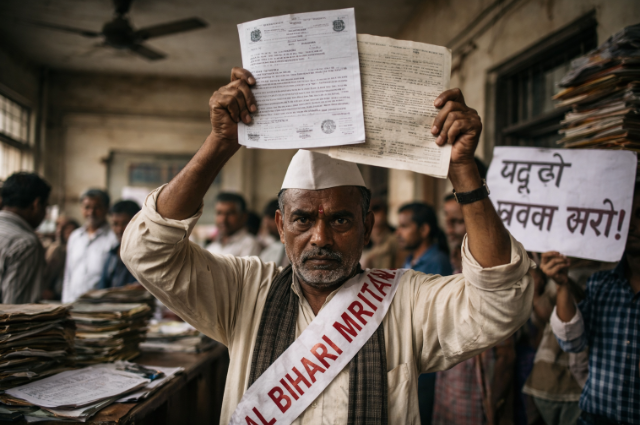
Imagine waking up one day to discover that, according to the government, you are officially dead—even though you’re very much alive, breathing, and arguing about it. This isn’t a dark comedy plot. It’s the real-life story of Lal Bihari Mritak, a man from India who spent nearly two decades fighting bureaucracy to prove a single, absurd truth: that he existed.
Declared Dead While Alive:
Lal Bihari was born in Uttar Pradesh, India. In the late 1970s, he discovered that his name had been removed from government records. Why? Because corrupt relatives had bribed officials to declare him legally dead, allowing them to seize his land. This kind of fraud—often called being made a “ghost” on paper—is not entirely unheard of in parts of India, where land disputes, corruption, and slow bureaucracy can create nightmarish legal loopholes. But Lal Bihari’s case would become the most famous example.
Once declared dead, Lal Bihari faced surreal consequences: He could not own property. He could not vote. He could not access government services. In the eyes of the state, he no longer existed Yet there he was, alive and protesting.
Fighting Death with Paperwork:
At first, Lal Bihari tried conventional routes: court petitions, appeals, and pleas to local officials. These efforts went nowhere. The same system that had erased him now refused to acknowledge him. So he changed tactics—and did something unforgettable. He added the word “Mritak” to his name. Mritak means “dead” in Hindi.
From that point on, he legally called himself Lal Bihari Mritak—a living man introducing himself as deceased.
Protests from Beyond the Grave:
Lal Bihari became a master of symbolic protest: He applied for a death certificate for himself. He attempted to run for public office as a dead man. He staged sit-ins and demonstrations demanding recognition. He once even tried to marry a widow, arguing that as a dead man, he qualified. His logic was razor-sharp: If the government insists I’m dead, then treat me as such. The absurdity attracted media attention, which became his strongest weapon.
The Association of the Living Dead:
Lal Bihari found that he was not the only one to be declared dead to cheat him out of his land. Thousands of other people had also been listed as deceased because of corruption and land disputes. To fight back against being listed as dead, Lal Bihari created a group called "The Association of Dead People" (Mritak Sangh).
This organisation fights for people who are alive but have had their legal status erased and uses humour, demonstrations, and persistence to pressure the government into giving people their legal rights back.
Resurrection at Last:
After 18 years of struggling in court, Lal Bihari won his battle in 1994, and the court gave him back his legal status. This not only gave Lal Bihari his legal identity but also exposed how many other people were in the same situation as he was and showed how bad the system was that allowed so many people to become deceased on paper only.
Why His Story Still Matters:
Lal Bihari’s story is a strange mix of humour, tragedy, and absurdity, but it also provides some important lessons. You are powerless if you don’t have a legal identity: Without a legal identity, you will not have a legal identity, and thus will not have access to your basic human rights. Bureaucracy can erase lives just as easily as it records them. Persistence matters: Lal Bihari used wit, protest, and patience to fight an inhuman system.
Most importantly, his story shows how ordinary people sometimes need extraordinary creativity just to be seen.
In 1975, Lal Bihari, a small-time farmer from Azamgarh district in Uttar Pradesh, went to the local tehsil office to apply for a bank loan using his ancestral land as collateral. The clerk checked the land records, paused, and looked up at him in confusion.
“You can’t apply,” the clerk said flatly. “Why?” Lal Bihari asked. “Because you are dead.”
According to official land records, Lal Bihari had died several years earlier. His distant relatives—seeking to seize his property—had bribed local officials to register his death and transfer ownership of the land to their names. On paper, the fraud was complete. In reality, Lal Bihari was standing right there, alive, arguing for his own existence.
What followed was not a single court case, but a 19-year bureaucratic nightmare. When Lal Bihari went to the police, they refused to file a report, citing government records that listed him as deceased. When he approached the courts, hearings were postponed endlessly, and officials demanded proof that he was alive—something the system had no clear mechanism to accept.
His wife was legally declared a widow and was encouraged to remarry. He lost access to voting rights, ration cards, bank services, and welfare schemes.
In desperation, Lal Bihari adopted extreme methods to force the state to acknowledge him. He began signing his name as “Lal Bihari Mritak” (“Lal Bihari, the Dead”). He staged protests, applied for a widow’s pension for his living wife, and once even attempted to contest elections against powerful politicians purely to draw attention to his case.
At one point, he reportedly tried to kidnap a judge’s child—not to harm them, but to compel the legal system to finally listen. The attempt failed, but it succeeded in attracting national media coverage. Finally, in 1994, after nearly two decades of legal battles, court appearances, and public protests, the Indian government officially declared Lal Bihari alive again. His land was restored, and his legal identity reinstated.
Ironically, by the time the state recognised him as living, Lal Bihari had already become famous as India’s most well-known “dead man”—a symbol of how bureaucratic corruption and inertia can erase a person’s existence without ever touching their body.
A Living Legend:
Now, Lal Bihari Mritak has become not just an example of identity fraud but also represents how one can stand up to absurdities in the government by using wit to beat and outsmart them. Few people can say they've lived again after passing away, but he did, using his determination and a paper chase to create a new identity and stubborn hope.
References: